Laboratoire de Neurosciences Cognitives et Computationnelles, Ecole Normale Supérieure, Inserm u960, PSL University, 24 rue Lhomond, Paris 75005, France.
Laboratoire de Neurosciences Cognitives et Computationnelles, Ecole Normale Supérieure, Inserm u960, PSL University, 24 rue Lhomond, Paris 75005, France.
Neuroimage. 2021 Aug 1;236:118050. doi: 10.1016/j.neuroimage.2021.118050. Epub 2021 Apr 19.
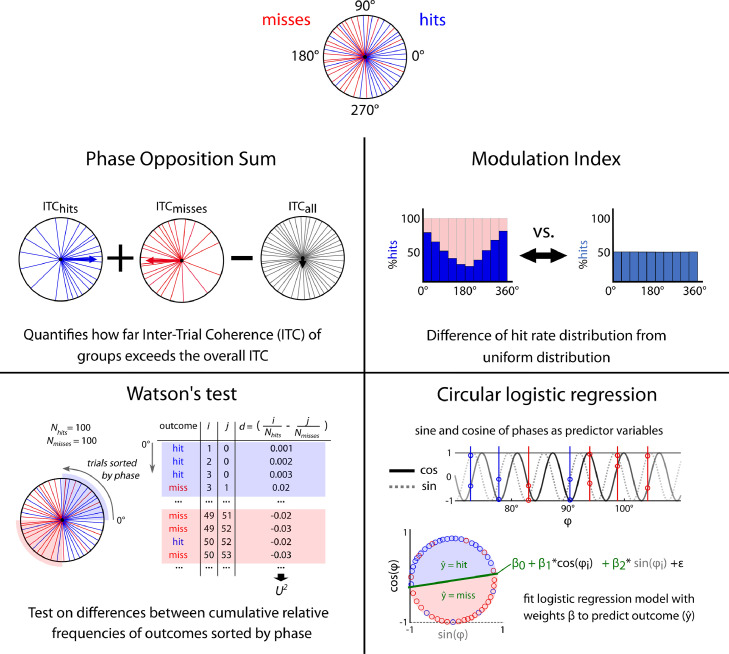
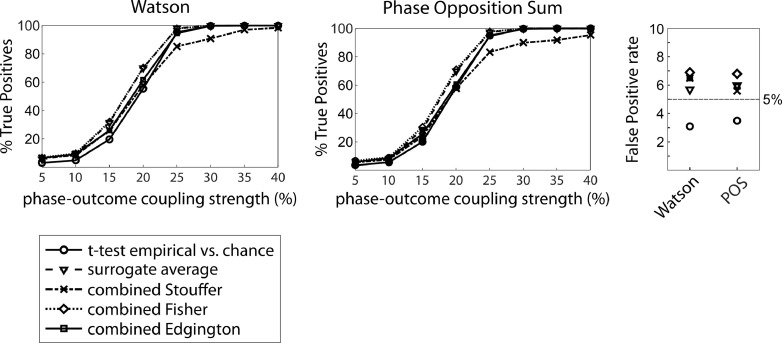
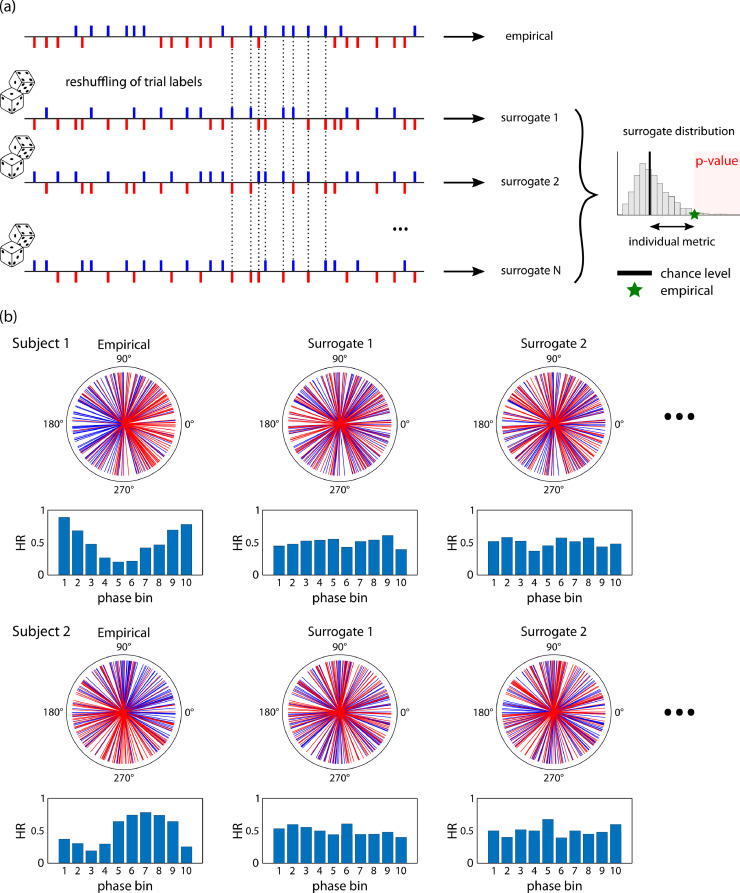
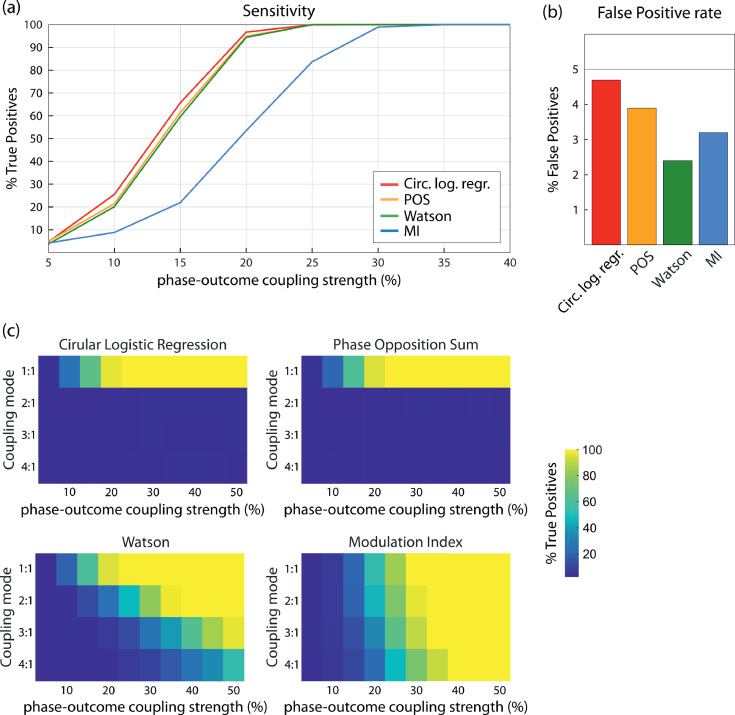
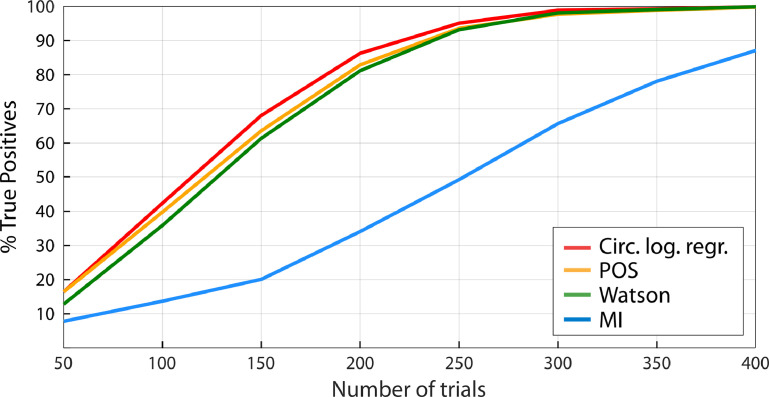
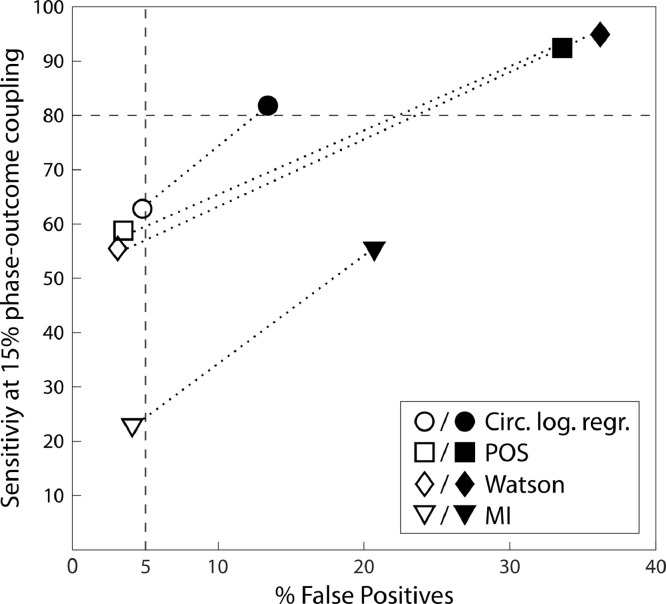
Growing experimental evidence points at relationships between the phase of a cortical or bodily oscillation and behavior, using various circular statistical tests. Here, we systematically compare the performance (sensitivity, False Positive rate) of four circular statistical tests (some commonly used, i.e. Phase Opposition Sum, Circular Logistic Regression, others less common, i.e., Watson test, Modulation Index). We created semi-artificial datasets mimicking real two-alternative forced choice experiments with 30 participants, where we imposed a link between a simulated binary behavioral outcome with the phase of a physiological oscillation. We systematically varied the strength of phase-outcome coupling, the coupling mode (1:1 to 4:1), the overall number of trials and the relative number of trials in the two outcome conditions. We evaluated different strategies to estimate phase-outcome coupling chance level, as well as significance at the individual or group level. The results show that the Watson test, although seldom used in the experimental literature, is an excellent first intention test, with a good sensitivity and low False Positive rate, some sensitivity to 2:1 coupling mode and low computational load. Modulation Index, initially designed for continuous variables but that we find useful to estimate coupling between phase and a binary outcome, should be preferred if coupling mode is higher than 2:1. Phase Opposition Sum, coupled with a resampling procedure, is the only test retaining a good sensitivity in the case of a large unbalance in the number of occurrences of the two behavioral outcomes.
越来越多的实验证据表明,使用各种循环统计检验,皮质或身体振荡的相位与行为之间存在关系。在这里,我们系统地比较了四种循环统计检验(一些常用的,如相位反对和总和、循环逻辑回归,其他不常用的,如 Watson 检验、调制指数)的性能(灵敏度、假阳性率)。我们创建了半人工数据集,模拟了具有 30 名参与者的真实二选一强制选择实验,在这些实验中,我们将模拟的二进制行为结果与生理振荡的相位联系起来。我们系统地改变了相位-结果耦合的强度、耦合模式(1:1 到 4:1)、总试验次数和两种结果条件下的相对试验次数。我们评估了不同的策略来估计相位-结果耦合的机会水平,以及个体或群体水平的显著性。结果表明,Watson 检验虽然在实验文献中很少使用,但却是一种出色的初始测试方法,具有良好的灵敏度和低假阳性率,对 2:1 耦合模式具有一定的敏感性,计算负荷低。调制指数最初是为连续变量设计的,但我们发现它在估计相位与二进制结果之间的耦合时非常有用,如果耦合模式高于 2:1,则应优先使用。相位反对和总和,结合重采样过程,是唯一一种在两种行为结果出现次数不平衡较大的情况下保持良好灵敏度的检验方法。