Li Yang, Lu Su, Zhang Yuhan, Wang Shuaibing, Liu Hong
The Second Surgical Department of Breast Cancer, Tianjin Medical University Cancer Institute and Hospital, National Clinical Research Center for Cancer & Key Laboratory of Cancer Prevention and Therapy, Tianjin's Clinical Research Center for Cancer, Tianjin, 300060, China.
Oncology Department, Taikang Xianlin Drum Tower Hospital, School of Medicine, Nanjing University, Nanjing, 210046, Jiangsu Province, China.
World J Surg Oncol. 2021 Apr 13;19(1):113. doi: 10.1186/s12957-021-02214-5.
The number of young patients diagnosed with breast cancer is on the rise. We studied the rate trend of local recurrence (LR) and regional recurrence (RR) in young breast cancer (YBC) patients and outcomes among these patients based on molecular subtypes.
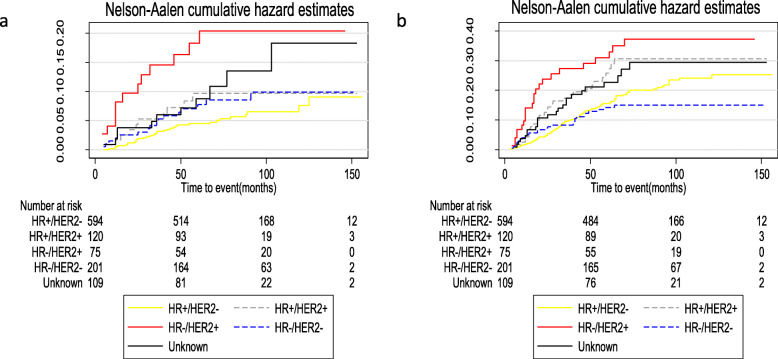
A retrospective cohort study was conducted based on data from Tianjin Medical University Cancer Institute and Hospital for patients ≤ 35 years of age with pathologically confirmed primary invasive breast cancer surgically treated between 2006 and 2014. Patients were categorized according to molecular subtypes on the basis of hormone receptor (HR) and human epidermal growth factor receptor 2 (HER2) status. The 5-year rates for LR, RR, and distant metastases (DM) were estimated by Kaplan-Meir statistics. Nelson-Aalen cumulative-hazard plots were used to describe local recurrence- and distant metastasis-free intervals.
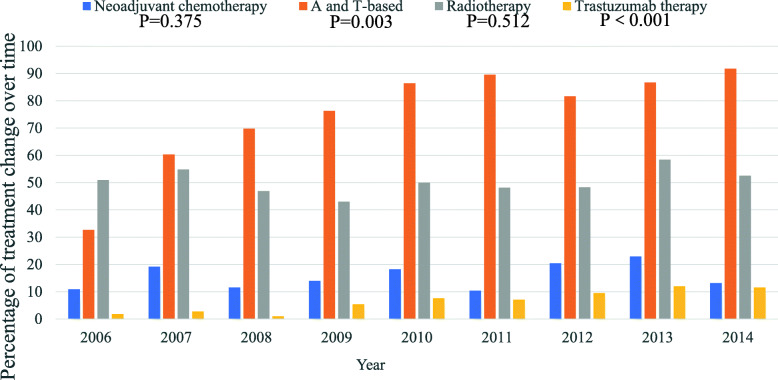
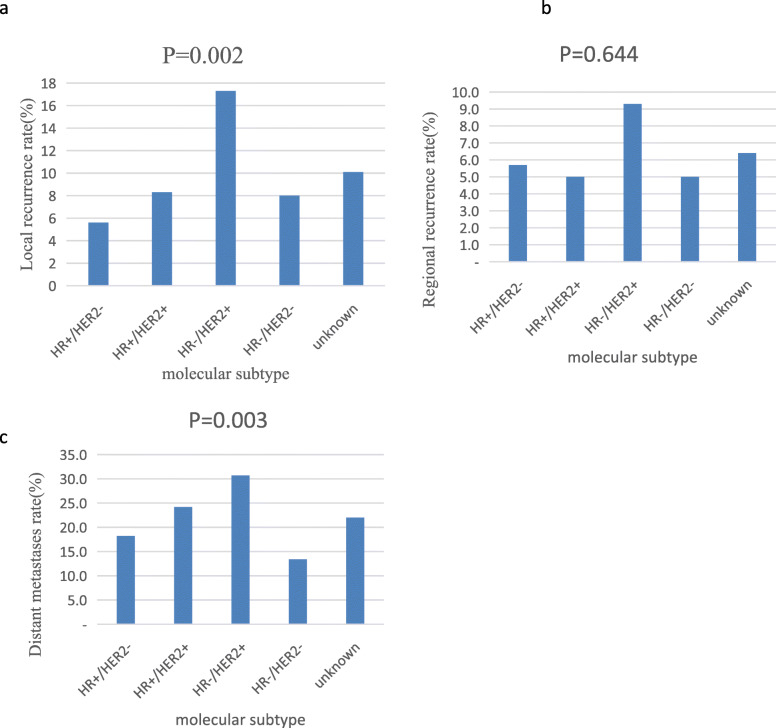
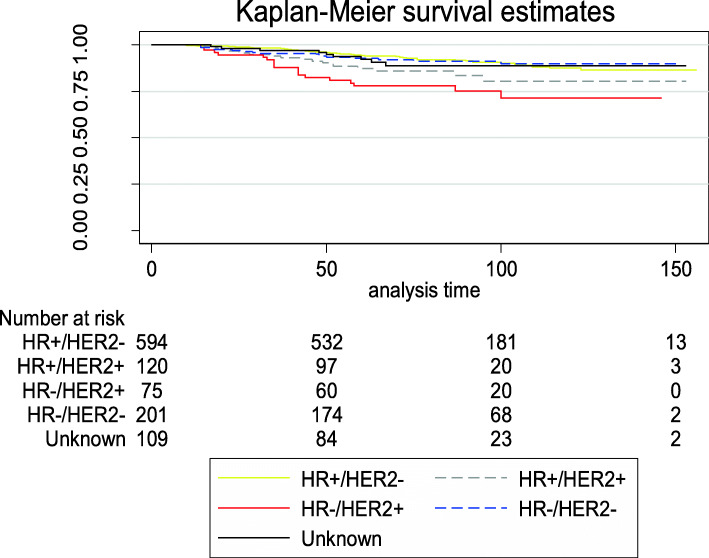
We identified 25,284 patients with a median follow-up of 82 months, of whom 1099 (4.3%) were YBC patients ≤ 35 years of age. The overall 5-year LR, RR, and DM rates in YBC patients were 6.7%, 5.1%, and 16.6%, respectively. The LR and RR rates demonstrated a decreasing trend over time (P = 0.028 and P = 0.015, respectively). We found that early-stage breast cancer and less lymph node metastases increased over time (P = 0.004 and P = 0.007, respectively). Patients with HR-/HER2+ status had a significantly higher LR (HR 20.4; 95% CI, 11.8-35.4) and DM (HR 37.2; 95% CI, 24.6-56.3) at 10 years. Breast-conserving surgery (BCS) or mastectomy did not influence rates of LR and RR. In the overall population, the 5-year survival of YBC patients exceeded 90%.
The rates of LR and RR with YBC patients demonstrated a downward trend and the proportion of early-stage breast cancer increased between 2006 and 2014. We report the highest LR rates in this young population were associated with HR-/HER2+ tumors.
被诊断为乳腺癌的年轻患者数量正在上升。我们研究了年轻乳腺癌(YBC)患者局部复发(LR)和区域复发(RR)的发生率趋势以及基于分子亚型的这些患者的预后情况。
基于天津医科大学肿瘤研究所和医院2006年至2014年期间接受手术治疗的年龄≤35岁、病理确诊为原发性浸润性乳腺癌患者的数据进行回顾性队列研究。根据激素受体(HR)和人表皮生长因子受体2(HER2)状态将患者按分子亚型分类。通过Kaplan-Meir统计方法估计LR、RR和远处转移(DM)的5年发生率。使用Nelson-Aalen累积风险图描述局部复发和无远处转移间隔。
我们确定了25284例患者,中位随访时间为82个月,其中1099例(4.3%)为年龄≤35岁的YBC患者。YBC患者的总体5年LR、RR和DM发生率分别为6.7%、5.1%和16.6%。LR和RR发生率随时间呈下降趋势(分别为P = 0.028和P = 0.015)。我们发现早期乳腺癌和较少的淋巴结转移随时间增加(分别为P = 0.004和P = 0.007)。HR-/HER2+状态的患者在10年时LR(HR 20.4;95% CI,11.8 - 35.4)和DM(HR 37.2;95% CI,24.6 - 56.3)显著更高。保乳手术(BCS)或乳房切除术不影响LR和RR发生率。在总体人群中,YBC患者的5年生存率超过90%。
2006年至2014年期间,YBC患者的LR和RR发生率呈下降趋势,早期乳腺癌的比例增加。我们报告在这个年轻人群中,最高的LR发生率与HR-/HER2+肿瘤相关。