Department of Geology and Geophysics, University of Utah, Salt Lake City, UT, 84112, USA.
Department of Science, Mathematics, and Engineering, Wright State University (Lake Campus), Celina, OH, 45822, USA.
Sci Rep. 2021 Apr 13;11(1):8055. doi: 10.1038/s41598-021-87379-5.
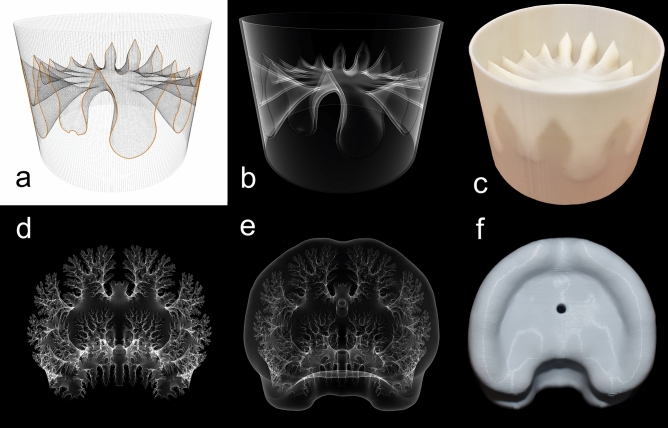
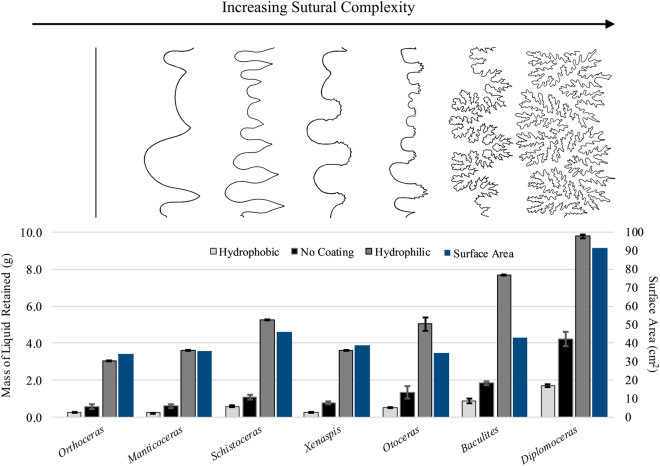
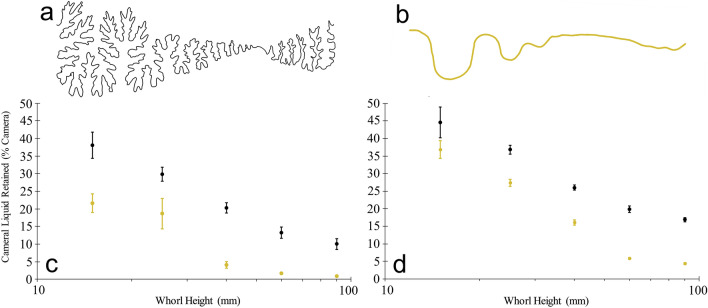
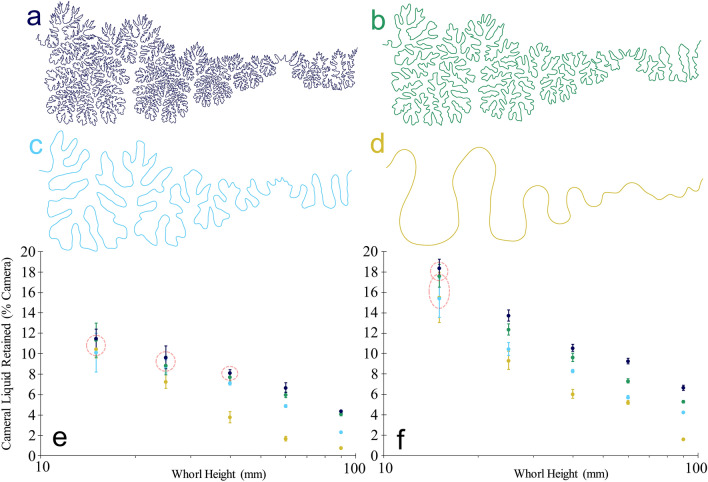
The internal architecture of chambered ammonoid conchs profoundly increased in complexity through geologic time, but the adaptive value of these structures is disputed. Specifically, these cephalopods developed fractal-like folds along the edges of their internal divider walls (septa). Traditionally, functional explanations for septal complexity have largely focused on biomechanical stress resistance. However, the impact of these structures on buoyancy manipulation deserves fresh scrutiny. We propose increased septal complexity conveyed comparable shifts in fluid retention capacity within each chamber. We test this interpretation by measuring the liquid retained by septa, and within entire chambers, in several 3D-printed cephalopod shell archetypes, treated with (and without) biomimetic hydrophilic coatings. Results show that surface tension regulates water retention capacity in the chambers, which positively scales with septal complexity and membrane capillarity, and negatively scales with size. A greater capacity for liquid retention in ammonoids may have improved buoyancy regulation, or compensated for mass changes during life. Increased liquid retention in our experiments demonstrate an increase in areas of greater surface tension potential, supporting improved chamber refilling. These findings support interpretations that ammonoids with complex sutures may have had more active buoyancy regulation compared to other groups of ectocochleate cephalopods. Overall, the relationship between septal complexity and liquid retention capacity through surface tension presents a robust yet simple functional explanation for the mechanisms driving this global biotic pattern.
通过地质时间,有壳鹦鹉螺内部结构的复杂性大大增加,但这些结构的适应价值存在争议。具体来说,这些头足类动物在内部隔板(隔板)边缘发展出分形样褶皱。传统上,对隔板复杂性的功能解释主要集中在生物力学抗应力上。然而,这些结构对浮力操纵的影响值得重新审视。我们提出,隔板复杂性的增加带来了每个腔室内流体保留能力的相应变化。我们通过测量几个 3D 打印头足类贝壳原型中隔板和整个腔室内保留的液体来检验这一解释,这些原型经过(和未经)仿生亲水性涂层处理。结果表明,表面张力调节腔室内的水保留能力,这与隔板复杂性和膜毛细作用呈正相关,与尺寸呈负相关。鹦鹉螺中保留液体的能力增加可能改善了浮力调节,或补偿了生命过程中的质量变化。我们的实验中保留更多液体的能力表明,具有更大表面张力潜力的区域增加,支持腔室的更好填充。这些发现支持了这样的解释,即与其他外鳃头足类动物相比,具有复杂缝合线的鹦鹉螺可能具有更活跃的浮力调节能力。总的来说,隔板复杂性与通过表面张力保留液体能力之间的关系为驱动这种全球生物模式的机制提供了一个稳健而简单的功能解释。