Kiss Andreea, Ryan Paul MacDaragh, Mondal Tapas
Faculty of Medicine, University of Ottawa, Ottawa, ON, Canada.
Brookfield School of Medicine and Health Sciences, University College Cork, Cork, Ireland.
Prog Pediatr Cardiol. 2021 Dec;63:101381. doi: 10.1016/j.ppedcard.2021.101381. Epub 2021 Apr 9.
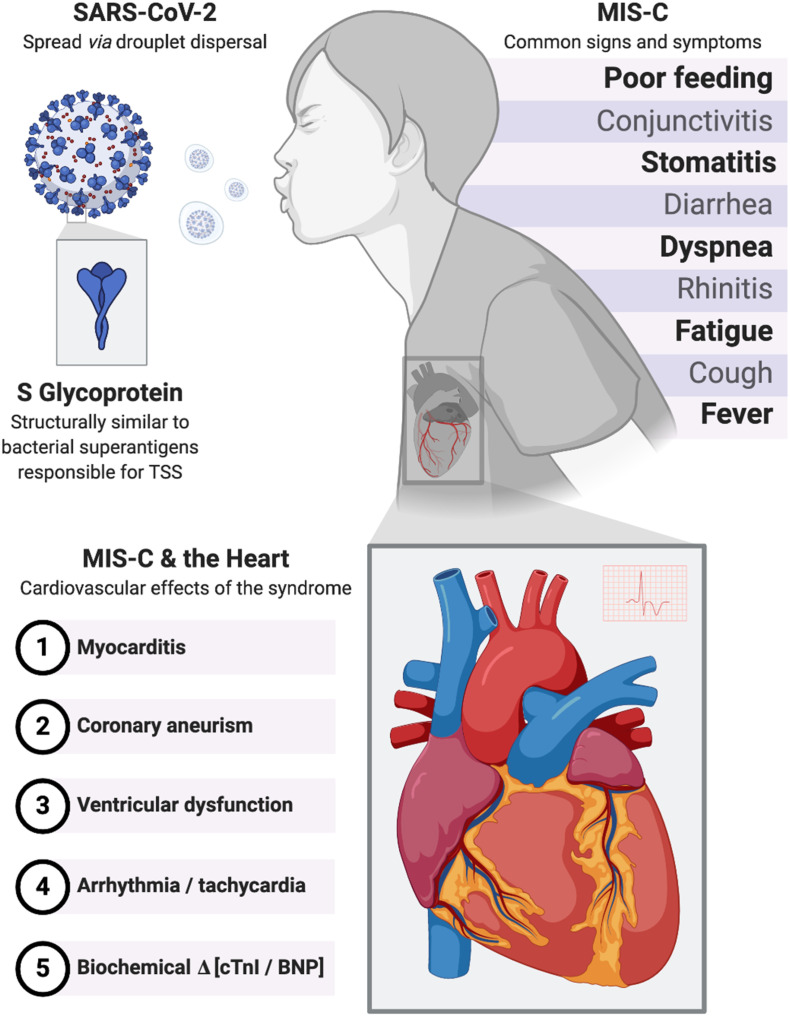
The prevalence and severity of COVID-19 are greatly reduced in children, yet some pediatric patients develop a syndrome resembling Kawasaki Disease (KD), termed Multisystem Inflammatory Syndrome in Children (MIS-C). With an estimated incidence of 2/100,000 children, MIS-C is relatively rare but can be fatal. Clinical features can include fever, hyperinflammatory state, gastrointestinal symptoms, myocardial dysfunction, and shock. The pathogenesis of MIS-C, although yet to be completely elucidated, appears to be distinct from KD in terms of epidemiology, severity, and biochemical signature.
Although efficacy of treatments for MIS-C have largely not yet been investigated, we aim to conduct a comprehensive literature search of numerous medical databases (AMED, EBM Reviews, Embase, Healthstar, MEDLINE, ERIC, and Cochrane) to highlight treatments used around the world, their rationale, and outcomes to better inform guidelines in the future. Using the findings, an approach to MIS-C management will be outlined.
•MIS-C appears to be a SARS-CoV-2 related post-infection phenomenon that is distinct from Kawasaki disease.•Although outcomes are largely favorable, there is significant variation in MIS-C treatment. Most management regimens reported to date mirror that of KD; however, targeted therapy based on specific MIS-C phenotypes may have the potential to improve outcomes.•We recommend close monitoring by a multidisciplinary team, symptomatic treatment (e.g., intravenous immunoglobulin for KD-like symptoms, steroids/immunotherapy for multisystem inflammation), and long-term follow-up.•Further research is required to evaluate the effectiveness of current MIS-C treatments and to determine more refined therapies.
儿童感染新型冠状病毒肺炎(COVID-19)的患病率和严重程度大幅降低,但部分儿科患者会出现一种类似川崎病(KD)的综合征,称为儿童多系统炎症综合征(MIS-C)。MIS-C的估计发病率为十万分之二,相对罕见,但可能致命。临床特征可包括发热、高炎症状态、胃肠道症状、心肌功能障碍和休克。MIS-C的发病机制虽尚未完全阐明,但在流行病学、严重程度和生化特征方面似乎与KD不同。
尽管尚未对MIS-C的治疗效果进行大量研究,但我们旨在对众多医学数据库(AMED、循证医学综述、Embase、Healthstar、医学索引数据库、教育资源信息中心和Cochrane)进行全面文献检索,以突出世界各地使用的治疗方法、其原理和结果,以便未来更好地为指南提供信息。根据研究结果,将概述MIS-C的管理方法。
•MIS-C似乎是一种与严重急性呼吸综合征冠状病毒2(SARS-CoV-2)相关的感染后现象,与川崎病不同。•尽管结果大多良好,但MIS-C的治疗存在显著差异。迄今为止报道的大多数管理方案与KD相似;然而,基于特定MIS-C表型的靶向治疗可能有改善结果的潜力。•我们建议由多学科团队进行密切监测、对症治疗(例如,针对类似KD症状使用静脉注射免疫球蛋白,针对多系统炎症使用类固醇/免疫疗法)以及长期随访。•需要进一步研究以评估当前MIS-C治疗的有效性并确定更精确的治疗方法。