Section of Endocrine Surgery, Department of General, Visceral and Transplantation Surgery, University Medical Centre Mainz, Johannes Gutenberg University Mainz, Mainz, Germany.
Institute for Medical Biometry, Epidemiology and Informatics, University Medical Centre Mainz, Johannes Gutenberg University Mainz, Mainz, Germany.
BJS Open. 2021 Mar 5;5(2). doi: 10.1093/bjsopen/zraa058.
The impact of intraoperative frozen section (iFS) analysis on the frequency of completion thyroidectomy for the management of thyroid carcinoma is controversial. Although specialized endocrine centres have published their respective results, there are insufficient data from primary and secondary healthcare levels. The aim of this study was to analyse the utility of iFS analysis.
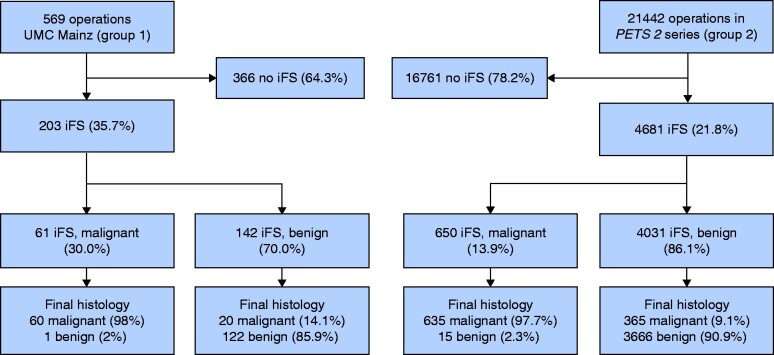
In the Prospective Evaluation Study Thyroid Surgery (PETS) 2 study, 22 011 operations for benign and malignant thyroid disease were registered prospectively in 68 European hospitals from 1 July 2010 to 31 December 2012. Group 1 consisted of 569 patients from University Medical Centre (UMC) Mainz, and group 2 comprised 21 442 patients from other PETS 2 participating hospitals. UMC Mainz exercised targeted but liberal use of iFS analysis for suspected malignant nodules. iFS analysis was compared with standard histological examination regarding the correct distinction between benign and malignant disease. The percentage of completion thyroidectomies was assessed for the participating hospitals.
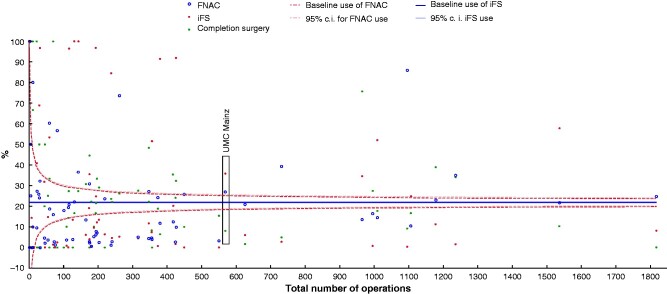
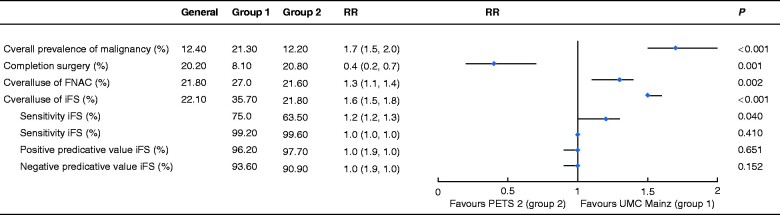
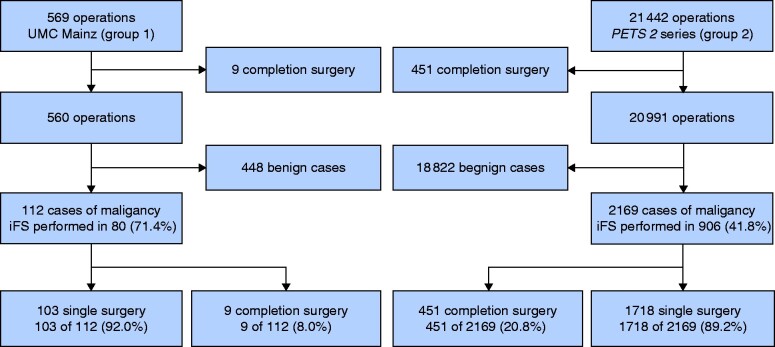
iFS analysis was performed in 35.70 per cent of patients in group 1 versus 21.80 per cent of those in group 2 (risk ratio (RR) 1.6, 95 per cent c.i. 1.5 to 1.8; P < 0.001). Sensitivity of iFS analysis was 75.0 per cent in group 1 versus 63.50 per cent in group 2 (RR 1.2, 1.2 to 1.3; P = 0.040). Completion surgery was necessary in 8.10 per cent of patients in group 1 versus 20.8 per cent of those in group 2 (RR 0.4, 0.2 to 0.7; P = 0.001).
iFS analysis is a useful tool in determining the appropriate surgical management of thyroid disease. Targeted use of iFS was associated with a significantly higher sensitivity for the detection of malignancy, and with a significantly reduced necessity for completion surgery.
术中冰冻切片(iFS)分析对甲状腺癌管理中甲状腺全切术的频率的影响存在争议。尽管专业的内分泌中心已经公布了他们各自的结果,但初级和二级医疗机构的数据还不够充分。本研究旨在分析 iFS 分析的实用性。
在前瞻性甲状腺手术评估研究(PETS)2 中,2010 年 7 月 1 日至 2012 年 12 月 31 日,68 家欧洲医院前瞻性地登记了 22011 例良性和恶性甲状腺疾病的手术。第 1 组包括来自美因茨大学医学中心(UMC)的 569 例患者,第 2 组包括来自其他 PETS 2 参与医院的 21442 例患者。UMC 美因茨针对可疑恶性结节有针对性但宽松地使用 iFS 分析。将 iFS 分析与标准组织学检查进行比较,以正确区分良性和恶性疾病。评估了参与医院的甲状腺全切率。
第 1 组中有 35.70%的患者进行了 iFS 分析,而第 2 组中只有 21.80%的患者进行了 iFS 分析(风险比(RR)为 1.6,95%置信区间为 1.5 至 1.8;P<0.001)。第 1 组的 iFS 分析敏感性为 75.0%,第 2 组为 63.50%(RR 1.2,1.2 至 1.3;P=0.040)。第 1 组中有 8.10%的患者需要进行完成手术,而第 2 组中有 20.8%的患者需要进行完成手术(RR 0.4,0.2 至 0.7;P=0.001)。
iFS 分析是确定甲状腺疾病适当手术治疗的有用工具。有针对性地使用 iFS 分析显著提高了恶性肿瘤的检测敏感性,并显著降低了完成手术的必要性。