Postgraduate Program in Medicine and Health, Federal University of Bahia, Salvador, Brazil.
Faculty of Medicine and Health Sciences, Military University Nueva Granada, Bogotá, Colombia.
PLoS One. 2021 Apr 14;16(4):e0249565. doi: 10.1371/journal.pone.0249565. eCollection 2021.
Multidrug- and rifampicin (RMP)-resistant tuberculosis (MDR/RR-TB) requires prolonged and expensive treatment, which is difficult to sustain in the Colombian health system. This requires the joint action of different providers to provide timely health services to people with TB. Identifying factors associated with unfavorable treatment outcomes in patients with MDR/RR-TB who received drug therapy between 2013 and 2015 in Colombia can help guide the strengthening of the national TB control program.
A retrospective cohort study was conducted with all patients who received treatment for MDR/RR-TB between January 2013 and December 2015 in Colombia who were registered and followed up by the national TB control program. A multivariate logistic regression model was used to estimate the associations between the exposure variables with the response variable (treatment outcome).
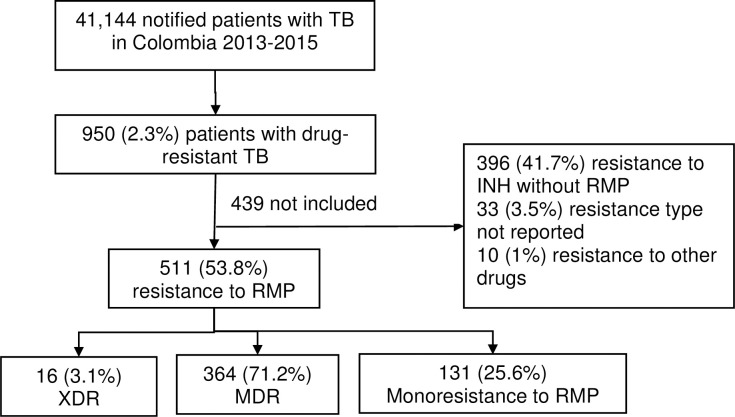
A total of 511 patients with MDR/RR-TB were registered and followed up by the national TB control program in Colombia, of whom 16 (3.1%) had extensive drug resistance, 364 (71.2%) had multidrug resistance, and 131 (25.6%) had RMP monoresistance. The mean age was 39.9 years (95% confidence interval (CI): 38.5-41.3), most patients were male 285 (64.6%), and 299 (67.8%) were eligible for subsidized health services. The rate of unfavorable treatment outcomes in the RR-TB cohort was 50.1%, with rates of 85.7% for patients with extensive drug resistance, 47.6% for patients with multidrug resistance, and 52.6% for patients with RMP monoresistance. The 511 MDR/RR-TB patients were included in bivariate and multivariate analyses, patients age ≥ 60 years (crude odds ratio (ORc) = 2.4, 95% CI 1.1-5.8; adjusted odds ratio (ORa) = 2.7, 95% CI 1.1-6.8) and subsidized health regime affiliation (ORc = 3.6, 95% CI 2.3-5.6; ORa = 3.4, 95% CI 2.0-6.0) were associated with unfavorable treatment outcomes.
More than 50% of the patients with MDR/RR-TB in Colombia experienced unfavorable treatment outcomes. The patients who were eligible for subsidized care were more likely to experience unfavorable treatment outcomes. Those who were older than 60 years were also more likely to experience unfavorable treatment outcomes.
耐多药和利福平(RMP)耐药结核病(MDR/RR-TB)需要长期和昂贵的治疗,这在哥伦比亚的卫生系统中很难维持。这需要不同提供者的共同行动,以便为结核病患者及时提供卫生服务。确定 2013 年至 2015 年间在哥伦比亚接受药物治疗的 MDR/RR-TB 患者治疗结果不良的相关因素,有助于指导加强国家结核病控制规划。
对 2013 年 1 月至 2015 年 12 月期间在哥伦比亚接受 MDR/RR-TB 治疗并由国家结核病控制规划登记和随访的所有患者进行了回顾性队列研究。使用多变量逻辑回归模型来估计暴露变量与因变量(治疗结果)之间的关联。
哥伦比亚国家结核病控制规划共登记和随访了 511 例 MDR/RR-TB 患者,其中 16 例(3.1%)有广泛耐药,364 例(71.2%)有多药耐药,131 例(25.6%)有 RMP 单耐药。平均年龄为 39.9 岁(95%置信区间[CI]:38.5-41.3),大多数患者为男性 285 例(64.6%),299 例(67.8%)有资格获得补贴的医疗服务。RR-TB 队列的治疗结果不良率为 50.1%,广泛耐药患者的治疗结果不良率为 85.7%,多药耐药患者的治疗结果不良率为 47.6%,RMP 单耐药患者的治疗结果不良率为 52.6%。511 例 MDR/RR-TB 患者纳入了双变量和多变量分析,年龄≥60 岁的患者(粗比值比[ORc] = 2.4,95%CI 1.1-5.8;调整后的比值比[ORa] = 2.7,95%CI 1.1-6.8)和补贴健康制度的参与(ORc = 3.6,95%CI 2.3-5.6;ORa = 3.4,95%CI 2.0-6.0)与治疗结果不良相关。
哥伦比亚超过 50%的 MDR/RR-TB 患者治疗结果不良。有资格获得补贴的患者更有可能出现不良的治疗结果。年龄大于 60 岁的患者也更有可能出现不良的治疗结果。