Li Wenjie, Luo Yuan, Xu Hongyu, Ma Qianqian, Yao Qi
Department of Geriatrics, Ningbo First Hospital, Ningbo, China.
J Int Med Res. 2021 Apr;49(4):300060521998471. doi: 10.1177/0300060521998471.
Parkinson's disease (PD) is a degenerative disorder characterized by steady motor function loss. PD pathogenesis remains inconclusive, but aberrant immune responses might play important roles. We hypothesized that imbalance between T helper (Th) 1 and regulatory T (Treg) cells was essential in experimental PD.
Th1 and Treg cells from the blood of patients with PD and healthy volunteer blood were measured by flow cytometry. Experimental PD was induced in mice by peritoneal injection of 1-methyl-4-phenyl-1,2,3,6-tetrahydropyridine. Experimental PD severity was measured by open field test behavior assessments (distance moved, rearing, and grooming). Mice were administered neutralizing anti-tumor necrosis factor (TNF) α to inhibit Th1 effects. Treg cells were depleted by anti-CD25 neutralizing antibodies or isolated and transferred to experimental PD mice.
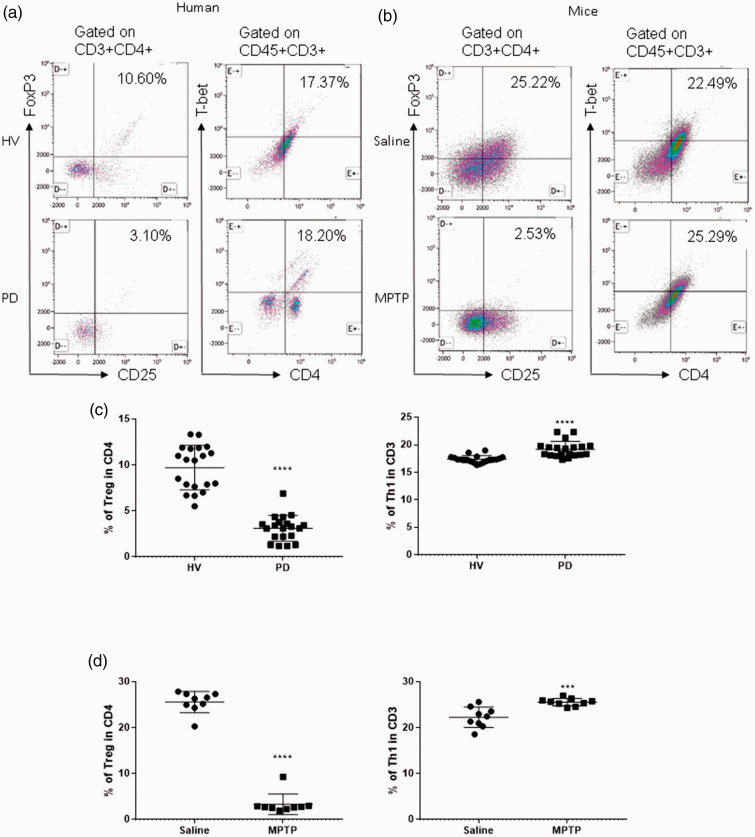
Patients with PD had fewer Treg and more Th1 cells than healthy volunteers. Experimental PD mice exhibited fewer Treg and more Th1 cells. Treg cell depletion exacerbated experimental PD, whereas TNFα neutralization attenuated PD in mice. Treg transfer to experimental PD mice reduced PD severity. Mechanistically, anti-TNFα antibody administration and Treg transfer increased Treg and reduced Th1 cell abundance in the brain.
Th1 and Treg cell imbalance plays an essential role in mouse experimental PD pathogenesis.
帕金森病(PD)是一种以运动功能持续丧失为特征的退行性疾病。PD的发病机制尚无定论,但异常的免疫反应可能起重要作用。我们假设辅助性T(Th)1细胞与调节性T(Treg)细胞之间的失衡在实验性PD中至关重要。
通过流式细胞术检测PD患者血液及健康志愿者血液中的Th1细胞和Treg细胞。通过腹腔注射1-甲基-4-苯基-1,2,3,6-四氢吡啶在小鼠中诱导实验性PD。通过旷场试验行为评估(移动距离、竖毛和梳理行为)来测量实验性PD的严重程度。给小鼠注射中和性抗肿瘤坏死因子(TNF)α以抑制Th1细胞的作用。用抗CD25中和抗体清除Treg细胞,或将其分离并转移至实验性PD小鼠体内。
与健康志愿者相比,PD患者的Treg细胞较少,Th1细胞较多。实验性PD小鼠也表现出Treg细胞较少,Th1细胞较多。清除Treg细胞会加重实验性PD,而中和TNFα则可减轻小鼠的PD症状。将Treg细胞转移至实验性PD小鼠可降低PD的严重程度。从机制上讲,给予抗TNFα抗体和转移Treg细胞可增加大脑中的Treg细胞数量,并减少Th1细胞数量。
Th1细胞与Treg细胞失衡在小鼠实验性PD发病机制中起重要作用。