Abir Mahshid, Taymour Rekar K, Goldstick Jason E, Malsberger Rosalie, Forman Jane, Hammond Stuart, Wahl Kathy
Department of Emergency Medicine, University of Michigan, Ann Arbor, MI, USA.
Acute Care Research Unit, Institute for Healthcare Policy and Innovation, University of Michigan, Ann Arbor, MI, USA.
Int J Emerg Med. 2021 Apr 14;14(1):22. doi: 10.1186/s12245-021-00343-y.
The study was done to evaluate levels of missing and invalid values in the Michigan (MI) National Emergency Medical Services Information System (NEMSIS) (MI-EMSIS) and explore possible causes to inform improvement in data reporting and prehospital care quality.
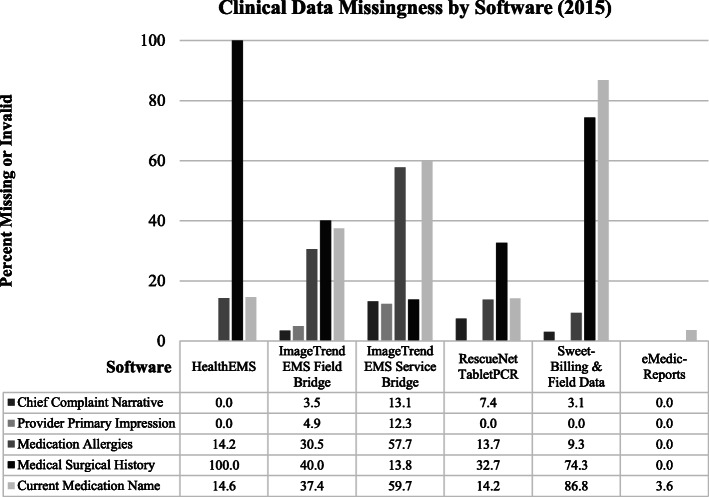
We used a mixed-methods approach to study trends in data reporting. The proportion of missing or invalid values for 18 key reported variables in the MI-EMSIS (2010-2015) dataset was assessed overall, then stratified by EMS agency, software platform, and Medical Control Authorities (MCA)-regional EMS oversight entities in MI. We also conducted 4 focus groups and 10 key-informant interviews with EMS participants to understand the root causes of data missingness in MI-EMSIS.
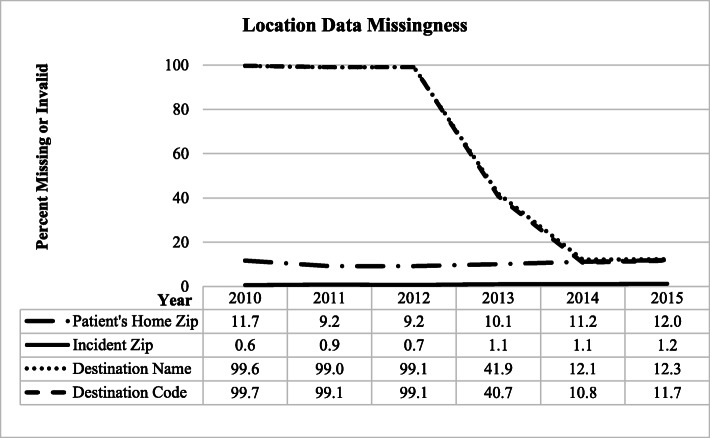
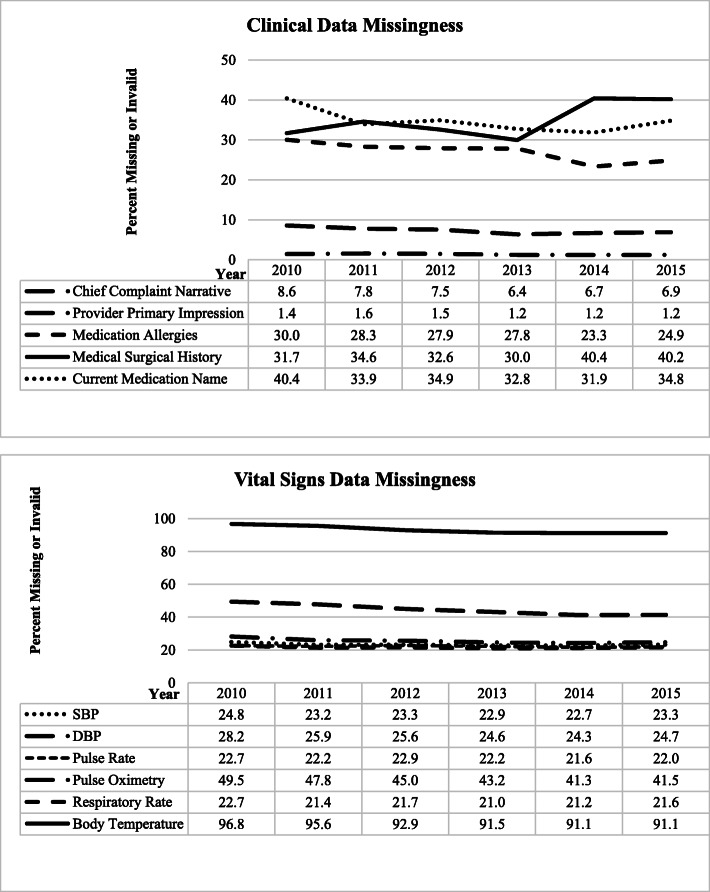
Only five variables of the 18 studied exhibited less than 10% missingness, and there was apparent variation in the rate of missingness across all stratifying variables under study. No consistent trends over time regarding the levels of missing or invalid values from 2010 to 2015 were identified. Qualitative findings indicated possible causes for this missingness including data-mapping issues, unclear variable definitions, and lack of infrastructure or training for data collection.
The adoption of electronic data collection in the prehospital setting can only support quality improvement if its entry is complete. The data suggest that there are many EMS agencies and MCAs with very high levels of missingness, and they do not appear to be improving over time, demonstrating a need for investment in efforts in improving data collection and reporting.
本研究旨在评估密歇根州(MI)国家紧急医疗服务信息系统(NEMSIS)(MI - EMSIS)中缺失值和无效值的水平,并探索可能的原因,以为数据报告和院前护理质量的改进提供参考。
我们采用混合方法研究数据报告趋势。总体评估了MI - EMSIS(2010 - 2015年)数据集中18个关键报告变量的缺失值或无效值比例,然后按EMS机构、软件平台以及密歇根州的医疗控制当局(MCA) - 区域EMS监督实体进行分层。我们还与EMS参与者进行了4次焦点小组讨论和10次关键 informant访谈,以了解MI - EMSIS中数据缺失的根本原因。
在研究的18个变量中,只有5个变量的缺失率低于10%,并且在所研究的所有分层变量中,缺失率存在明显差异。未发现2010年至2015年期间缺失值或无效值水平随时间的一致趋势。定性研究结果表明,这种缺失的可能原因包括数据映射问题、变量定义不明确以及缺乏数据收集的基础设施或培训。
只有在院前环境中电子数据收集的录入完整时,其采用才能支持质量改进。数据表明,许多EMS机构和MCA的缺失率非常高,而且它们似乎并未随着时间的推移而有所改善,这表明需要投入努力改进数据收集和报告。