Ani Friday E, Ibeji Collins U, Obasi Nnamdi L, Kelani Monsuru T, Ukogu Kingsley, Tolufashe Gideon F, Ogundare Segun A, Oyeneyin Oluwatoba E, Maguire Glenn E M, Kruger Hendrik G
Department of Pure and Industrial Chemistry, Faculty of Physical Sciences, University of Nigeria, Nsukka, 410001, Enugu State, Nigeria.
Catalysis and Peptide Research Unit, School of Health Sciences, University of KwaZulu-Natal, Durban, 4041, South Africa.
Sci Rep. 2021 Apr 14;11(1):8151. doi: 10.1038/s41598-021-87370-0.
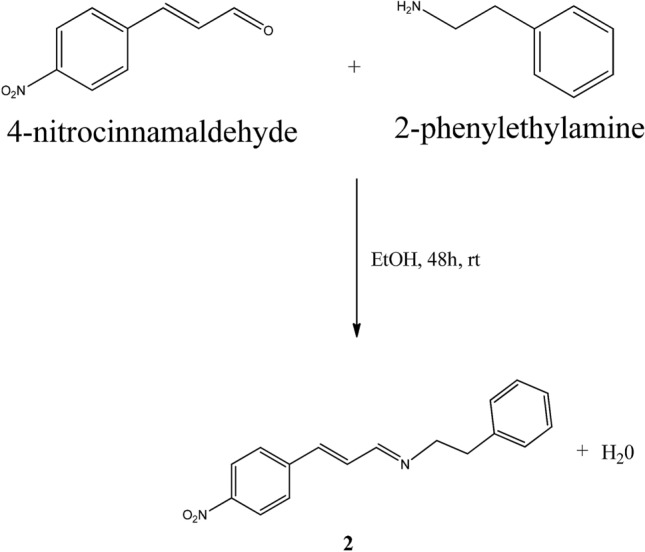
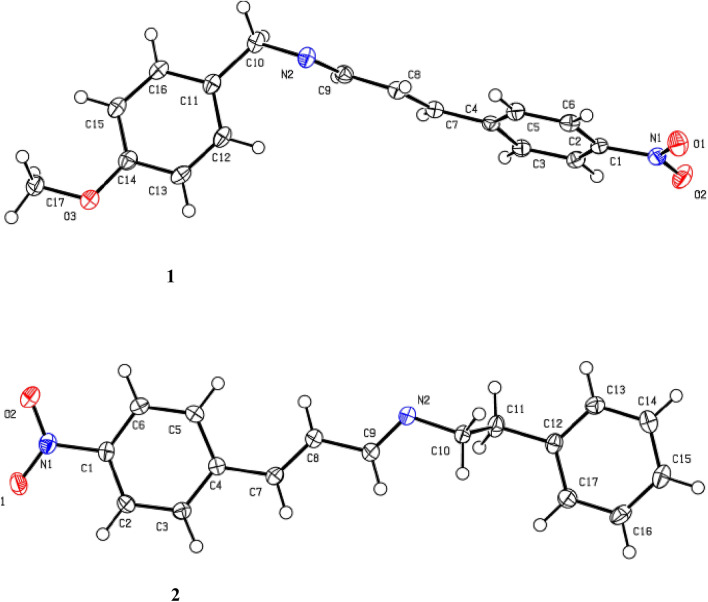
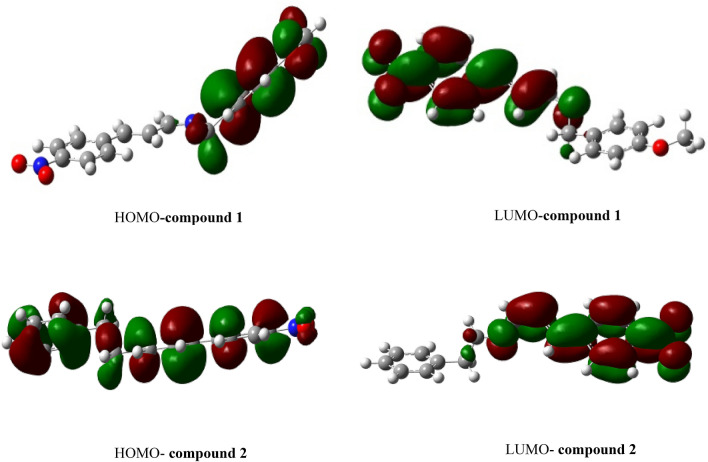
Two Schiff bases, (E)-1-(4-methoxyphenyl)-N-((E)-3-(4-nitrophenyl)allylidene)methanamine (compound 1) and (E)-N-((E)-3-(4-nitrophenyl)allylidene)-2-phenylethanamine (compound 2) have been synthesized and characterized using spectroscopic methods; time of flight MS, H and C NMR, FT-IR, UV-VIS, photoluminescence and crystallographic methods. The structural and electronic properties of compounds 1 and 2 in the ground state were also examined using the DFT/B3LYP functional and 6-31 + G(d,p) basis set, while the electronic transitions for excited state calculations were carried out using the TD-DFT/6-31 + G(d,p) method. The Schiff base compounds, 1 and 2 crystallized in a monoclinic crystal system and the P2/c space group. The emission spectra of the compounds are attributed to conjugated π-bond interaction while the influence of the intra-ligand charge transfer resulted in a broad shoulder for 1 and a double emission peak for 2. The calculated transitions at 450 and 369 nm for 1 and 2 respectively are in reasonable agreement with the experimental results. The higher values of dipole moment, linear polarizability and first hyperpolarizability of 1, suggest a better optical property and better candidate for the development of nonlinear optical (NLO) materials.
已合成了两种席夫碱,即(E)-1-(4-甲氧基苯基)-N-((E)-3-(4-硝基苯基)亚烯丙基)甲胺(化合物1)和(E)-N-((E)-3-(4-硝基苯基)亚烯丙基)-2-苯基乙胺(化合物2),并使用光谱方法进行了表征;包括飞行时间质谱、氢和碳核磁共振、傅里叶变换红外光谱、紫外可见光谱、光致发光光谱以及晶体学方法。还使用密度泛函理论/ B3LYP泛函和6-31 + G(d,p)基组研究了化合物1和2基态的结构和电子性质,而激发态计算的电子跃迁则使用含时密度泛函理论/6-31 + G(d,p)方法进行。席夫碱化合物1和2结晶于单斜晶体系统和P2/c空间群。化合物的发射光谱归因于共轭π键相互作用,而配体内电荷转移的影响导致化合物1出现宽肩峰,化合物2出现双发射峰。化合物1和2分别在450和369 nm处的计算跃迁与实验结果合理吻合。化合物1具有较高的偶极矩、线性极化率和一阶超极化率值,表明其具有更好的光学性质,是开发非线性光学(NLO)材料的更好候选物。