Issac Hancy, Taylor Melissa, Moloney Clint, Lea Jackie
School of Nursing and Midwifery, University of Southern Queensland, Toowoomba, Australia.
J Multidiscip Healthc. 2021 Apr 6;14:767-785. doi: 10.2147/JMDH.S276702. eCollection 2021.
Acute exacerbations of chronic obstructive pulmonary disease (COPD) have a significant and prolonged impact on health-related quality of life, patient outcomes, and escalation of pulmonary function decline. COPD-X guidelines published in 2003 subsist to facilitate a shift from the emphasis on pharmacological treatment to a more holistic multi-disciplinary interventions approach. Despite the existing comprehensive recommendations, readmission rates have increased in the last decade. Evidence to date has reported sub-optimal COPD guidelines adherence in emergency departments. This qualitative study explored contributing factors to interdisciplinary staff non-adherence and utilisation of COPD-X guidelines in a major Southern Queensland Emergency Department.
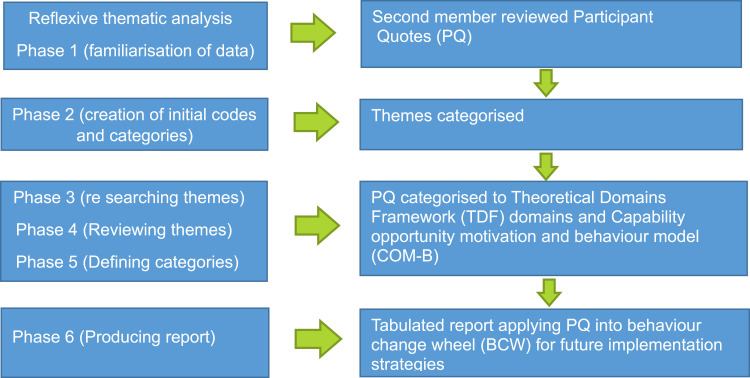
Semi-structured qualitative interviews with interdisciplinary staff were conducted in an emergency department. A purposive sample of doctors, nurses, physiotherapists, pharmacist and a social worker were recruited. Interviews were digitally recorded, de-identified and transcribed verbatim. Data analysis followed a coding process against the Theoretical Domains Framework (TDF) to examine implementation barriers and potential solutions. Identified factors affecting non-adherence and underutilisation of guidelines were then mapped to the capability, opportunity, motivation, behaviour model (COM-B) and behaviour change wheel (BCW) to inform future implementation recommendations.
Prominent barriers influencing the clinical uptake of COPD guidelines were identified using TDF analysis and included knowledge, professional role clarity, clinical behaviour regulation, memory, attention, and decision process, beliefs about departmental capabilities, environmental context and resources. Potential interventions included education, training, staffing, funding and time-efficient digitalised referrals and systems management reminders to prevent COPD readmissions, remissions and improve patient health-related quality of life.
Implementation strategies such as electronic interdisciplinary COPD proforma that facilitates a multimodal approach with appropriate patient/staff resources and referrals prior to discharge from an ED require further exploration. Greater clarity around which components of the COPD X guidelines must be applied in ED settings needs to stem from future research.
慢性阻塞性肺疾病(COPD)急性加重对健康相关生活质量、患者预后以及肺功能下降的加剧有着重大且持久的影响。2003年发布的COPD-X指南旨在推动从强调药物治疗向更全面的多学科干预方法转变。尽管已有全面的建议,但过去十年再入院率仍有所上升。迄今为止的证据表明,急诊科对COPD指南的依从性欠佳。这项定性研究探讨了昆士兰南部一家大型急诊科跨学科工作人员不遵守和未使用COPD-X指南的影响因素。
在急诊科对跨学科工作人员进行半结构化定性访谈。招募了医生、护士、物理治疗师、药剂师和一名社会工作者的目的样本。访谈进行数字录音、去识别化并逐字转录。数据分析遵循针对理论领域框架(TDF)的编码过程,以检查实施障碍和潜在解决方案。然后将确定的影响指南不遵守和未充分使用的因素映射到能力、机会、动机、行为模型(COM-B)和行为改变轮(BCW),以为未来的实施建议提供信息。
通过TDF分析确定了影响COPD指南临床应用的突出障碍,包括知识、专业角色清晰度、临床行为规范、记忆、注意力和决策过程、对科室能力的信念、环境背景和资源。潜在干预措施包括教育、培训、人员配备、资金以及高效的数字化转诊和系统管理提醒,以预防COPD再入院、缓解症状并改善患者的健康相关生活质量。
诸如电子跨学科COPD预填表等实施策略,该预填表有助于在患者从急诊科出院前采用多模式方法并配备适当的患者/工作人员资源及转诊,需要进一步探索。未来的研究需要更明确地确定在急诊科环境中必须应用COPD X指南的哪些组成部分。