Bussières André E, Al Zoubi Fadi, Quon Jeffrey A, Ahmed Sara, Thomas Aliki, Stuber Kent, Sajko Sandy, French Simon
School of Physical and Occupational Therapy, Faculty of Medicine, McGill University, 3630 Promenade Sir-William-Osler, H3G 1Y5, Montreal, QC, Canada.
Département chiropratique, Université du Québec à Trois-Rivières, Trois-Rivières, QC, Canada.
Implement Sci. 2015 Feb 11;10:18. doi: 10.1186/s13012-015-0213-5.
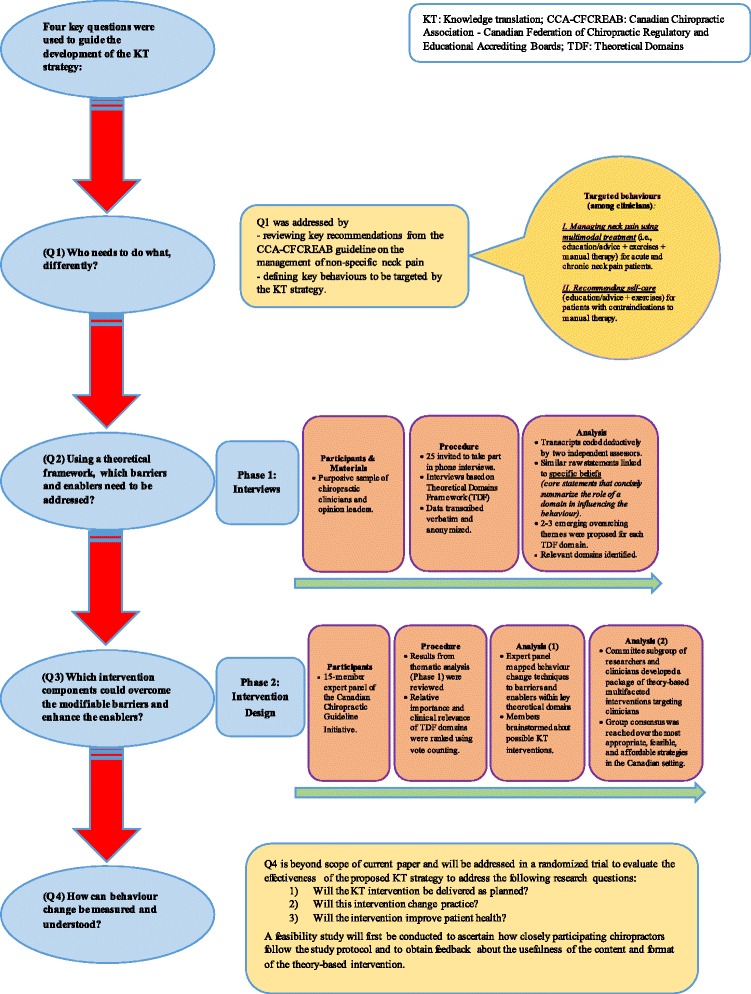
Despite available evidence for optimal management of spinal pain, poor adherence to guidelines and wide variations in healthcare services persist. One of the objectives of the Canadian Chiropractic Guideline Initiative is to develop and evaluate targeted theory- and evidence-informed interventions to improve the management of non-specific neck pain by chiropractors. In order to systematically develop a knowledge translation (KT) intervention underpinned by the Theoretical Domains Framework (TDF), we explored the factors perceived to influence the use of multimodal care to manage non-specific neck pain, and mapped behaviour change techniques to key theoretical domains.
Individual telephone interviews exploring beliefs about managing neck pain were conducted with a purposive sample of 13 chiropractors. The interview guide was based upon the TDF. Interviews were digitally recorded, transcribed verbatim and analysed by two independent assessors using thematic content analysis. A 15-member expert panel formally met to design a KT intervention.
Nine TDF domains were identified as likely relevant. Key beliefs (and relevant domains of the TDF) included the following: influence of formal training, colleagues and patients on clinicians (Social Influences); availability of educational material (Environmental Context and Resources); and better clinical outcomes reinforcing the use of multimodal care (Reinforcement). Facilitating factors considered important included better communication (Skills); audits of patients' treatment-related outcomes (Behavioural Regulation); awareness and agreement with guidelines (Knowledge); and tailoring of multimodal care (Memory, Attention and Decision Processes). Clinicians conveyed conflicting beliefs about perceived threats to professional autonomy (Social/Professional Role and Identity) and speed of recovery from either applying or ignoring the practice recommendations (Beliefs about Consequences). The expert panel mapped behaviour change techniques to key theoretical domains and identified relevant KT strategies and modes of delivery to increase the use of multimodal care among chiropractors.
A multifaceted KT educational intervention targeting chiropractors' management of neck pain was developed. The KT intervention consisted of an online education webinar series, clinical vignettes and a video underpinned by the Brief Action Planning model. The intervention was designed to reflect key theoretical domains, behaviour change techniques and intervention components. The effectiveness of the proposed intervention remains to be tested.
尽管有关于脊柱疼痛最佳管理的现有证据,但对指南的依从性差以及医疗服务存在广泛差异的情况仍然存在。加拿大脊椎按摩疗法指南倡议的目标之一是开发和评估有针对性的、基于理论和证据的干预措施,以改善脊椎按摩师对非特异性颈部疼痛的管理。为了系统地开发一种以理论领域框架(TDF)为基础的知识转化(KT)干预措施,我们探讨了被认为会影响使用多模式护理来管理非特异性颈部疼痛的因素,并将行为改变技术映射到关键理论领域。
对13名脊椎按摩师进行了有目的抽样的个人电话访谈,以探讨他们对颈部疼痛管理的看法。访谈指南基于TDF。访谈进行了数字录音,逐字转录,并由两名独立评估员使用主题内容分析法进行分析。一个由15名成员组成的专家小组正式开会设计KT干预措施。
确定了九个可能相关的TDF领域。关键信念(以及TDF的相关领域)包括以下内容:正规培训、同事和患者对临床医生的影响(社会影响);教育材料的可用性(环境背景和资源);以及更好的临床结果强化了多模式护理的使用(强化)。被认为重要的促进因素包括更好的沟通(技能);对患者治疗相关结果的审核(行为调节);对指南的认识和认同(知识);以及多模式护理的个性化(记忆、注意力和决策过程)。临床医生对专业自主权的感知威胁(社会/专业角色和身份)以及应用或忽视实践建议后恢复速度的信念(对后果的信念)表达了相互矛盾的看法。专家小组将行为改变技术映射到关键理论领域,并确定了相关的KT策略和交付方式,以增加脊椎按摩师对多模式护理的使用。
开发了一种针对脊椎按摩师颈部疼痛管理的多方面KT教育干预措施。KT干预措施包括一个在线教育网络研讨会系列、临床案例和一个以简短行动计划模型为基础的视频。该干预措施旨在反映关键理论领域、行为改变技术和干预组成部分。所提议干预措施的有效性仍有待测试。