Wen Lingzhu, Zhang Guochun, Ren Chongyang, Li Xuerui, Mok Hsiaopei, Jia Minghan, Wang Yulei, Chen Bo, Li Kai, Cao Li, Li Cheukfai, Xiao Weikai, Lai Jianguo, Lin Jiali, Wei Guangnan, Li Yingzi, Zhang Yuchen, Chen Xiaoqing, Liao Ning
Department of Breast Cancer, Guangdong Provincial People's Hospital (Guangdong Academy of Medical Sciences), Guangzhou, Guangdong, People's Republic of China.
Department of Breast Surgical Oncology, Foshan Maternity and Children's Healthcare Hospital Affiliated to Southern Medical University, Foshan, Guangdong, People's Republic of China.
Cancer Manag Res. 2021 Apr 7;13:3055-3065. doi: 10.2147/CMAR.S299624. eCollection 2021.
This study aimed to investigate AKT gene mutation status in Chinese breast cancer patients.
The study included 411 breast cancer patients hospitalized in Guangdong Provincial People's Hospital (GDPH) from June 1, 2017 to September 27, 2018. Mastectomy or breast conserving surgery was performed, and tissue samples were subjected to next-generation sequencing (NGS) to determine AKT gene mutation status. Meanwhile, the expression of human epidermal growth factor receptor 2 (Her2), progesterone receptor (PR), and estrogen receptor (ER) was analyzed by immunohistochemistry staining. The Cancer Genome Atlas (TCGA) database was used for comparative studies.
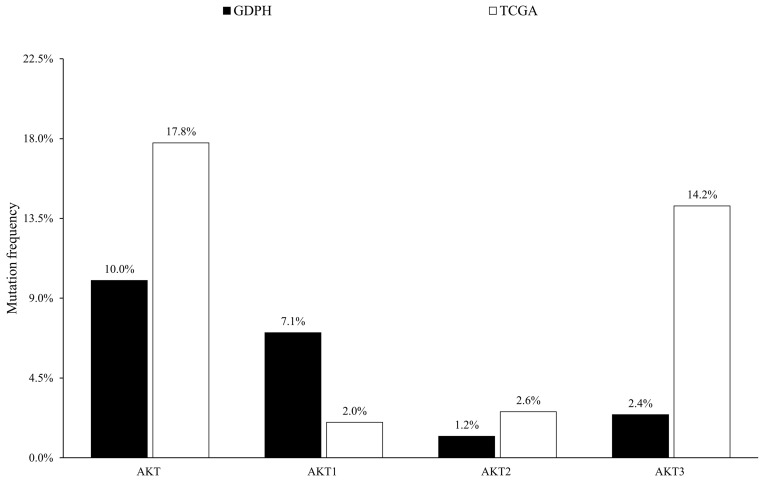
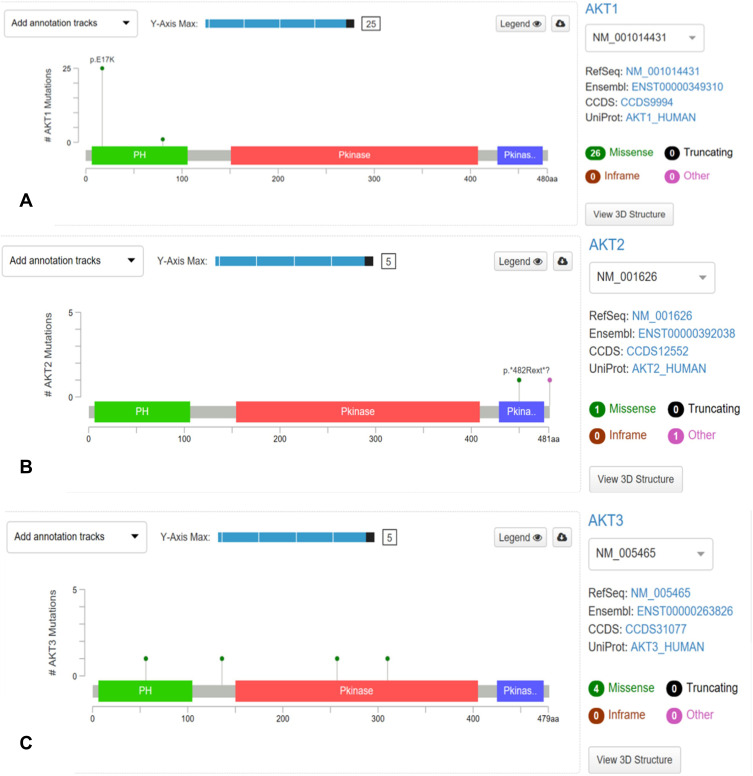
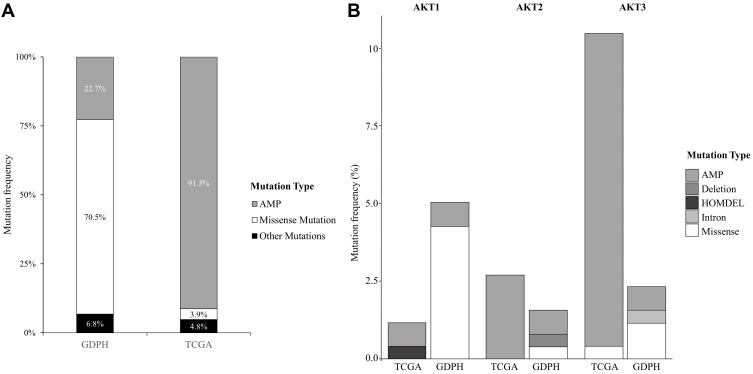
Patients in the GDPH cohort had an older age ( < 0.001), higher postmenopausal rate ( < 0.001), larger tumor size ( < 0.001), higher histologic type of infiltrating duct cancer ( < 0.001), higher metastatic rate ( < 0.001), higher expression of ER ( = 0.015) and HER2 ( < 0.001), and higher percentage of the HR/HER2 subtype ( < 0.001) than those in the TCGA cohort. The GDPH cohort displayed lower rates of overall AKT and AKT3 mutation ( < 0.001), but a higher AKT1 mutation rate ( < 0.0001) compared with the TCGA cohort. Notably, the NGS studies identified missense mutation and copy number amplification as the most common AKT variation type in the GDPH and TCGA cohorts, respectively. Specifically, E17K mutation in AKT1 was predominantly detected in GDPH cohort, while being absent in TCGA cohort. Moreover, in the GDPH cohort, AKT variation was correlated with a number of clinicopathological variables, including age over 50, HER2-, HR+/HER2-, and PR+.
Patients in the GDPH cohort had lower rates of AKT and AKT3 mutation and higher AKT1 mutation rate than those in the TCGA cohort, while harboring missense mutations detected predominantly as E17K mutation in AKT1. In GDPH cohort, there were correlations between AKT mutation and the clinicopathological characteristics of patients.
本研究旨在调查中国乳腺癌患者中AKT基因突变状态。
本研究纳入了2017年6月1日至2018年9月27日在广东省人民医院(GDPH)住院的411例乳腺癌患者。进行了乳房切除术或保乳手术,并对组织样本进行二代测序(NGS)以确定AKT基因突变状态。同时,通过免疫组织化学染色分析人表皮生长因子受体2(Her2)、孕激素受体(PR)和雌激素受体(ER)的表达。使用癌症基因组图谱(TCGA)数据库进行比较研究。
与TCGA队列中的患者相比,GDPH队列中的患者年龄更大(<0.001)、绝经后率更高(<0.001)、肿瘤尺寸更大(<0.001)、浸润性导管癌的组织学类型更高(<0.001)、转移率更高(<0.001)、ER(=0.015)和HER2(<0.001)表达更高,以及HR/HER2亚型的百分比更高(<0.001)。与TCGA队列相比,GDPH队列中AKT和AKT3的总体突变率较低(<0.001),但AKT1突变率较高(< 0.0001)。值得注意的是,NGS研究分别将错义突变和拷贝数扩增确定为GDPH和TCGA队列中最常见的AKT变异类型。具体而言,AKT1中的E17K突变主要在GDPH队列中检测到,而在TCGA队列中不存在。此外,在GDPH队列中,AKT变异与一些临床病理变量相关,包括年龄超过50岁、HER2阴性、HR+/HER2阴性和PR阳性。
与TCGA队列中的患者相比,GDPH队列中的患者AKT和AKT3突变率较低,AKT1突变率较高,同时存在主要检测为AKT1中E17K突变的错义突变。在GDPH队列中,AKT突变与患者的临床病理特征之间存在相关性。