Department of Biomedical Engineering, University of Southern California, Los Angeles, CA, United States.
Metabolic Unit, CNR Institute of Neuroscience, Padova, Italy.
Front Endocrinol (Lausanne). 2021 Mar 29;12:641713. doi: 10.3389/fendo.2021.641713. eCollection 2021.
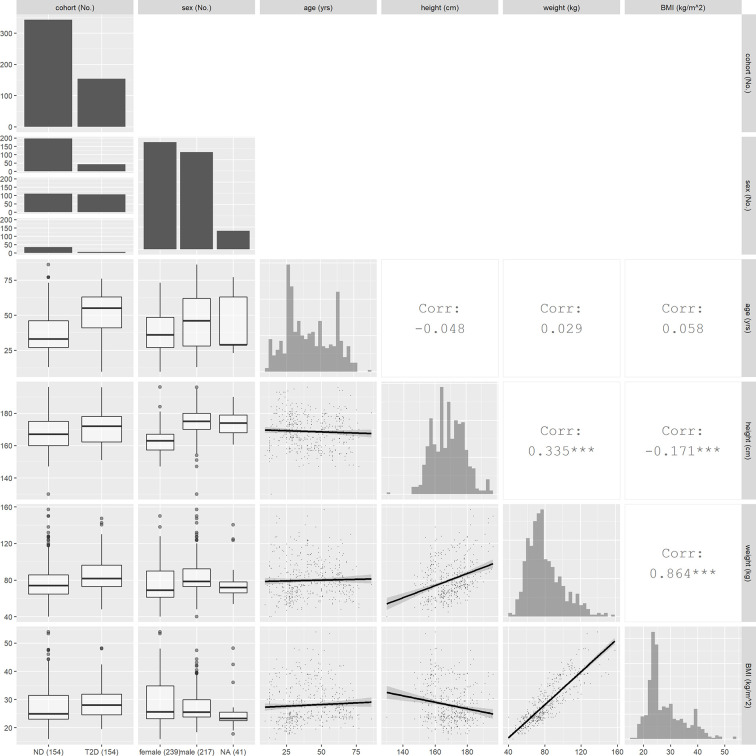
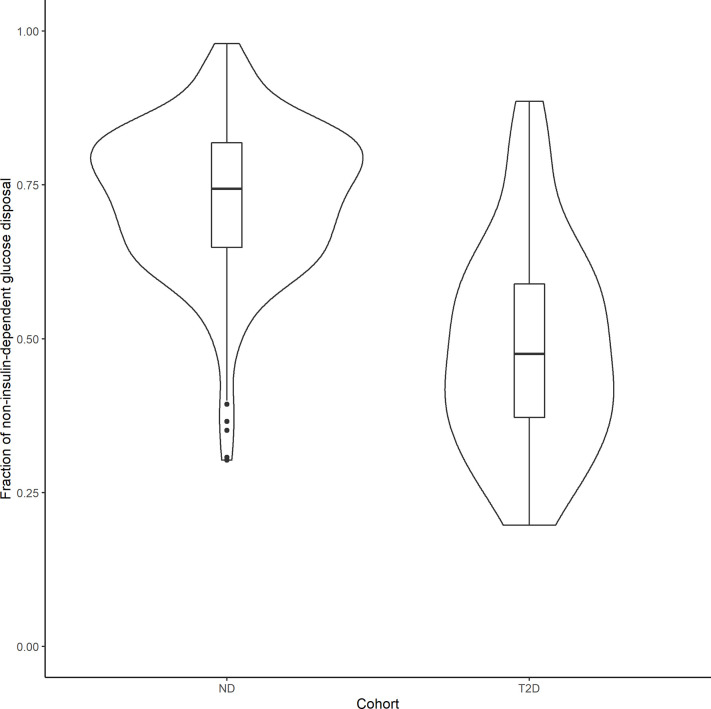
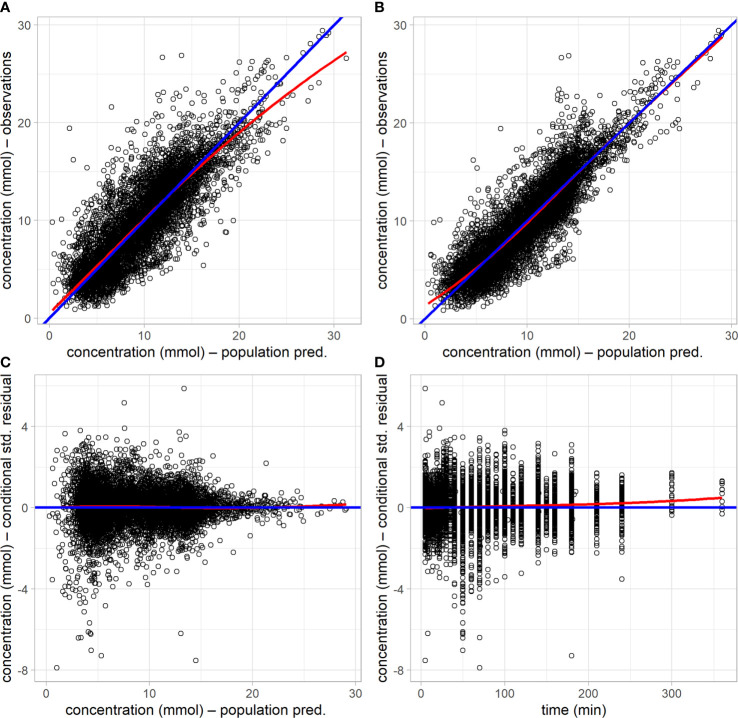
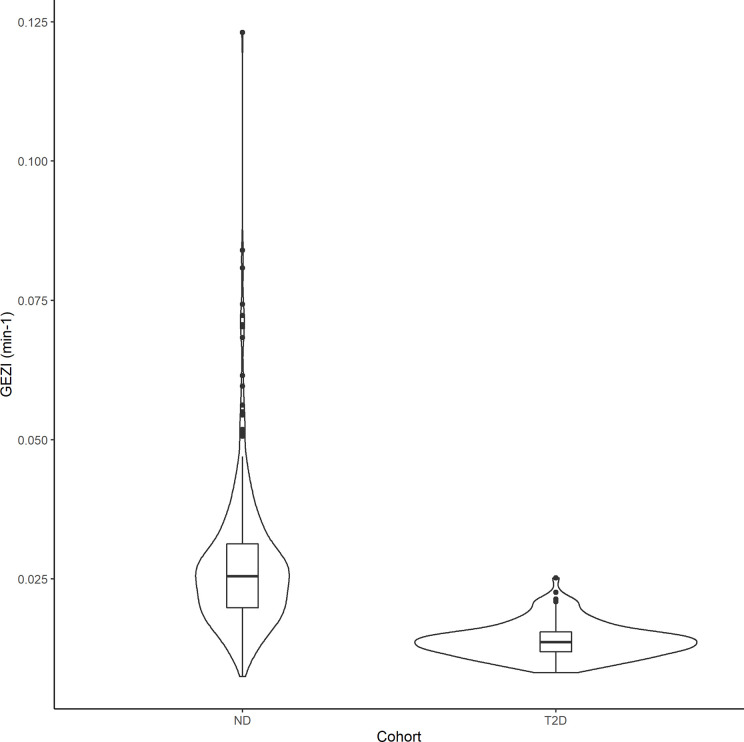
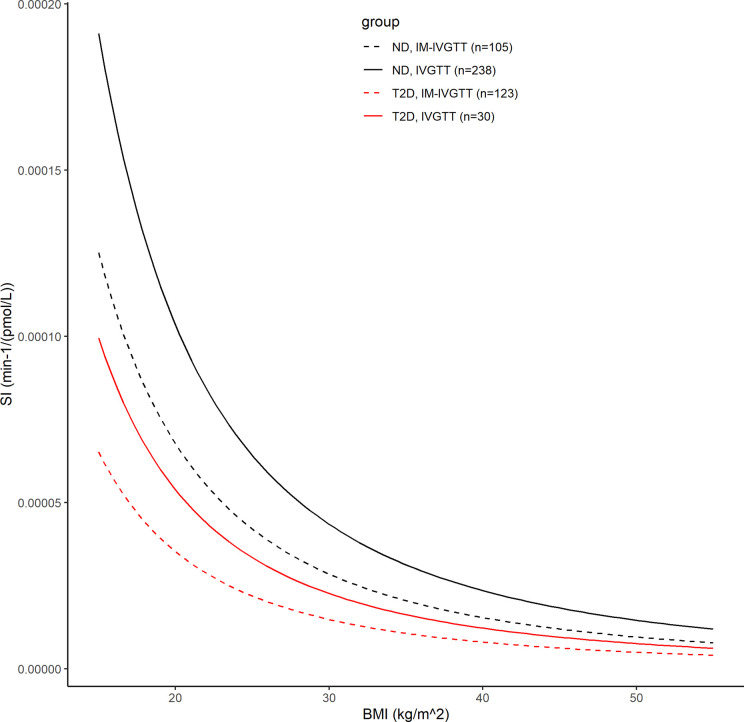
Glucose effectiveness, defined as the ability of glucose itself to increase glucose utilization and inhibit hepatic glucose production, is an important mechanism maintaining normoglycemia. We conducted a minimal modeling analysis of glucose effectiveness at zero insulin () using intravenous glucose tolerance test data from subjects with type 2 diabetes (T2D, n=154) and non-diabetic (ND) subjects (n=343). A hierarchical statistical analysis was performed, which provided a formal mechanism for pooling the data from all study subjects, to yield a single composite population model that quantifies the role of subject specific characteristics such as weight, height, age, sex, and glucose tolerance. Based on the resulting composite population model, was reduced from 0.021 min (standard error - 0.00078 min) in the ND population to 0.011 min (standard error - 0.00045 min) in T2D. The resulting model was also employed to calculate the proportion of the non-insulin-dependent net glucose uptake in each subject receiving an intravenous glucose load. Based on individual parameter estimates, the fraction of total glucose disposal independent of insulin was 72.8% ± 12.0% in the 238 ND subjects over the course of the experiment, indicating the major contribution to the whole-body glucose clearance under non-diabetic conditions. This fraction was significantly reduced to 48.8% ± 16.9% in the 30 T2D subjects, although still accounting for approximately half of the total in the T2D population based on our modeling analysis. Given the potential application of glucose effectiveness as a predictor of glucose intolerance and as a potential therapeutic target for treating diabetes, more investigations of glucose effectiveness in other disease conditions can be conducted using the hierarchical modeling framework reported herein.
葡萄糖效应,定义为葡萄糖本身增加葡萄糖利用和抑制肝葡萄糖产生的能力,是维持正常血糖的重要机制。我们使用来自 2 型糖尿病 (T2D,n=154) 和非糖尿病 (ND) 受试者 (n=343) 的静脉葡萄糖耐量试验数据,对零胰岛素 ( ) 时的葡萄糖效应进行了最小建模分析。进行了层次统计分析,为从所有研究受试者的数据中进行汇总提供了正式的机制,得出了一个单一的综合人群模型,该模型量化了受试者特定特征的作用,如体重、身高、年龄、性别和葡萄糖耐量。基于得出的综合人群模型,在 T2D 中,从 ND 人群中的 0.021 min(标准误差-0.00078 min)降低到 0.011 min(标准误差-0.00045 min)。所得到的模型也被用于计算每个接受静脉葡萄糖负荷的受试者的非胰岛素依赖的净葡萄糖摄取的比例。基于个体参数估计,在整个实验过程中,238 名 ND 受试者中胰岛素独立的总葡萄糖处置的分数为 72.8%±12.0%,表明在非糖尿病条件下对全身葡萄糖清除的主要贡献。尽管基于我们的建模分析,该分数在 30 名 T2D 受试者中显著降低至 48.8%±16.9%,但在 T2D 人群中仍占总分数的近一半。鉴于葡萄糖效应作为葡萄糖不耐受的预测因子和治疗糖尿病的潜在治疗靶点的潜在应用,可以使用本文报告的层次建模框架在其他疾病情况下进一步研究葡萄糖效应。