Madrid-García Alfredo, Pérez Inés, Colomer José Ignacio, León-Mateos Leticia, Jover Juan A, Fernández-Gutiérrez Benjamín, Abásolo-Alcazar Lydia, Rodríguez-Rodríguez Luis
Rheumatology Department, and Health Research Institute (IdISSC), Hospital Clínico San Carlos, Madrid, Spain.
Rheumatology Department, and Health Research Institute (IdISSC), Hospital Clínico San Carlos, c\ Prof. Martin Lagos s/n, Madrid, 28040, Spain.
Ther Adv Musculoskelet Dis. 2021 Mar 26;13:1759720X211002684. doi: 10.1177/1759720X211002684. eCollection 2021.
To analyze the association between colchicine prescription and COVID-19-related hospital admissions in patients with rheumatic and musculoskeletal diseases (RMDs).
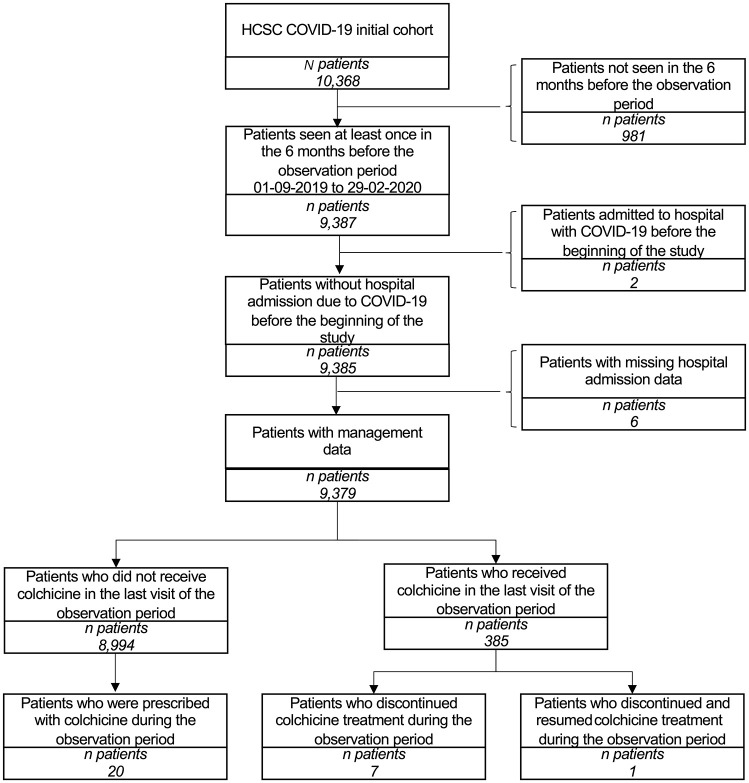
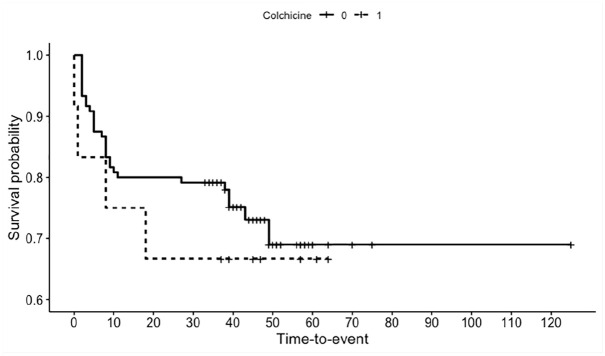
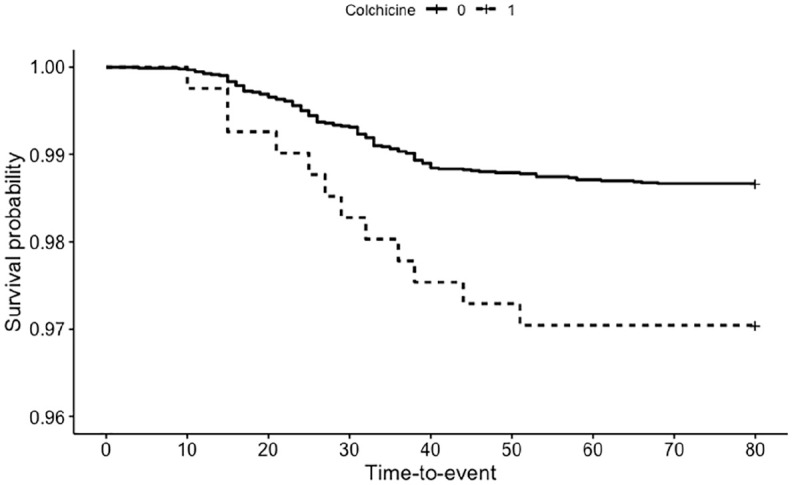
Patients attending a rheumatology outpatient clinic from a tertiary care center in Madrid, Spain, from 1 September 2019 to 29 February 2020 were included. Patients were assigned as exposed or unexposed based on whether they were prescribed with colchicine in their last visit to the clinic during the 6 months before the start of the observation period. Treatment changes during the observation period were also considered. The primary outcome was COVID-19-related hospital admissions between 1 March and 20 May 2020. Secondary outcome included COVID-19-related mortality. Several weighting techniques for data balancing, based and non-based on the propensity score, followed by Cox regressions were performed to estimate the association of colchicine prescription on both outcomes.
The number of patients entered in the study was 9379, with 406 and 9002 exposed and unexposed follow-up periods, respectively. Generalized Boosted Models (GBMs) and Empirical Balancing Calibration Weighting (EBCW) methods showed the best balance for COVID-19-related hospital admissions. Colchicine prescription did not show a statistically significant association after covariable balancing (-value = 0.195 and 0.059 for GBM and EBCW, respectively). Regarding mortality, the low number of events prevented a success variable balancing and analysis.
Colchicine prescription does not play a significant protective or risk role in RMD patients regarding COVID-19-related hospital admissions. Our observations could support the maintenance of colchicine prescription in those patients already being treated, as it is not associated with a worse prognosis.
Colchicine influence in COVID-19-related hospital admissions.
分析秋水仙碱处方与风湿性和肌肉骨骼疾病(RMD)患者新冠病毒病(COVID-19)相关住院之间的关联。
纳入2019年9月1日至2020年2月29日在西班牙马德里一家三级医疗中心风湿科门诊就诊的患者。根据在观察期开始前6个月内最后一次就诊时是否开具秋水仙碱,将患者分为暴露组或非暴露组。观察期内的治疗变化也纳入考虑。主要结局是2020年3月1日至5月20日期间与COVID-19相关的住院情况。次要结局包括与COVID-19相关的死亡率。采用几种基于和不基于倾向评分的数据平衡加权技术,随后进行Cox回归,以估计秋水仙碱处方与这两个结局之间的关联。
纳入研究的患者有9379例,暴露组和非暴露组的随访期分别为406例和9002例。广义增强模型(GBM)和经验平衡校准加权(EBCW)方法在与COVID-19相关的住院方面显示出最佳平衡。在协变量平衡后,秋水仙碱处方未显示出统计学上的显著关联(GBM和EBCW的P值分别为0.195和0.059)。关于死亡率,事件数量较少,无法成功进行变量平衡和分析。
在RMD患者中,秋水仙碱处方在与COVID-19相关的住院方面未发挥显著的保护或风险作用。我们的观察结果可能支持维持对那些已在接受治疗患者的秋水仙碱处方,因为它与更差的预后无关。
秋水仙碱对COVID-19相关住院的影响