Li Wanxia, Yang Chao, Lv Zehong, Li Junzheng, Li Zonghua, Yuan Xiaofei, Wu Shuting, Yuan Yue, Cui Linchong, Lu Juan, Chen Jing, Zhao Feipeng
Department of Otolaryngology-Head and Neck Surgery, Nanfang Hospital, Southern Medical University, Guangzhou 510515, Guangdong, China.
Department of Health Management, Nanfang Hospital, Southern Medical University, Guangzhou 510515, Guangdong, China.
J Cancer. 2021 Mar 5;12(9):2715-2722. doi: 10.7150/jca.56397. eCollection 2021.
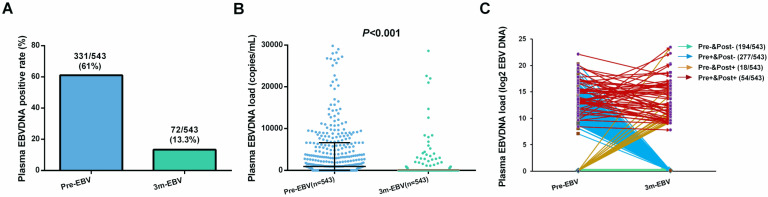
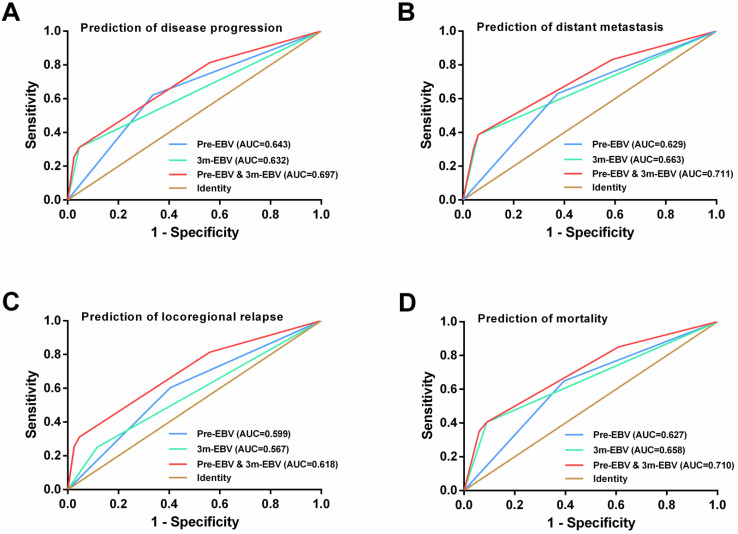
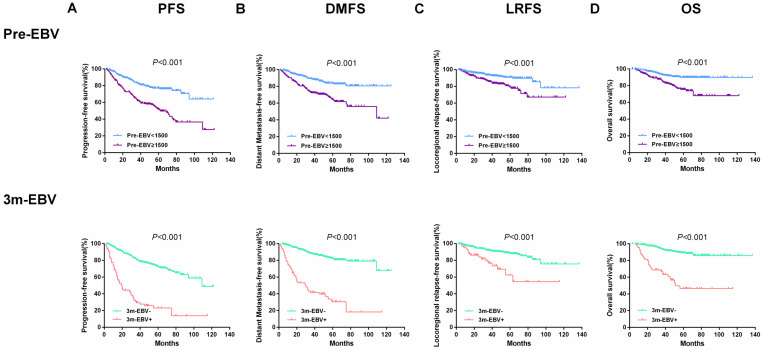
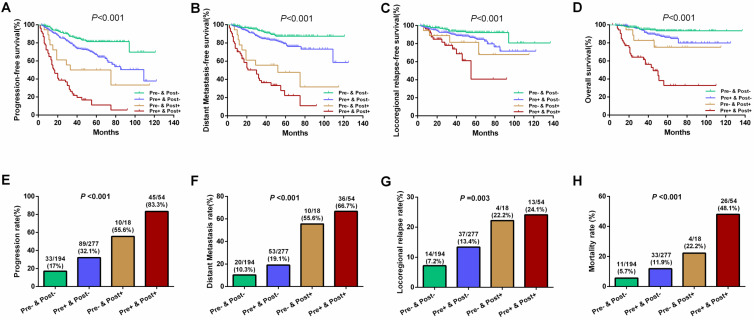
Pre- and post-treatment plasma Epstein-Barr virus (EBV) DNA are important biomarkers for the prognosis of nasopharyngeal carcinoma (NPC). This study was performed to determine the prognostic potential of integrating EBV DNA levels in plasma measured pre-treatment (pre-EBV) and 3 months post-treatment (3 m-EBV). A total of 543 incident non-metastatic NPC patients treated with intensity-modulated radiotherapy, with or without chemotherapy, were reviewed. Patients were divided into four subgroups based on pre-EBV and 3 m-EBV status. The data for pre-EBV and 3 m-EBV samples were integrated, and the predictability of the survival of patients with NPC was analyzed. There were significant differences in the 5-year progression-free survival, distant metastasis-free survival, locoregional relapse-free survival, and overall survival among the four patient subgroups (<0.001). Patients who tested negative for both pre-EBV and 3 m-EBV had the best prognosis, followed by patients who tested positive for pre-EBV and negative for 3 m-EBV, and those who tested negative for pre-EBV and positive for 3 m-EBV; however, patients who tested positive for both pre-EBV and 3 m-EBV had the poorest chances of survival. Multivariate analyses demonstrated that integration of pre-EBV and 3 m-EBV data was an independent predictor of NPC progression in patients. Receiver operating characteristic curve analysis further confirmed that the combination of pre-EBV and 3 m-EBV had a greater prognostic value than pre-EBV or 3 m-EBV alone. Integrating pre-EBV and 3 m-EBV data could provide more accurate risk stratification and better prognostic prediction in NPC.
治疗前和治疗后血浆中的爱泼斯坦-巴尔病毒(EBV)DNA是鼻咽癌(NPC)预后的重要生物标志物。本研究旨在确定整合治疗前(治疗前EBV)和治疗后3个月(3个月EBV)血浆中EBV DNA水平的预后潜力。回顾了总共543例接受调强放疗(无论是否联合化疗)的初发非转移性NPC患者。根据治疗前EBV和3个月EBV状态将患者分为四个亚组。整合治疗前EBV和3个月EBV样本的数据,并分析NPC患者生存的可预测性。四个患者亚组的5年无进展生存期、无远处转移生存期、无局部区域复发生存期和总生存期存在显著差异(<0.001)。治疗前EBV和3个月EBV检测均为阴性的患者预后最佳,其次是治疗前EBV检测为阳性而3个月EBV检测为阴性的患者,以及治疗前EBV检测为阴性而3个月EBV检测为阳性的患者;然而,治疗前EBV和3个月EBV检测均为阳性的患者生存机会最差。多因素分析表明,整合治疗前EBV和3个月EBV数据是NPC患者病情进展的独立预测因素。受试者工作特征曲线分析进一步证实,治疗前EBV和3个月EBV联合使用比单独使用治疗前EBV或3个月EBV具有更大的预后价值。整合治疗前EBV和3个月EBV数据可为NPC提供更准确的风险分层和更好的预后预测。