Seifried Janna, Hoffmann Alexandra, Reda Sarah, Böttcher Sindy, Abu Sin Muna, Hofmann Alexandra, Noll Ines, von Laer Anja, Reuss Annicka, Oh Djin-Ye, Albrecht Stefan, Stern Daniel, Willrich Niklas, Staat Doreen, Zacher Benedikt, Schneider Marc, Feig Marcel, Nitsche Andreas, Rieck Thorsten, Rexroth Ute, Eckmanns Tim, Hamouda Osamah
Abteilung für Infektionsepidemiologie, Robert Koch-Institut, Seestraße 10, 13353, Berlin, Deutschland.
Abteilung für Infektionskrankheiten, Robert Koch-Institut, Berlin, Deutschland.
Bundesgesundheitsblatt Gesundheitsforschung Gesundheitsschutz. 2021 Apr;64(4):403-411. doi: 10.1007/s00103-021-03307-y. Epub 2021 Apr 15.
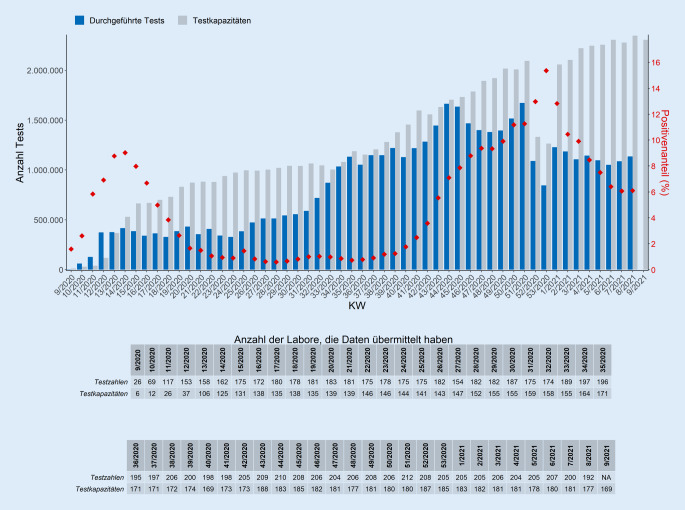
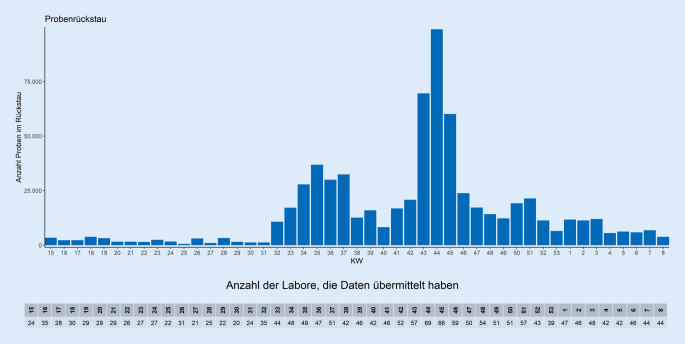
The collection of data on SARS-CoV‑2 tests is central to the assessment of the infection rate in the context of the COVID-19 pandemic. At the Robert Koch Institute (RKI), data collected from various laboratory data recording systems are consolidated. First, this article aims to exemplify significant aspects regarding test procedures. Subsequently the different systems for recording laboratory tests are described and test numbers from the RKI test laboratory query and the laboratory-based SARS-CoV‑2 surveillance as well as accounting data from the Association of Statutory Health Insurance Physicians for SARS-CoV‑2 laboratory tests are shown.Early in the pandemic, the RKI test laboratory query and the laboratory-based SARS-CoV‑2 surveillance became available and able to evaluate data on performed tests and test capacities. By recording the positive and negative test results, statements about the total number of tests and the proportion of positive test rates can be made. While the aggregate test numbers are largely representative nationwide, they are not always representative at the state and district level. The billing data of the Association of Statutory Health Insurance Physicians can complement the laboratory data afterwards. In addition, it can provide a retrospective assessment of the total number of SARS-CoV‑2 numbers in Germany, because the services provided by statutory health insurers (around 85% of the population in Germany) are included. The various laboratory data recording systems complement one another and the evaluations flow into the recommended measures for the pandemic response.
在新冠疫情背景下,收集严重急性呼吸综合征冠状病毒2(SARS-CoV-2)检测数据对于评估感染率至关重要。在罗伯特·科赫研究所(RKI),从各种实验室数据记录系统收集的数据被整合起来。首先,本文旨在举例说明检测程序的重要方面。随后描述了记录实验室检测的不同系统,并展示了来自RKI检测实验室查询、基于实验室的SARS-CoV-2监测的检测数量,以及法定医疗保险医生协会关于SARS-CoV-2实验室检测的计费数据。在疫情早期,RKI检测实验室查询和基于实验室的SARS-CoV-2监测就已可用,并能够评估已进行检测的数据和检测能力。通过记录阳性和阴性检测结果,可以得出关于检测总数和阳性检测率比例的陈述。虽然汇总检测数量在全国范围内大体具有代表性,但在州和地区层面并不总是具有代表性。法定医疗保险医生协会的计费数据随后可以补充实验室数据。此外,它可以对德国SARS-CoV-2检测总数进行回顾性评估,因为法定健康保险公司提供的服务(覆盖德国约85%的人口)被纳入其中。各种实验室数据记录系统相互补充,评估结果被纳入疫情应对的建议措施中。