Department of Radiology, Third Xiangya Hospital, Central South University, No. 138 Tongzipo Road, Changsha, 410013, Hunan, China.
Molecular Imaging Research Center, Central South University, Changsha, Hunan, China.
Eur Radiol. 2021 Oct;31(10):7925-7935. doi: 10.1007/s00330-021-07957-z. Epub 2021 Apr 15.
To develop and validate a machine learning model for the prediction of adverse outcomes in hospitalized patients with COVID-19.
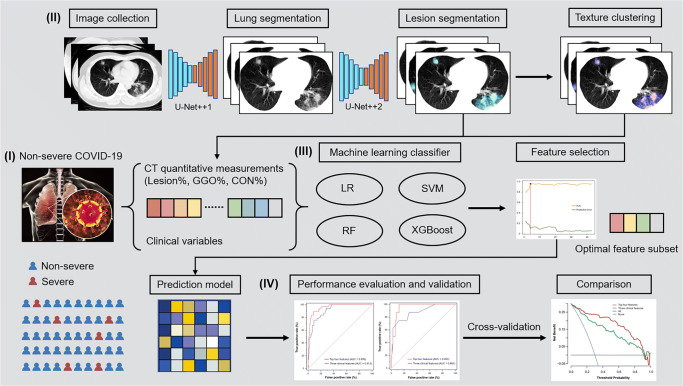
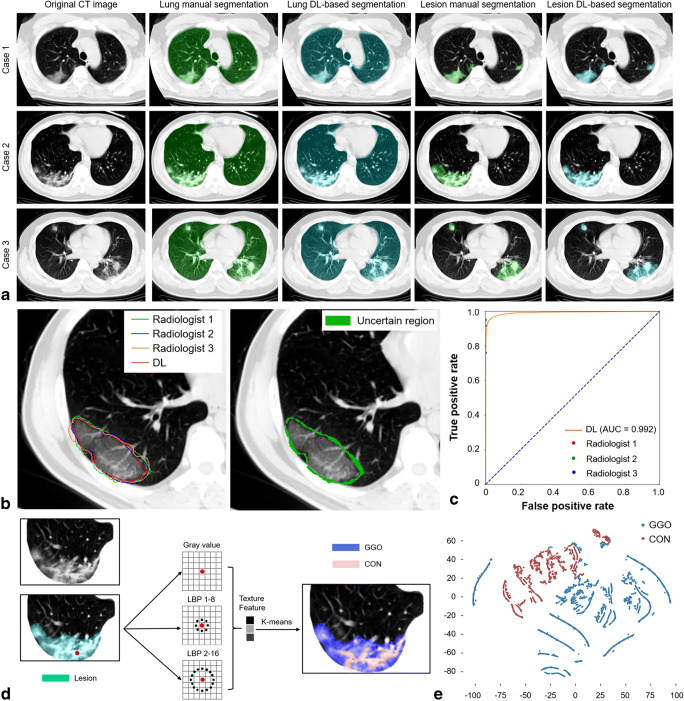
We included 424 patients with non-severe COVID-19 on admission from January 17, 2020, to February 17, 2020, in the primary cohort of this retrospective multicenter study. The extent of lung involvement was quantified on chest CT images by a deep learning-based framework. The composite endpoint was the occurrence of severe or critical COVID-19 or death during hospitalization. The optimal machine learning classifier and feature subset were selected for model construction. The performance was further tested in an external validation cohort consisting of 98 patients.
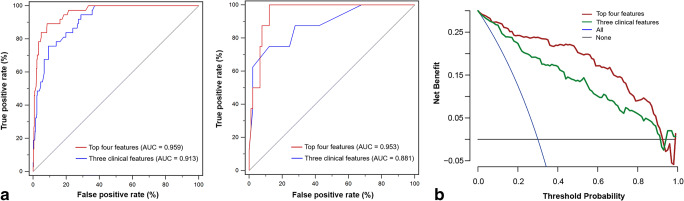
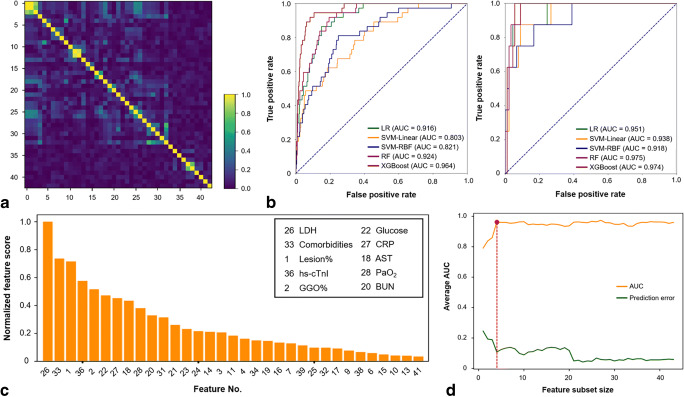
There was no significant difference in the prevalence of adverse outcomes (8.7% vs. 8.2%, p = 0.858) between the primary and validation cohorts. The machine learning method extreme gradient boosting (XGBoost) and optimal feature subset including lactic dehydrogenase (LDH), presence of comorbidity, CT lesion ratio (lesion%), and hypersensitive cardiac troponin I (hs-cTnI) were selected for model construction. The XGBoost classifier based on the optimal feature subset performed well for the prediction of developing adverse outcomes in the primary and validation cohorts, with AUCs of 0.959 (95% confidence interval [CI]: 0.936-0.976) and 0.953 (95% CI: 0.891-0.986), respectively. Furthermore, the XGBoost classifier also showed clinical usefulness.
We presented a machine learning model that could be effectively used as a predictor of adverse outcomes in hospitalized patients with COVID-19, opening up the possibility for patient stratification and treatment allocation.
• Developing an individually prognostic model for COVID-19 has the potential to allow efficient allocation of medical resources. • We proposed a deep learning-based framework for accurate lung involvement quantification on chest CT images. • Machine learning based on clinical and CT variables can facilitate the prediction of adverse outcomes of COVID-19.
开发和验证一种用于预测 COVID-19 住院患者不良结局的机器学习模型。
我们纳入了这项回顾性多中心研究的初级队列中 2020 年 1 月 17 日至 2 月 17 日期间入院的 424 例非重症 COVID-19 患者。使用基于深度学习的框架对胸部 CT 图像上的肺部受累程度进行量化。复合终点为住院期间发生严重或危急 COVID-19 或死亡。选择最佳的机器学习分类器和特征子集用于模型构建。在由 98 例患者组成的外部验证队列中进一步测试了该模型的性能。
初级队列和验证队列中不良结局的发生率(8.7%比 8.2%,p=0.858)无显著差异。机器学习方法极端梯度提升(XGBoost)和最优特征子集(包括乳酸脱氢酶(LDH)、共存疾病、CT 病变比(病变%)和高敏心肌肌钙蛋白 I(hs-cTnI))被用于模型构建。基于最优特征子集的 XGBoost 分类器在初级和验证队列中对不良结局的发生预测效果良好,AUC 分别为 0.959(95%置信区间[CI]:0.936-0.976)和 0.953(95% CI:0.891-0.986)。此外,XGBoost 分类器还具有临床实用性。
我们提出了一种机器学习模型,可有效用于预测 COVID-19 住院患者的不良结局,为患者分层和治疗分配提供了可能。
开发 COVID-19 个体预后模型有可能实现医疗资源的有效分配。
我们提出了一种基于深度学习的框架,用于准确量化胸部 CT 图像上的肺部受累程度。
基于临床和 CT 变量的机器学习有助于预测 COVID-19 的不良结局。