Faust Elizabeth, Pivneva Irina, Yang Karen, Betts Keith A, Ahmed Zubair, Joshi Shivang, Hogan Rebecca, Blumenfeld Andrew, Schim Jack, Feoktistov Alexander, Carnes Kenneth, Bensink Mark, Wu Eric Q, Chou Denise E, Chandler David
Analysis Group, Inc., 151 W 42nd St, 23rd Floor, New York, NY, 10036, USA.
Analysis Group, Inc., Montreal, QC, Canada.
Neurol Ther. 2021 Jun;10(1):293-306. doi: 10.1007/s40120-021-00245-4. Epub 2021 Apr 15.
Erenumab, a first-in-class monoclonal antibody targeting the calcitonin gene-related peptide pathway, was approved by the US Food and Drug Administration in 2018 for the prevention of migraine in adults. There is limited data available on its impact in real-world settings. The study aim was to characterize the real-world treatment profiles, clinical outcomes, and healthcare resource utilization of patients prescribed erenumab from select major US headache centers.
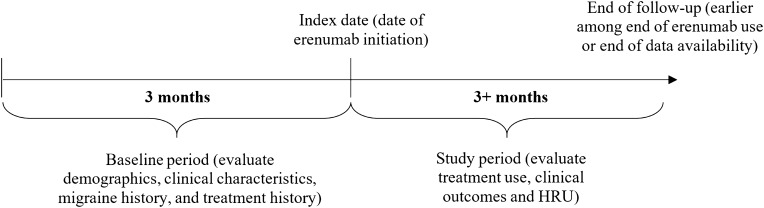
A retrospective chart review of patients with migraine treated with erenumab for at least 3 months across five major headache centers was conducted. Data was collected from patient charts between April 2019 and April 2020 and included patient and clinical characteristics, migraine medication use, and outpatient visits. The date of the first prescription fill of erenumab was defined as the index date. The baseline period comprised the 3 months prior to the index date and the study period comprised the at least 3 months on erenumab treatment.
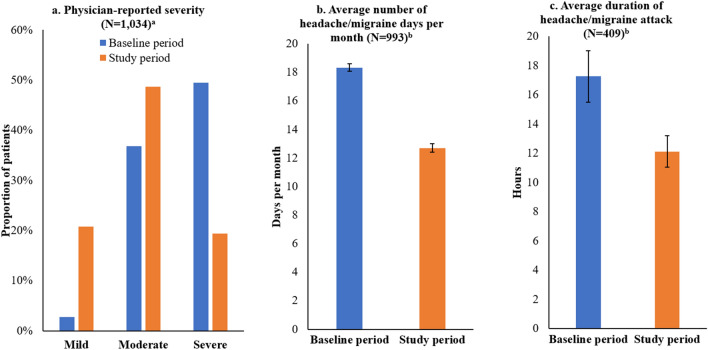
Data from a total of 1034 patients with chronic migraine with a mean of 9.3 months of erenumab treatment were analyzed. Patients were on average 48 years old, 86% were female, and 79% were white. Patients had a mean of 5 preventive treatment failures prior to erenumab initiation. Patients used a mean of 2 preventive treatments (excluding erenumab) and 2 acute treatments during baseline and study periods. Among patients with effectiveness data, 45% of patients had improvement in physician-reported migraine severity and 35% experienced at least 50% reduction in mean headache/migraine days per month. The average number of monthly outpatient visits was 0.43 and 0.30 before and after erenumab initiation, respectively.
In this predominantly refractory chronic migraine population treated in select headache centers, patients had fewer headache/migraine days per month and outpatient visits after initiating erenumab. However, patients largely continued to be managed via a polypharmacy approach after erenumab initiation.
erenumab是首个靶向降钙素基因相关肽途径的单克隆抗体,于2018年获美国食品药品监督管理局批准用于预防成人偏头痛。关于其在实际应用中的影响的数据有限。本研究的目的是描述美国一些主要头痛中心开具erenumab处方的患者的实际治疗情况、临床结局和医疗资源利用情况。
对五个主要头痛中心接受erenumab治疗至少3个月的偏头痛患者进行回顾性病历审查。数据收集于2019年4月至2020年4月期间的患者病历,包括患者和临床特征、偏头痛药物使用情况和门诊就诊情况。erenumab首次配药日期定义为索引日期。基线期包括索引日期前3个月,研究期包括erenumab治疗至少3个月。
共分析了1034例慢性偏头痛患者的数据,平均接受erenumab治疗9.3个月。患者平均年龄48岁,86%为女性,79%为白人。患者在开始使用erenumab之前平均有5次预防性治疗失败。患者在基线期和研究期平均使用2种预防性治疗(不包括erenumab)和2种急性治疗。在有疗效数据的患者中,45%的患者医生报告的偏头痛严重程度有所改善,35%的患者每月平均头痛/偏头痛天数减少至少50%。开始使用erenumab前后每月门诊就诊的平均次数分别为0.43次和0.30次。
在这些主要在选定头痛中心接受治疗的难治性慢性偏头痛患者中,开始使用erenumab后患者每月的头痛/偏头痛天数和门诊就诊次数减少。然而,开始使用erenumab后,患者在很大程度上仍继续采用联合用药的方法进行治疗。