Department of Psychology, Korea University, Seoul, Republic of Korea.
School of Psychology, University of Nottingham, Nottingham, United Kingdom.
PLoS One. 2021 Apr 15;16(4):e0249111. doi: 10.1371/journal.pone.0249111. eCollection 2021.
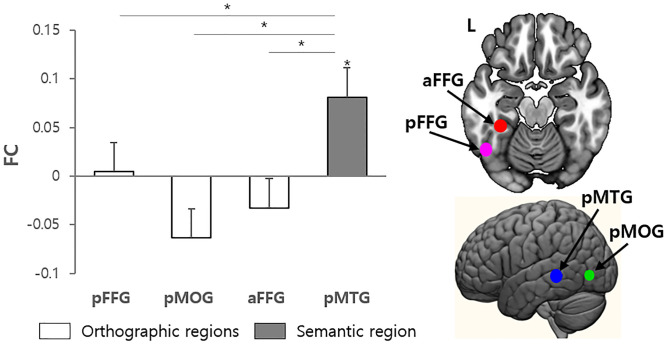
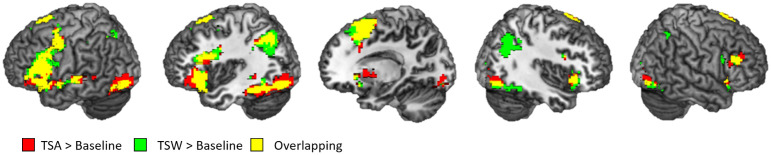
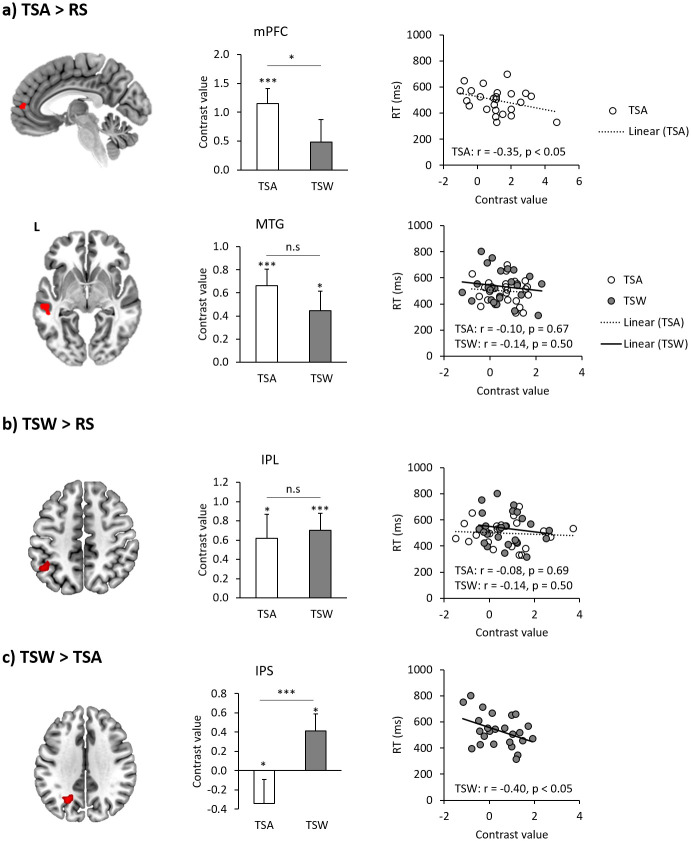
When people confuse and reject a non-word that is created by switching two adjacent letters from an actual word, is called the transposition confusability effect (TCE). The TCE is known to occur at the very early stages of visual word recognition with such unit exchange as letters or syllables, but little is known about the brain mechanisms of TCE. In this study, we examined the neural correlates of TCE and the effect of a morpheme boundary placement on TCE. We manipulated the placement of a morpheme boundary by exchanging places of two syllables embedded in Korean morphologically complex words made up of lexical morpheme and grammatical morpheme. In the two experimental conditions, the transposition syllable within-boundary condition (TSW) involved exchanging two syllables within the same morpheme, whereas the across-boundary condition (TSA) involved the exchange of syllables across the stem and grammatical morpheme boundary. During fMRI, participants performed the lexical decision task. Behavioral results revealed that the TCE was found in TSW condition, and the morpheme boundary, which is manipulated in TSA, modulated the TCE. In the fMRI results, TCE induced activation in the left inferior parietal lobe (IPL) and intraparietal sulcus (IPS). The IPS activation was specific to a TCE and its strength of activation was associated with task performance. Furthermore, two functional networks were involved in the TCE: the central executive network and the dorsal attention network. Morpheme boundary modulation suppressed the TCE by recruiting the prefrontal and temporal regions, which are the key regions involved in semantic processing. Our findings propose the role of the dorsal visual pathway in syllable position processing and that its interaction with other higher cognitive systems is modulated by the morphological boundary in the early phases of visual word recognition.
当人们混淆并拒绝由实际单词中的两个相邻字母交换而创建的非单词时,就会出现转位混淆效应(TCE)。已知 TCE 发生在视觉单词识别的早期阶段,涉及字母或音节等单位交换,但对 TCE 的大脑机制知之甚少。在这项研究中,我们检查了 TCE 的神经相关性以及词素边界位置对 TCE 的影响。我们通过在由词汇词素和语法词素组成的韩语形态复杂词中交换两个嵌入音节的位置来操纵词素边界的位置。在两个实验条件下,转位音节内边界条件(TSW)涉及在同一词素内交换两个音节,而跨边界条件(TSA)涉及在词干和语法词素边界之间交换音节。在 fMRI 期间,参与者执行词汇决策任务。行为结果表明,在 TSW 条件下发现了 TCE,并且在 TSA 中操纵的词素边界调节了 TCE。在 fMRI 结果中,TCE 引起了左侧顶下小叶(IPL)和顶内沟(IPS)的激活。IPS 激活是 TCE 的特异性,其激活强度与任务表现相关。此外,两个功能网络参与了 TCE:中央执行网络和背侧注意网络。词素边界调制通过招募额顶叶和颞叶区域来抑制 TCE,这些区域是涉及语义处理的关键区域。我们的发现提出了在早期视觉单词识别阶段,背侧视觉通路在音节位置处理中的作用,并且其与其他更高认知系统的相互作用受到形态边界的调节。