Risk Factor Assessment Branch, Epidemiology and Genomics Research Program, Division of Cancer Control and Population Sciences, National Cancer Institute, Bethesda, Maryland, United States of America.
Genomics Epidemiology Branch, Epidemiology and Genomics Research Program, Division of Cancer Control and Population Sciences, National Cancer Institute, Bethesda, Maryland, United States of America.
PLoS One. 2021 Apr 15;16(4):e0250061. doi: 10.1371/journal.pone.0250061. eCollection 2021.
Systems epidemiology approaches may lead to a better understanding of the complex and dynamic multi-level constellation of contributors to cancer risk and outcomes and help target interventions. This grant portfolio analysis aimed to describe the National Institutes of Health (NIH) and the National Cancer Institute (NCI) investments in systems epidemiology and to identify gaps in the cancer systems epidemiology portfolio.
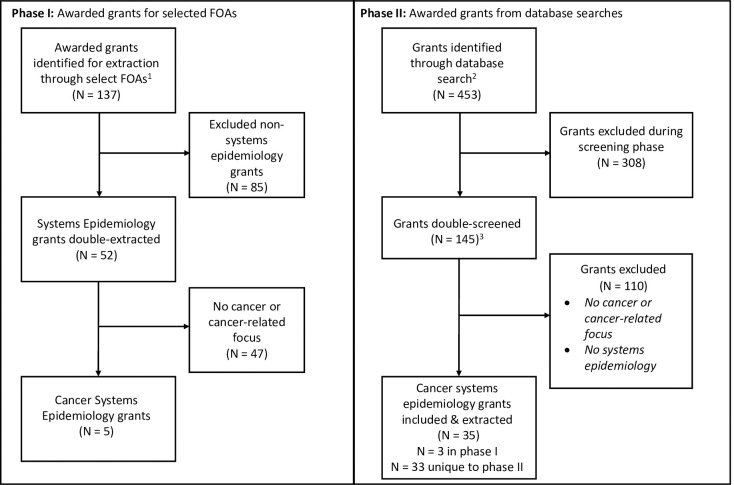
The analysis examined grants funded (2013-2018) through seven NIH systems science Funding Opportunity Announcements (FOAs) as well as cancer-specific systems epidemiology grants funded by NCI during that same time. Study characteristics were extracted from the grant abstracts and specific aims and coded.
Of the 137 grants awarded under the NIH FOAs, 52 (38%) included systems epidemiology. Only five (4%) were focused on cancer systems epidemiology. The NCI-wide search (N = 453 grants) identified 35 grants (8%) that included cancer systems epidemiology in their specific aims. Most of these grants examined epidemiology and surveillance-based questions (60%); fewer addressed clinical care or clinical trials (37%). Fifty-four percent looked at multiple scales within the individual (e.g., cell, tissue, organ), 49% looked beyond the individual (e.g., individual, community, population), and few (9%) included both. Across all grants examined, the systems epidemiology grants primarily focused on discovery or prediction, rather than on impacts of intervention or policy.
The most notable finding was that grants focused on cancer versus other diseases reflected a small percentage of the portfolio, highlighting the need to encourage more cancer systems epidemiology research. Opportunities include encouraging more multiscale research and continuing the support for broad examination of domains in these studies. Finally, the nascent discipline of systems epidemiology could benefit from the creation of standard terminology and definitions to guide future progress.
系统流行病学方法可能有助于更好地理解导致癌症风险和结果的复杂和动态多层次因素组合,并有助于确定干预措施的目标。本资助组合分析旨在描述美国国立卫生研究院 (NIH) 和美国国家癌症研究所 (NCI) 在系统流行病学方面的投资,并确定癌症系统流行病学组合中的空白。
该分析审查了通过 NIH 七个系统科学资助机会公告 (FOA) 资助的(2013-2018 年)资助以及 NCI 在同一时期资助的特定于癌症的系统流行病学资助。从资助摘要和具体目标中提取研究特征并进行编码。
在 NIH FOA 下授予的 137 项资助中,有 52 项(38%)包含系统流行病学。只有五项(4%)专注于癌症系统流行病学。NCI 范围内的搜索(N=453 项资助)确定了 35 项(8%)在其具体目标中包含癌症系统流行病学的资助。这些资助中的大多数研究了基于流行病学和监测的问题(60%);较少涉及临床护理或临床试验(37%)。54%的研究着眼于个体内部的多个尺度(例如,细胞、组织、器官),49%的研究着眼于个体之外(例如,个体、社区、人群),很少(9%)包括两者。在所审查的所有资助中,系统流行病学资助主要侧重于发现或预测,而不是干预或政策的影响。
最显著的发现是,针对癌症与其他疾病的资助占投资组合的比例很小,这突出表明需要鼓励更多的癌症系统流行病学研究。机会包括鼓励更多多尺度研究,并继续支持这些研究中广泛研究领域。最后,系统流行病学这一新兴学科可以从创建标准术语和定义中受益,以指导未来的进展。