Theranova LLC, 101 Mississippi Street, San Francisco, CA, 94107, USA.
Division of Neurology, National University Hospital and Yong Loo Lin School of Medicine, National University of Singapore, NUHS, Tower Block, 1E Kent Ridge Road, 119228, Singapore City, Singapore.
BMC Infect Dis. 2021 Apr 16;21(1):354. doi: 10.1186/s12879-021-06056-0.
COVID-19 pandemic led to wide-spread use of face-masks, respirators and other personal protective equipment (PPE) by healthcare workers. Various symptoms attributed to the use of PPE are believed to be, at least in part, due to elevated carbon-dioxide (CO2) levels. We evaluated concentrations of CO2 under various PPE.
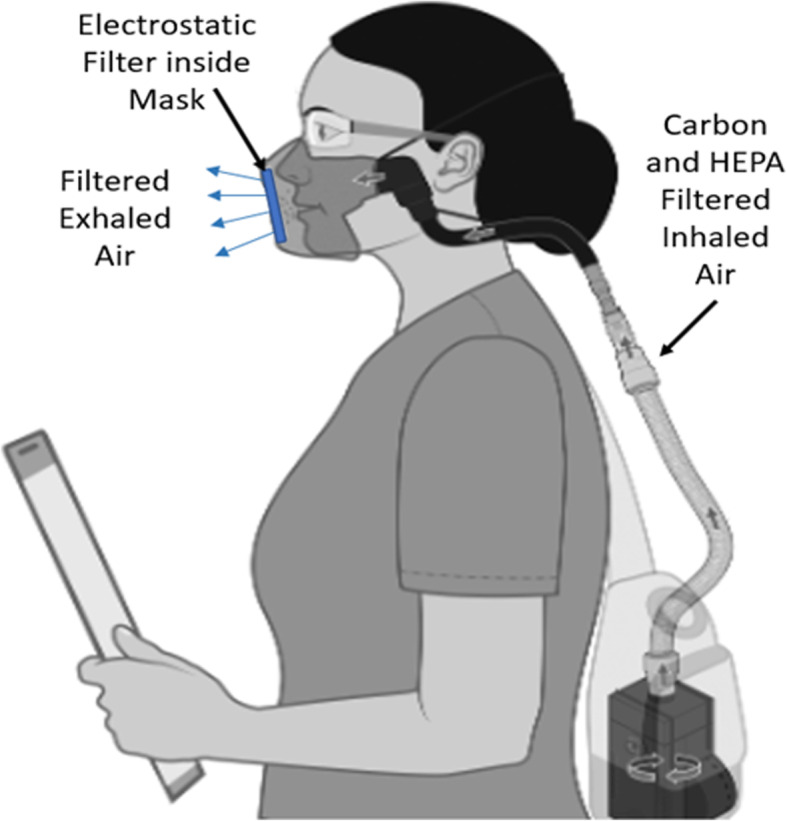
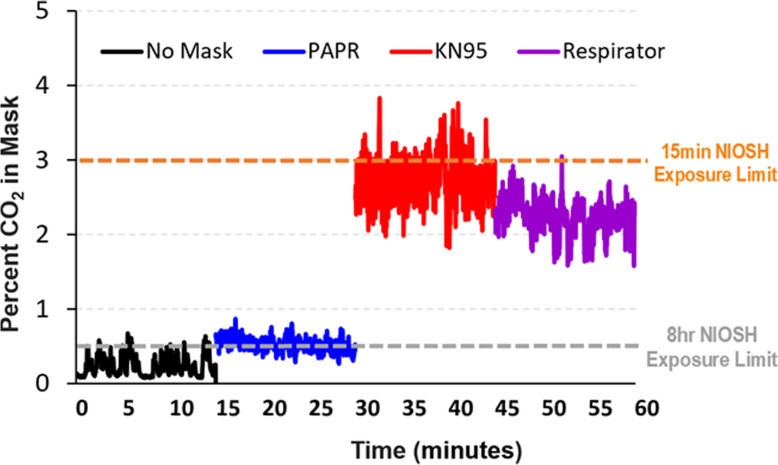
In a prospective observational study on healthy volunteers, CO2 levels were measured during regular breathing while donning 1) no mask, 2) JustAir® powered air purifying respirator (PAPR), 3) KN95 respirator, and 4) valved-respirator. Serial CO2 measurements were taken with a nasal canula at a frequency of 1-Hz for 15-min for each PPE configuration to evaluate whether National Institute for Occupational Safety and Health (NIOSH) limits were breached.
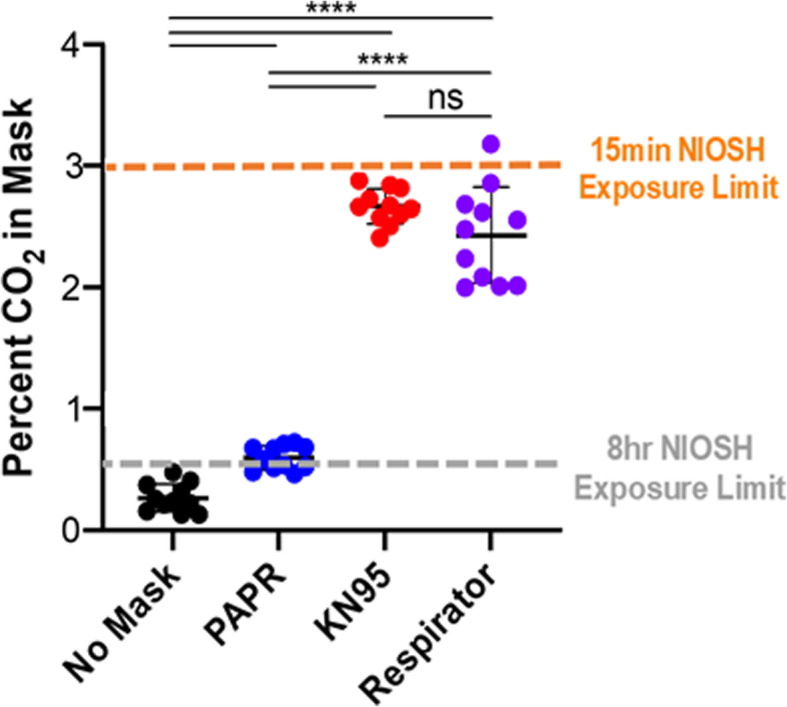
The study included 11 healthy volunteers, median age 32 years (range 16-54) and 6 (55%) men. Percent mean (SD) changes in CO2 values for no mask, JustAir® PAPR, KN95 respirator and valve respirator were 0.26 (0.12), 0.59 (0.097), 2.6 (0.14) and 2.4 (0.59), respectively. Use of face masks (KN95 and valved-respirator) resulted in significant increases in CO2 concentrations, which exceeded the 8-h NIOSH exposure threshold limit value-weighted average (TLV-TWA). However, the increases in CO2 concentrations did not breach short-term (15-min) limits. Importantly, these levels were considerably lower than the long-term (8-h) NIOSH limits during donning JustAir® PAPR. There was a statistically significant difference between all pairs (p < 0.0001, except KN95 and valved-respirator (p = 0.25). However, whether increase in CO2 levels are clinically significant remains debatable.
Although, significant increase in CO2 concentrations are noted with routinely used face-masks, the levels still remain within the NIOSH limits for short-term use. Therefore, there should not be a concern in their regular day-to-day use for healthcare providers. The clinical implications of elevated CO2 levels with long-term use of face masks needs further studies. Use of PAPR prevents relative hypercapnoea. However, whether PAPR should be advocated for healthcare workers requiring PPE for extended hours needs to evaluated in further studies.
COVID-19 大流行导致医护人员广泛使用口罩、呼吸器和其他个人防护设备(PPE)。各种与 PPE 使用相关的症状被认为至少部分是由于二氧化碳(CO2)水平升高所致。我们评估了不同 PPE 下 CO2 的浓度。
在一项对健康志愿者的前瞻性观察研究中,在佩戴 1)无口罩、2)JustAir®动力空气净化呼吸器(PAPR)、3)KN95 呼吸器和 4)带阀呼吸器时,通过鼻插管以 1-Hz 的频率测量 CO2 水平,持续 15 分钟,以评估每个 PPE 配置是否违反了美国国家职业安全与健康研究所(NIOSH)的限值。
该研究纳入了 11 名健康志愿者,中位年龄 32 岁(范围 16-54 岁),6 名(55%)男性。无口罩、JustAir® PAPR、KN95 呼吸器和带阀呼吸器的 CO2 值平均(SD)变化百分比分别为 0.26(0.12)、0.59(0.097)、2.6(0.14)和 2.4(0.59)。口罩(KN95 和带阀呼吸器)的使用导致 CO2 浓度显著升高,超过了 8 小时 NIOSH 暴露阈限值加权平均值(TLV-TWA)。然而,CO2 浓度的升高并未突破 15 分钟的短期限制。重要的是,这些水平远低于佩戴 JustAir® PAPR 时的长期(8 小时)NIOSH 限值。所有组之间的差异均有统计学意义(p<0.0001,除 KN95 和带阀呼吸器(p=0.25)外)。然而,CO2 水平的升高是否具有临床意义仍存在争议。
尽管常规使用口罩会导致 CO2 浓度显著升高,但仍在 NIOSH 短期使用限值范围内。因此,医护人员在日常工作中不必担心其常规使用。长期使用口罩导致 CO2 水平升高的临床意义需要进一步研究。使用 PAPR 可防止相对高碳酸血症。然而,是否应提倡为需要长时间使用 PPE 的医护人员使用 PAPR,还需要进一步研究。