Hussain Sana Yasmin, Khanuja Samiksha, Panjiar Pratibha, Jain Dhruv, Batt Kharat Mohammad
Department of Anesthesiology, Pain Medicine and Critical Care, All India Institute of Medical Sciences, New Delhi, India.
Department of Anesthesiology, Hamdard Institute of Medical Sciences and Research, New Delhi, India.
Indian J Occup Environ Med. 2023 Jan-Mar;27(1):38-41. doi: 10.4103/ijoem.ijoem_170_22. Epub 2023 Mar 31.
N95 filtering facepiece respirators (FFR) are used by health care workers for prevention of airborne infection, and its use has increased manifolds during COVID-19 pandemic. Prolonged use may result in carbon dioxide (CO) accumulation, affect hemodynamics, and blood gas values. Although arterial blood gas values accurately measure the blood CO levels, venous blood gas values also show acceptable correlation.
To evaluate the physiological impact of N95 FFRs on health care workers, including hemodynamic changes and venous blood levels of CO during a period of 6 h.
Prospective observational study in a tertiary care hospital.
The study was conducted on 30 health care workers who performed routine duties while wearing N95 FFR. Venous blood gas values (CO, pH, and bicarbonate) and vitals (respiratory rate, heart rate, blood pressure, and saturation) were noted at baseline, 2 (T2), and 6 h (T6) after wearing the mask. Discomfort level was also measured on a Visual Analogue Scale (VAS) of 1-10.
Repeated measures analysis was done using repeated measures ANOVA or Friedman's test. Group comparisons for continuously distributed data were made using independent sample "" test or Wilcoxon test.
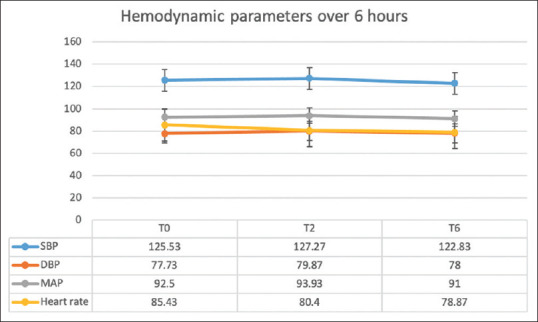
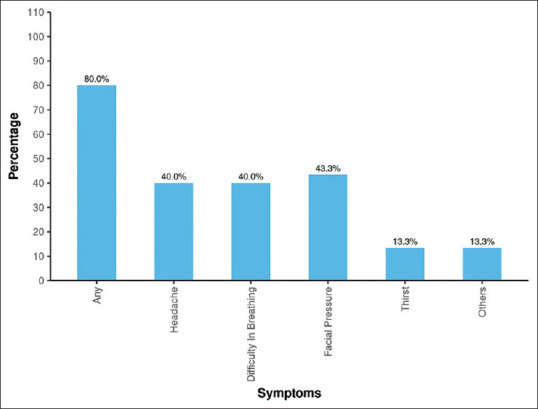
Hemodynamic and blood gas values did not change over time. The VAS for discomfort because of respirator use was 1.33 (1.42) at T2 and 2.77 (1.91) at T6. This was a significant increase in discomfort over time ( = 0.001). About 80% of participants experienced discomfort during this period. N95 FFR did not lead to significant alteration in hemodynamics or change in blood gas values after 6 h of continuous usage. However, discomfort significantly increased over time.
医护人员使用N95过滤式面罩呼吸器(FFR)预防空气传播感染,在新冠疫情期间其使用量大幅增加。长时间使用可能导致二氧化碳(CO)积聚,影响血流动力学和血气值。虽然动脉血气值能准确测量血液中的CO水平,但静脉血气值也显示出可接受的相关性。
评估N95 FFR对医护人员的生理影响,包括6小时期间的血流动力学变化和静脉血中CO水平。
在一家三级护理医院进行的前瞻性观察研究。
对30名佩戴N95 FFR执行日常工作的医护人员进行研究。在佩戴口罩后的基线、2小时(T2)和6小时(T6)记录静脉血气值(CO、pH和碳酸氢盐)及生命体征(呼吸频率、心率、血压和饱和度)。还使用1 - 10的视觉模拟量表(VAS)测量不适程度。
使用重复测量方差分析或弗里德曼检验进行重复测量分析。对连续分布数据进行组间比较时,使用独立样本t检验或威尔科克森检验。
血流动力学和血气值未随时间变化。因使用呼吸器导致的不适VAS在T2时为1.33(1.42),在T6时为2.77(1.91)。随着时间推移,这种不适有显著增加(P = 0.001)。在此期间约80%的参与者感到不适。连续使用6小时后,N95 FFR未导致血流动力学显著改变或血气值变化。然而,不适随时间显著增加。