Department of Endocrinology, Morbid Obesity and Preventive Medicine, Oslo University Hospital, Oslo, Norway
Institute of Clinical Medicine, Faculty of Medicine, University of Oslo, Oslo, Norway.
Diabetes Care. 2021 Jun;44(6):1402-1409. doi: 10.2337/dc20-2089. Epub 2021 Apr 15.
Methylglyoxal (MGO), a reactive aldehyde forming advanced glycation end products (AGEs), is increased in diabetes and recognized by the immune system, resulting in anti-AGE-specific autoantibodies. The association of these immune responses with macro- and microvascular complications in type 1 diabetes remains unclarified. We investigated associations between MGO-modified apolipoprotein B100 (apoB100) and apoB100 peptide 5 (MGO-p5) autoantibodies and coronary atherosclerosis and retinopathy in type 1 diabetes.
IgM and IgG against MGO-apoB100 and MGO-p5 were measured by ELISA in plasma from 103 subjects with type 1 diabetes and 63 control subjects (Dialong study) and in a replication cohort of 27 subjects with type 1 diabetes (Oslo study). Coronary atherosclerosis was assessed by computed tomography coronary angiography or intravascular ultrasound. Retinopathy was classified by retinal photos.
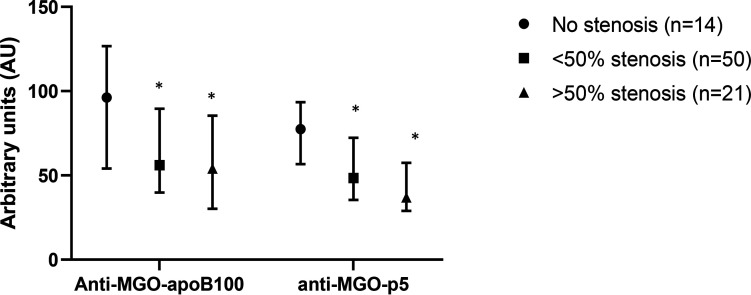
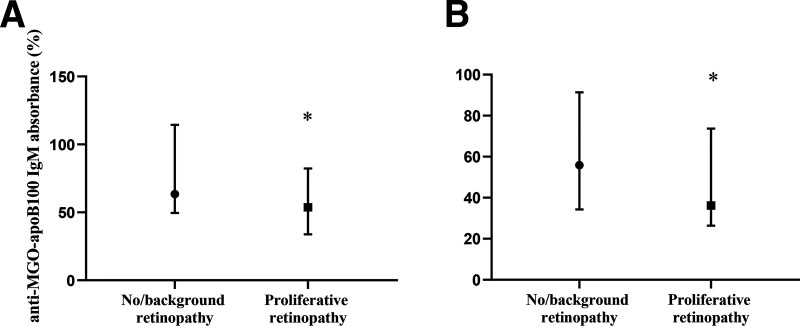
MGO-apoB100 IgM and MGO-p5 IgM levels were higher in subjects with diabetes with no coronary artery stenosis compared with subjects with significant stenosis (median [interquartile range]: 96.2 arbitrary units [AU] [71-126.8] vs. 54 AU [36.1-85.4], 0.003 for MGO-apoB100; and 77.4 AU [58-106] vs. 36.9 AU [28.9-57.4], 0.005 for MGO-p5). MGO-apoB100 IgM and MGO-p5 IgM were associated with less severe coronary stenosis after adjusting for confounders (odds ratio 0.2 [95% CI 0.05-0.6], 0.01; and 0.22 [0.06-0.75], 0.02). The inverse association of MGO-p5 IgM and coronary stenosis was confirmed in the replication cohort. Subjects with proliferative retinopathy had significantly lower MGO-apoB100 IgM and MGO-p5 IgM than those with background retinopathy.
Autoantibodies against AGE-modified apoB100 are inversely associated with coronary atherosclerosis and proliferative retinopathy, suggesting vascular protective effects of these autoantibodies in type 1 diabetes.
甲基乙二醛(MGO)是一种形成晚期糖基化终产物(AGEs)的反应性醛,在糖尿病中增加,并被免疫系统识别,导致针对 AGE 的特异性自身抗体。这些免疫反应与 1 型糖尿病的大血管和微血管并发症之间的关系仍不清楚。我们研究了 MGO 修饰的载脂蛋白 B100(apoB100)和 apoB100 肽 5(MGO-p5)自身抗体与 1 型糖尿病患者的冠状动脉粥样硬化和视网膜病变之间的关联。
通过 ELISA 法检测 103 例 1 型糖尿病患者和 63 例对照者(Dialong 研究)以及 27 例 1 型糖尿病患者(奥斯陆研究)的血浆中针对 MGO-apoB100 和 MGO-p5 的 IgM 和 IgG。通过计算机断层扫描冠状动脉造影或血管内超声评估冠状动脉粥样硬化。通过视网膜照片对视网膜病变进行分类。
与有明显狭窄的受试者相比,无冠状动脉狭窄的糖尿病患者的 MGO-apoB100 IgM 和 MGO-p5 IgM 水平更高(中位数[四分位距]:96.2 个任意单位[AU] [71-126.8]与 54 AU [36.1-85.4],P=0.003 用于 MGO-apoB100;77.4 AU [58-106]与 36.9 AU [28.9-57.4],P=0.005 用于 MGO-p5)。在调整混杂因素后,MGO-apoB100 IgM 和 MGO-p5 IgM 与冠状动脉狭窄程度较轻相关(比值比 0.2 [95%CI 0.05-0.6],P=0.01;和 0.22 [0.06-0.75],P=0.02)。在复制队列中,MGO-p5 IgM 与冠状动脉狭窄的负相关关系得到了证实。增殖性视网膜病变患者的 MGO-apoB100 IgM 和 MGO-p5 IgM 明显低于背景性视网膜病变患者。
针对 AGE 修饰的 apoB100 的自身抗体与冠状动脉粥样硬化和增殖性视网膜病变呈负相关,表明这些自身抗体在 1 型糖尿病中具有血管保护作用。