Fredrikson G N, Anand D V, Hopkins D, Corder R, Alm R, Bengtsson E, Shah P K, Lahiri A, Nilsson J
Department of Clinical Sciences, Malmö University Hospital, Lund University, Malmö, Sweden.
Diabetologia. 2009 Jul;52(7):1426-33. doi: 10.1007/s00125-009-1377-9. Epub 2009 May 12.
AIMS/HYPOTHESIS: Oxidation of LDL in the arterial extracellular matrix is a key event in the development of atherosclerosis and autoantibodies against oxidised LDL antigens reflect disease severity and the risk of developing acute cardiovascular events. Since type 2 diabetes is associated with increased oxidative stress, we tested the hypothesis that autoantibodies against oxidised LDL antigens are biomarkers for vascular complications in diabetes.
We studied 497 patients with type 2 diabetes without clinical signs of coronary heart disease. Oxidised LDL autoantibodies were determined by ELISA detecting IgG and IgM specific for native and malondialdehyde (MDA)-modified apolipoprotein B-100 peptides p45 and p210. The severity of coronary disease was assessed as the coronary artery calcium score.
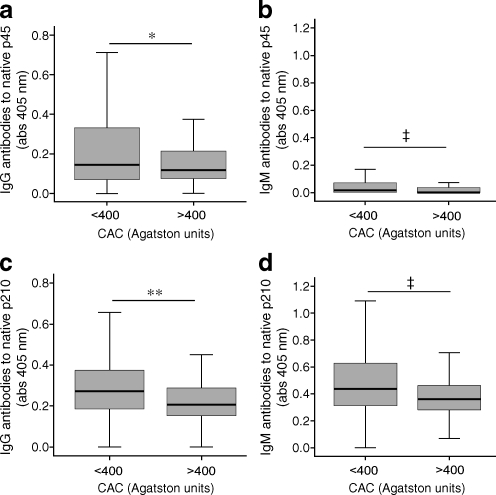
Patients affected by retinopathy had significantly higher levels of IgG against MDA-p45 and MDA-p210. In contrast, high levels of autoantibodies against the corresponding native peptides were associated with less coronary calcification and a lower risk of progression of coronary disease.
CONCLUSIONS/INTERPRETATION: Our observations suggest that LDL oxidation is involved in the pathogenesis of diabetic retinopathy and that autoantibodies against apolipoprotein B peptides may act as biomarkers for both micro- and macrovascular complications in diabetes.
目的/假设:动脉细胞外基质中低密度脂蛋白(LDL)的氧化是动脉粥样硬化发展的关键事件,针对氧化LDL抗原的自身抗体反映了疾病的严重程度以及发生急性心血管事件的风险。由于2型糖尿病与氧化应激增加有关,我们检验了以下假设:针对氧化LDL抗原的自身抗体是糖尿病血管并发症的生物标志物。
我们研究了497例无冠心病临床症状的2型糖尿病患者。通过酶联免疫吸附测定(ELISA)检测针对天然和丙二醛(MDA)修饰的载脂蛋白B - 100肽p45和p210的IgG和IgM,以测定氧化LDL自身抗体。将冠状动脉疾病的严重程度评估为冠状动脉钙化评分。
患有视网膜病变的患者针对MDA - p45和MDA - p210的IgG水平显著更高。相比之下,针对相应天然肽的高水平自身抗体与较少的冠状动脉钙化以及较低的冠状动脉疾病进展风险相关。
结论/解读:我们的观察结果表明,LDL氧化参与糖尿病视网膜病变的发病机制,并且针对载脂蛋白B肽的自身抗体可能作为糖尿病微血管和大血管并发症的生物标志物。