Coates Chloe S, Baise Mia, Schmutzler Adrian, Simonov Arkadiy, Makepeace Joshua W, Seel Andrew G, Smith Ronald I, Playford Helen Y, Keen David A, Siegel Renée, Senker Jürgen, Slater Ben, Goodwin Andrew L
Department of Chemistry, University of Oxford, Inorganic Chemistry Laboratory, Oxford, UK.
Department of Chemistry, University College London, London, UK.
Nat Commun. 2021 Apr 15;12(1):2272. doi: 10.1038/s41467-021-22515-3.
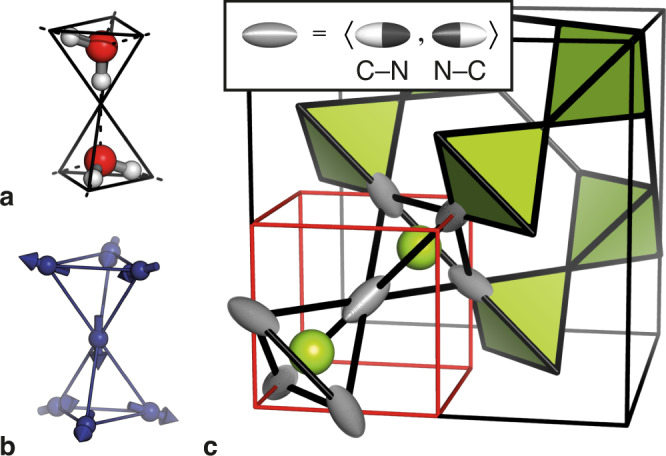
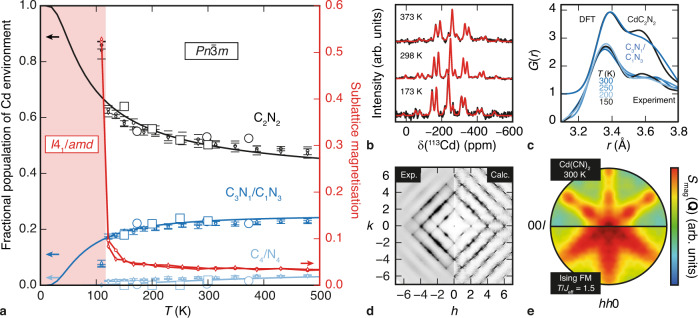
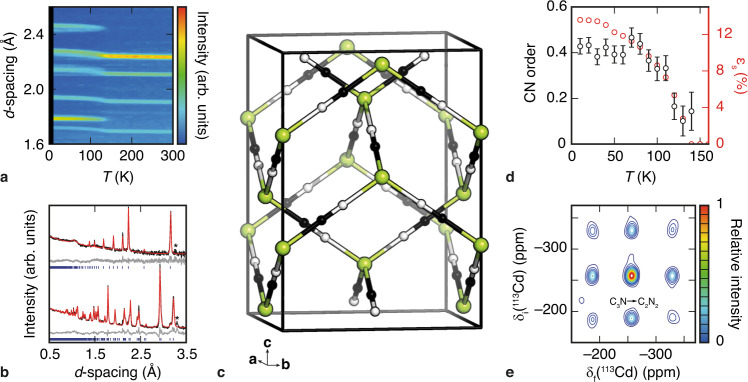
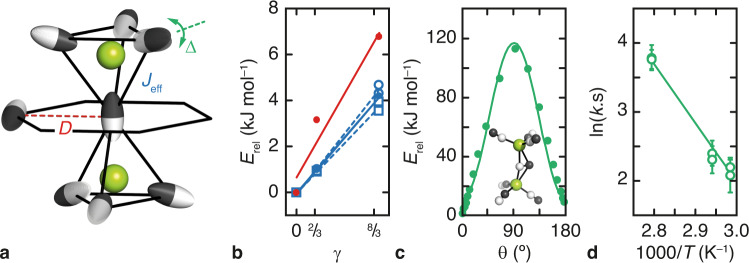
Spin-ices are frustrated magnets that support a particularly rich variety of emergent physics. Typically, it is the interplay of magnetic dipole interactions, spin anisotropy, and geometric frustration on the pyrochlore lattice that drives spin-ice formation. The relevant physics occurs at temperatures commensurate with the magnetic interaction strength, which for most systems is 1-5 K. Here, we show that non-magnetic cadmium cyanide, Cd(CN), exhibits analogous behaviour to magnetic spin-ices, but does so on a temperature scale that is nearly two orders of magnitude greater. The electric dipole moments of cyanide ions in Cd(CN) assume the role of magnetic pseudospins, with the difference in energy scale reflecting the increased strength of electric vs magnetic dipolar interactions. As a result, spin-ice physics influences the structural behaviour of Cd(CN) even at room temperature.
自旋冰是一类具有受挫相互作用的磁体,支持特别丰富多样的涌现物理现象。通常,正是磁偶极相互作用、自旋各向异性以及在烧绿石晶格上的几何受挫的相互作用驱动了自旋冰的形成。相关物理现象发生在与磁相互作用强度相当的温度下,对于大多数系统而言,该温度为1 - 5K。在此,我们表明非磁性的氰化镉Cd(CN)₂表现出与磁性自旋冰类似的行为,但发生这种行为的温度范围要高出近两个数量级。Cd(CN)₂中氰离子的电偶极矩承担了磁赝自旋的角色,能量尺度上的差异反映出电偶极相互作用相对于磁偶极相互作用强度的增加。因此,即使在室温下,自旋冰物理也会影响Cd(CN)₂的结构行为。