Estévez-González Agustín Jesús, Donadio Márcio Vinícius Fagundes, Cobo-Vicente Fernando, Fernández-Luna Álvaro, Sanz-Santiago Verónica, Villa Asensi José Ramón, Iturriaga Ramirez Tamara, Fernández-Del-Valle Maria, Diez-Vega Ignacio, Larumbe-Zabala Eneko, Pérez-Ruiz Margarita
Faculty of Sport Sciences, Universidad Europea de Madrid, Madrid, Spain.
Laboratory of Pediatric Physical Activity, Centro Infant, Pontifícia Universidade Católica do Rio Grande do Sul (PUCRS), Porto Alegre, Brazil.
Front Physiol. 2021 Mar 30;12:652029. doi: 10.3389/fphys.2021.652029. eCollection 2021.
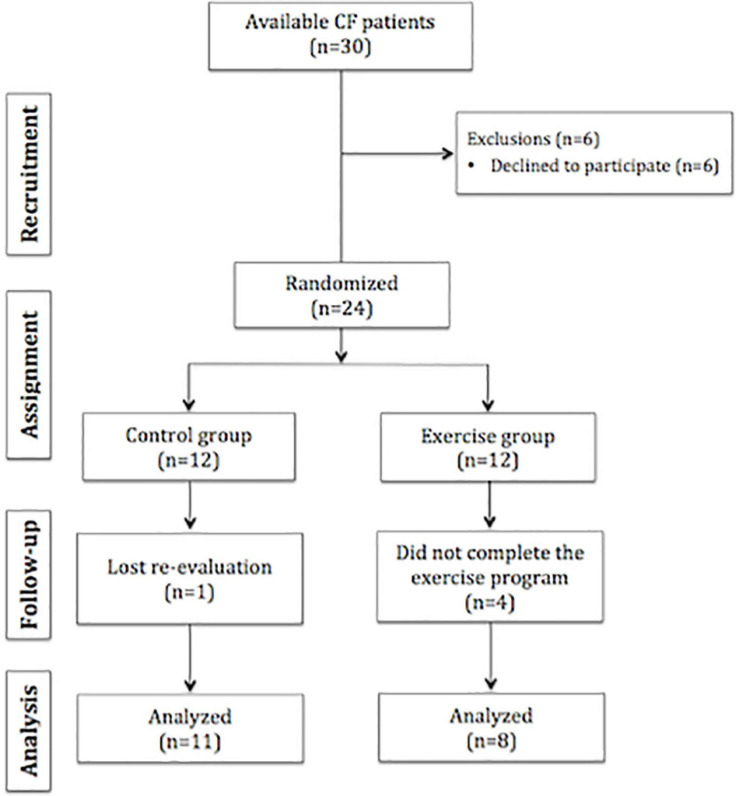
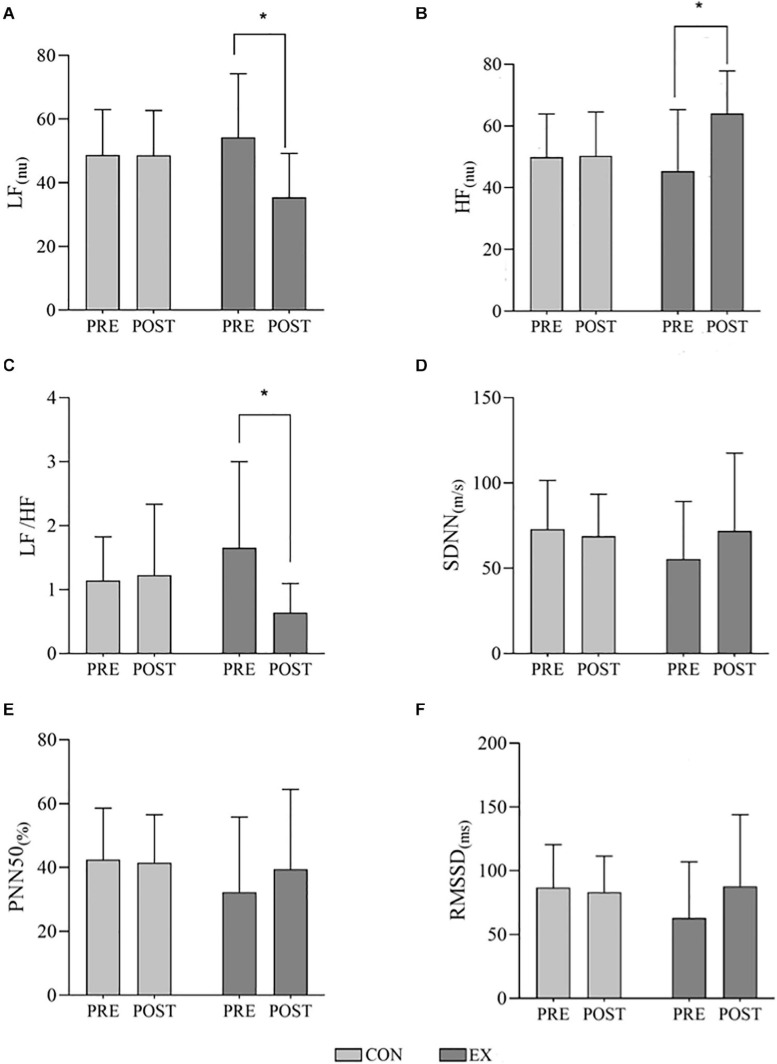
Cystic fibrosis (CF) affects the autonomic nervous system (ANS) and exercise in healthy children modulates the interaction between sympathetic and parasympathetic activity. This study aimed to evaluate the effects of a short-term resistance exercise program on heart rate variability (HRV) in children and adolescents with CF. A randomized controlled trial was carried out in children diagnosed with CF aged 6-18 years. Individuals were divided into two groups: control (CON) and resistance-training (EX). Individuals in the EX group completed an individualized guided resistance program (5-RM-60-80%) for 8 weeks (3 sessions of 60 min/week). Upper and lower limbs exercises (seated bench press, seated lateral row, and leg press) were used. HRV was measured using a Suunto watch with subjects in lying position. Nineteen subjects (13 boys) were included (CON = 11; and EX = 8). Mean age was 12.2 ± 3.3, FEV (forced expiratory volume in the first second) z-score was 1.72 ± 1.54 and peak oxygen consumption (VOpeak) 42.7 ± 7.4 mL.Kg.min. Exercise induced significant changes in the frequency-domain variables, including a decrease in LF power ( = 0.001, = 0.98) and LF/HF ratio ( = 0.020, = 0.92), and an increase in HF power ( = 0.001, = -0.97), compared to the CON group. No significant changes were found for time-domain variables, although increases with a moderate effect size were seen for SDNN ( = 0.152, = -0.41) and RMSSD ( = 0.059, = -0.49) compared to the CON group. A short-term resistance exercise-training program was able to modulate HRV in children and adolescents with CF presenting mild to moderate lung function impairment and good physical condition. www.ClinicalTrials.gov, identifier NCT04293926.
囊性纤维化(CF)会影响自主神经系统(ANS),而健康儿童进行运动可调节交感神经和副交感神经活动之间的相互作用。本研究旨在评估短期抗阻运动计划对CF儿童和青少年心率变异性(HRV)的影响。对6至18岁被诊断为CF的儿童进行了一项随机对照试验。个体被分为两组:对照组(CON)和抗阻训练组(EX)。EX组个体完成了个性化指导的抗阻计划(5-RM-60-80%),为期8周(每周3次,每次60分钟)。使用了上肢和下肢运动(坐姿卧推、坐姿侧平举和腿举)。使用Suunto手表在受试者卧位时测量HRV。纳入了19名受试者(13名男孩)(CON = 11;EX = 8)。平均年龄为12.2±3.3岁,第1秒用力呼气量(FEV)z评分1.72±1.54,峰值耗氧量(VOpeak)42.7±7.4 mL.Kg.min。与CON组相比,运动引起了频域变量的显著变化,包括低频功率降低(P = 0.001,r = 0.98)和低频/高频比值降低(P = 0.020,r = 0.92),以及高频功率增加(P = 0.001,r = -0.97)。时域变量未发现显著变化,尽管与CON组相比,标准差(SDNN)(P = 0.152,r = -0.41)和连续差值的均方根(RMSSD)(P = 0.059,r = -0.49)有中等效应量的增加。短期抗阻运动训练计划能够调节CF儿童和青少年的HRV,这些儿童和青少年存在轻度至中度肺功能损害且身体状况良好。ClinicalTrials.gov网站,标识符NCT04293926。