Zhenjiang Mental Health Center, The Fifth People's Hospital of Zhenjiang City, Zhenjiang 212000, Jiangsu Province, China.
Department of Neurology, The Affiliated Yantai Yuhuangding Hospital of Qingdao University, Yantai 264000, Shandong Province, China.
Behav Neurol. 2021 Mar 31;2021:5533827. doi: 10.1155/2021/5533827. eCollection 2021.
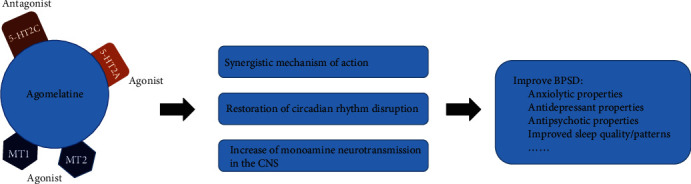
There are nearly 50 million Alzheimer's disease (AD) patients worldwide, 90% of whom develop behavioral and psychological symptoms of dementia (BPSD), which increase the mortality rate of patients, and impose an economic and care burden on families and society. As a neurotransmitter and neuromodulator, serotonin is involved in the regulation of psychoemotional, sleep, and feeding functions. Accumulating data support the importance of serotonin in the occurrence and development of BPSD. Studies have shown that reduction of serotonin receptors can increase depression and mental symptoms in AD patients. At present, there is no drug treatment for AD approved by the US Food and Drug Administration. Among them, agomelatine, as a new type of antidepressant, can act on serotonin 2 receptors to improve symptoms such as depression and anxiety. At present, research on BPSD is still in the preliminary exploratory stage, and there are still a lot of unknowns. This review summarizes the relationship between serotonin 2 receptors, agomelatine, and BPSD. It provides a new idea for the study of the pathogenesis and treatment of BPSD.
全球有近 5000 万阿尔茨海默病(AD)患者,其中 90%会出现行为和心理症状的痴呆(BPSD),这增加了患者的死亡率,并给家庭和社会带来了经济和护理负担。作为一种神经递质和神经调质,5-羟色胺参与了情绪、睡眠和摄食功能的调节。越来越多的数据支持 5-羟色胺在 BPSD 的发生和发展中的重要性。研究表明,5-羟色胺受体的减少会增加 AD 患者的抑郁和精神症状。目前,美国食品和药物管理局批准的治疗 AD 的药物中没有针对 5-羟色胺的药物。其中,阿戈美拉汀作为一种新型抗抑郁药,可作用于 5-羟色胺 2 受体,改善抑郁和焦虑等症状。目前,BPSD 的研究仍处于初步探索阶段,仍有许多未知因素。本综述总结了 5-羟色胺 2 受体、阿戈美拉汀与 BPSD 的关系,为 BPSD 的发病机制和治疗研究提供了新的思路。