The Key Laboratory of Cardiovascular Remodeling and Function Research, Chinese Ministry of Education, Chinese National Health Commission and Chinese Academy of Medical Sciences, The State and Shandong Province Joint Key Laboratory of Translational Cardiovascular Medicine, Department of Cardiology, Qilu Hospital, Cheeloo College of Medicine, Shandong University, Jinan, China.
Department of Cardiology, Shandong Provincial Hospital, Shandong University, Jinan, China.
Aging (Albany NY). 2021 Apr 16;13(8):11470-11490. doi: 10.18632/aging.202839.
A major side effect of statin, a widely used drug to treat hyperlipidemia, is skeletal myopathy through cell apoptosis. The aim of this study is to investigate the roles of microRNA in statin-induced injury.
Apolipoprotein E knockout (ApoE-/-) mice were administered with simvastatin (20 mg/kg/day) for 8 weeks. Exercise capacity was evaluated by hanging grid test, forelimb grip strength, and running tolerance test.
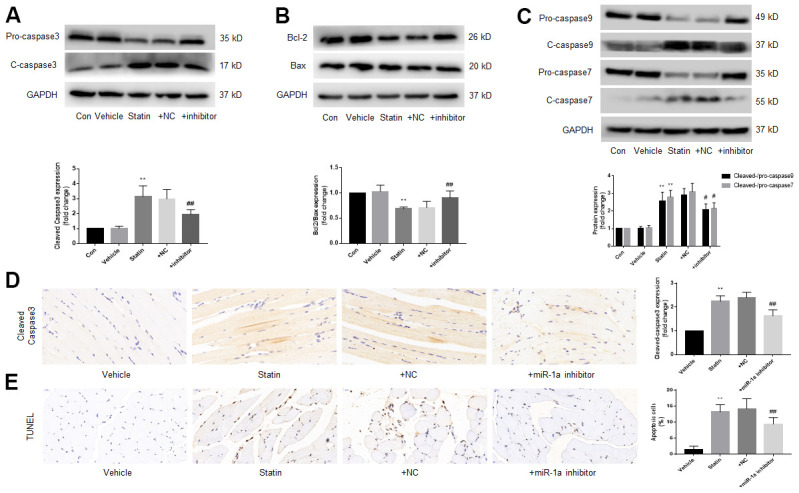
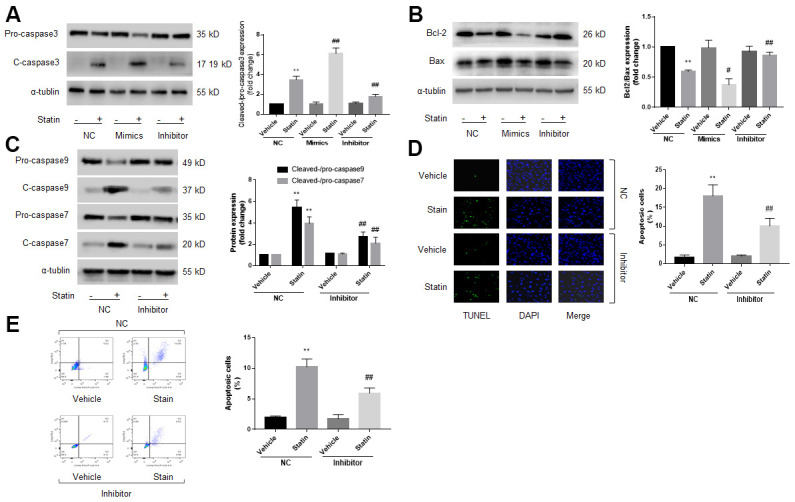
In cultured skeletal muscle cells, statin increased the levels of miR-1a but decreased the levels of mitogen-activated protein kinase kinase kinase 1 (MAP3K1) in a time or dose dependent manner. Both computational target-scan analysis and luciferase gene reporter assay indicated that MAP3K1 is the target gene of miR-1a. Statin induced cell apoptosis of skeletal muscle cells, but abolished by downregulating of miR-1a or upregulation of MAP3K1. Further, the effects of miR-1a inhibition on statin-induced cell apoptosis were ablated by MAP3K1 siRNA. In ApoE-/- mice, statin induced cell apoptosis of skeletal muscle cells and decreased exercise capacity in mice infected with vector, but not in mice with lentivirus-mediated miR-1a gene silence.
Statin causes skeletal injury through induction of miR-1a excessive expression to decrease MAP3K1 gene expression.
他汀类药物是一种广泛用于治疗高脂血症的药物,其主要副作用是通过细胞凋亡引起的骨骼肌病。本研究旨在探讨 microRNA 在他汀类药物诱导损伤中的作用。
载脂蛋白 E 基因敲除(ApoE-/-)小鼠给予辛伐他汀(20mg/kg/天)治疗 8 周。通过悬挂网格试验、前肢握力和跑步耐力试验评估运动能力。
在培养的骨骼肌细胞中,他汀类药物以时间或剂量依赖的方式增加 miR-1a 的水平,但降低丝裂原活化蛋白激酶激酶激酶 1(MAP3K1)的水平。计算靶标扫描分析和荧光素酶基因报告基因检测均表明 MAP3K1 是 miR-1a 的靶基因。他汀类药物诱导骨骼肌细胞凋亡,但下调 miR-1a 或上调 MAP3K1 可消除这种作用。此外,miR-1a 抑制对他汀类药物诱导的细胞凋亡的作用可被 MAP3K1 siRNA 消除。在 ApoE-/-小鼠中,他汀类药物诱导骨骼肌细胞凋亡并降低感染载体的小鼠的运动能力,但不降低感染慢病毒介导的 miR-1a 基因沉默的小鼠的运动能力。
他汀类药物通过诱导 miR-1a 过度表达降低 MAP3K1 基因表达,导致骨骼肌损伤。