Kim Taehoon, Samraj Shafina, Jiménez Juan, Gómez Celina, Liu Tie, Begcy Kevin
University of Florida, Environmental Horticulture Department, Gainesville, Florida, 32611, USA.
University of Florida, Horticultural Science Department, Gainesville, Florida, 32611, USA.
BMC Plant Biol. 2021 Apr 17;21(1):185. doi: 10.1186/s12870-021-02959-x.
Heat shock factors (Hsfs) and Heat shock proteins (Hsps) belong to an essential group of molecular regulators involved in controlling cellular processes under normal and stress conditions. The role of Hsfs and Hsps is well known in model plant species under diverse stress conditions. While plants Hsfs are vital components of the signal transduction response to maintain cellular homeostasis, Hsps function as chaperones helping to maintain folding of damaged and newly formed proteins during stress conditions. In lettuce (Lactuca sativa), a highly consumed vegetable crop grown in the field and in hydroponic systems, the role of these gene families in response to artificial light is not well characterized.
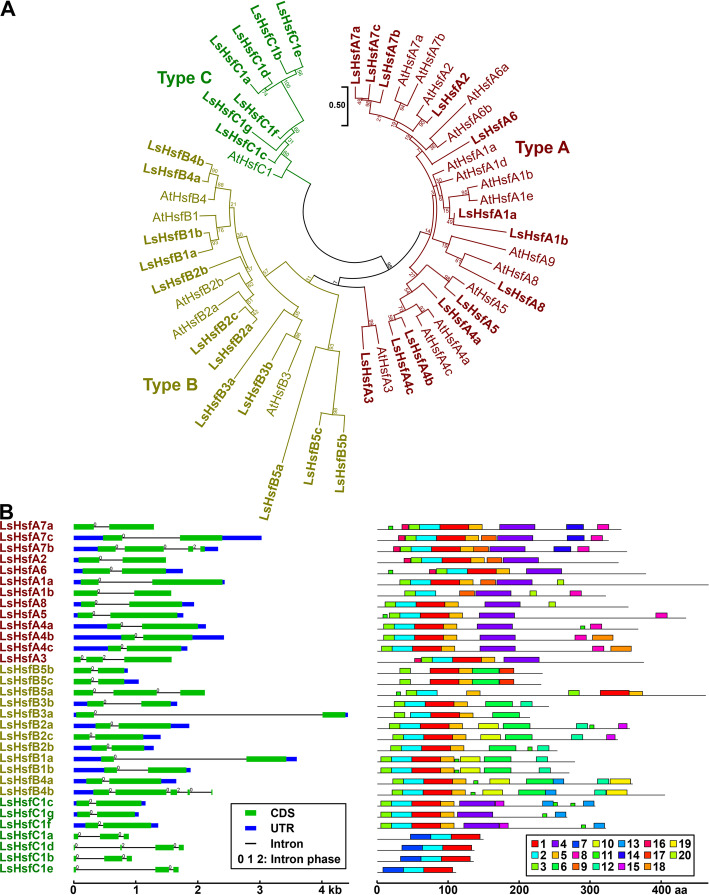
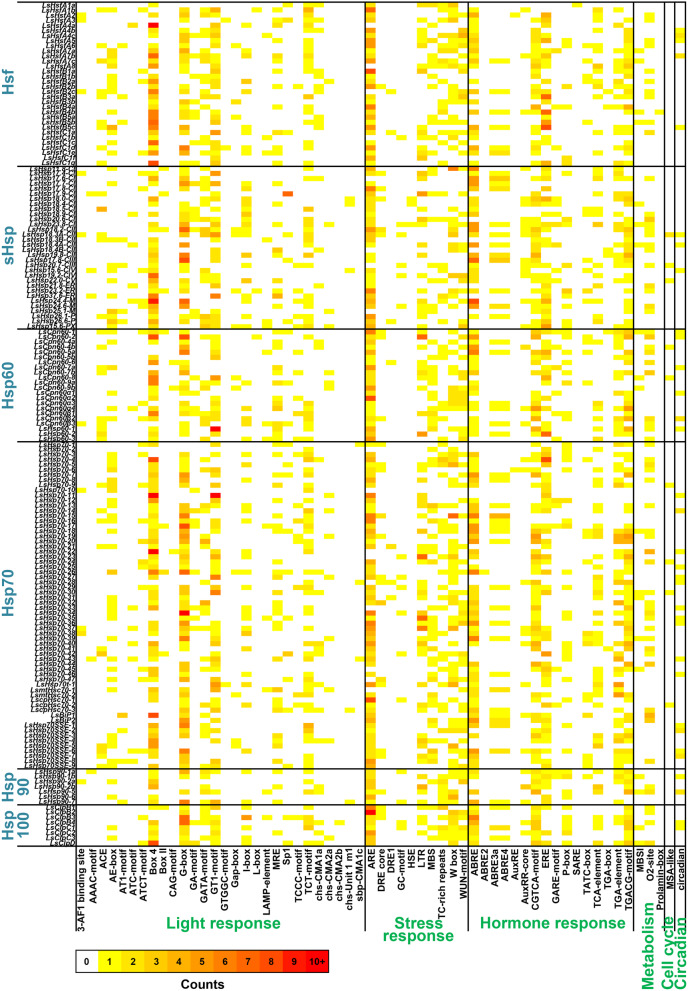
Using a genome-wide analysis approach, we identified 32 Hsfs and 22 small heat shock proteins (LsHsps) in lettuce, some of which do not have orthologs in Arabidopsis, poplar, and rice. LsHsp60s, LsHsp90s, and LsHsp100s are highly conserved among dicot and monocot species. Surprisingly, LsHsp70s have three times more members than Arabidopsis and two times more than rice. Interestingly, the lettuce genome triplication did not contribute to the increased number of LsHsp70s genes. The large number of LsHsp70s was the result of genome tandem duplication. Chromosomal distribution analysis shows larger tandem repeats of LsHsp70s genes in Chr1, Chr7, Chr8, and Chr9. At the transcriptional level, some genes of the LsHsfs, LsHsps, LsHsp60s, and LsHsp70s families were highly responsive to UV and high intensity light stress, in contrast to LsHsp90s and LsHsp100s which did not respond to a light stimulus.
Our genome-wide analysis provides a detailed identification of Hsfs and Hsps in lettuce. Chromosomal location and syntenic region analysis together with our transcriptional analysis under different light conditions provide candidate genes for breeding programs aiming to produce lettuce varieties able to grow healthy under hydroponic systems that use artificial light.
热休克因子(Hsfs)和热休克蛋白(Hsps)属于一类重要的分子调节因子,参与在正常和应激条件下控制细胞过程。在不同应激条件下,Hsfs和Hsps在模式植物物种中的作用已广为人知。虽然植物Hsfs是维持细胞内稳态信号转导反应的重要组成部分,但Hsps作为伴侣蛋白,在应激条件下有助于维持受损和新形成蛋白质的折叠。生菜(Lactuca sativa)是一种在田间和水培系统中广泛种植且消费量很高的蔬菜作物,这些基因家族在响应人工光照方面的作用尚未得到充分表征。
采用全基因组分析方法,我们在生菜中鉴定出32个Hsfs和22个小热休克蛋白(LsHsps),其中一些在拟南芥、杨树和水稻中没有直系同源物。LsHsp60s、LsHsp90s和LsHsp100s在双子叶和单子叶物种中高度保守。令人惊讶的是,LsHsp70s的成员数量比拟南芥多两倍,比水稻多一倍。有趣的是,生菜基因组三倍化并没有导致LsHsp70s基因数量增加。大量的LsHsp70s是基因组串联重复的结果。染色体分布分析表明,在Chr1、Chr7、Chr8和Chr9中,LsHsp70s基因存在较大的串联重复。在转录水平上,LsHsfs、LsHsps、LsHsp60s和LsHsp70s家族的一些基因对紫外线和高强度光胁迫高度响应,而LsHsp90s和LsHsp100s对光刺激无响应。
我们的全基因组分析详细鉴定了生菜中的Hsfs和Hsps。染色体定位和共线性区域分析以及我们在不同光照条件下的转录分析,为旨在培育能够在使用人工光照的水培系统中健康生长的生菜品种的育种计划提供了候选基因。