Almulhim Tarifa S, Barahona Igor
Department of Quantitative Methods, School of Business, King Faisal University, P.O.Box 400, Al-Ahsa, 31982 Saudi Arabia.
Laboratory of Applications of Mathematics, Institute of Mathematics, Universidad Nacional Autónoma de México (UNAM), 62243 Cuernavaca City, Morelos México.
Qual Quant. 2022;56(2):463-491. doi: 10.1007/s11135-021-01129-3. Epub 2021 Apr 10.
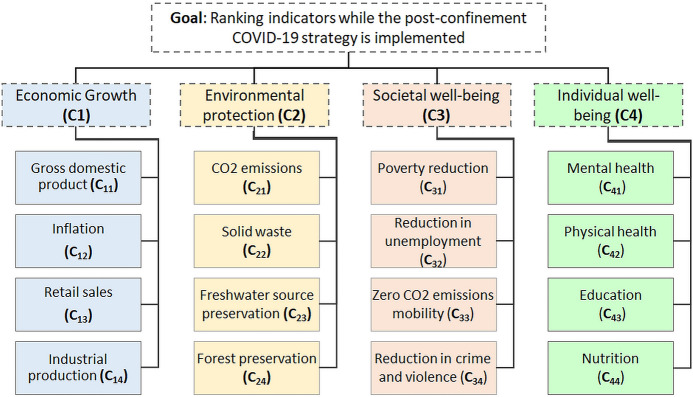
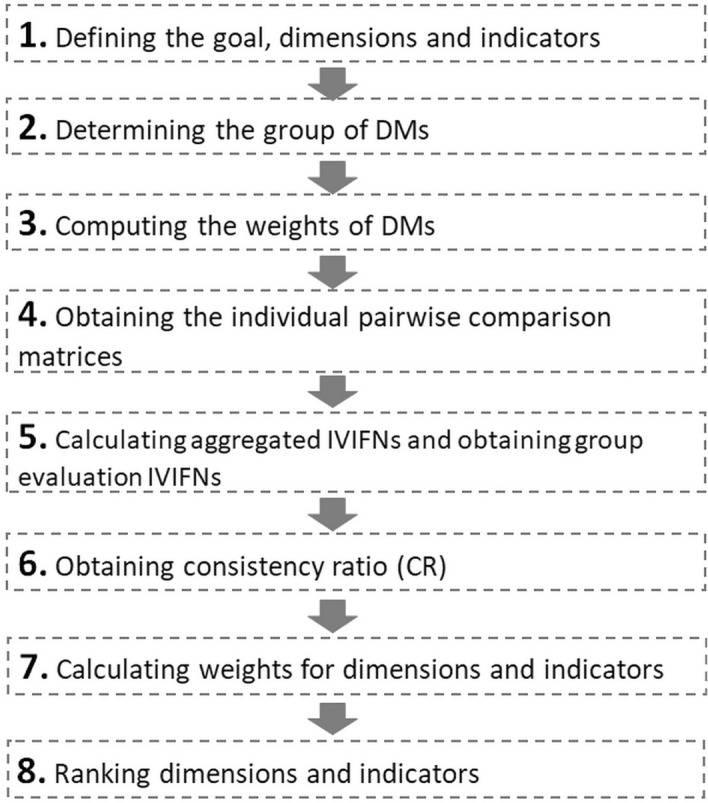
The pandemic caused by the spread of the SARS-CoV-2 virus forced governments around the world to impose lockdowns, which mostly involved restricting non-essential activities. Once the rate of infection is manageable, governments must implement strategies that reverse the negative effects of the lockdowns. A decision support system based on fuzzy theory and multi-criteria decision analysis principles is proposed to investigate the importance of a set of key indicators for post-COVID-19 reopening strategies. This system yields more reliable results because it considers the hesitation and experience of decision makers. By including 16 indicators that are utilized by international organizations for comparing, ranking, or investigating countries, our results suggest that governments and policy makers should focus their efforts on reducing violence, crime and unemployment. The provided methodology illustrates the suitability of decision science tools for tackling complex and unstructured problems, such as the COVID-19 pandemic. Governments, policy makers and stakeholders might find in this work scientific-based guidelines that facilitate complex decision-making processes.
由严重急性呼吸综合征冠状病毒2(SARS-CoV-2)病毒传播引发的大流行迫使世界各国政府实施封锁措施,这些措施大多涉及限制非必要活动。一旦感染率可控,政府必须实施策略以扭转封锁措施带来的负面影响。本文提出了一种基于模糊理论和多准则决策分析原则的决策支持系统,以研究一组关键指标对新冠疫情后重新开放策略的重要性。该系统产生的结果更可靠,因为它考虑了决策者的犹豫和经验。通过纳入国际组织用于比较、排名或调查各国的16项指标,我们的结果表明,政府和政策制定者应将工作重点放在减少暴力、犯罪和失业上。所提供的方法说明了决策科学工具在解决复杂和非结构化问题(如新冠疫情)方面的适用性。政府、政策制定者和利益相关者可能会在这项工作中找到有助于复杂决策过程的科学依据准则。