Abbas Fatima, Vinberg Frans
Vinberg Lab, Department of Ophthalmology and Visual Science, John A. Moran Center, University of Utah, Salt Lake City, UT, United States.
Front Cell Neurosci. 2021 Apr 1;15:662453. doi: 10.3389/fncel.2021.662453. eCollection 2021.
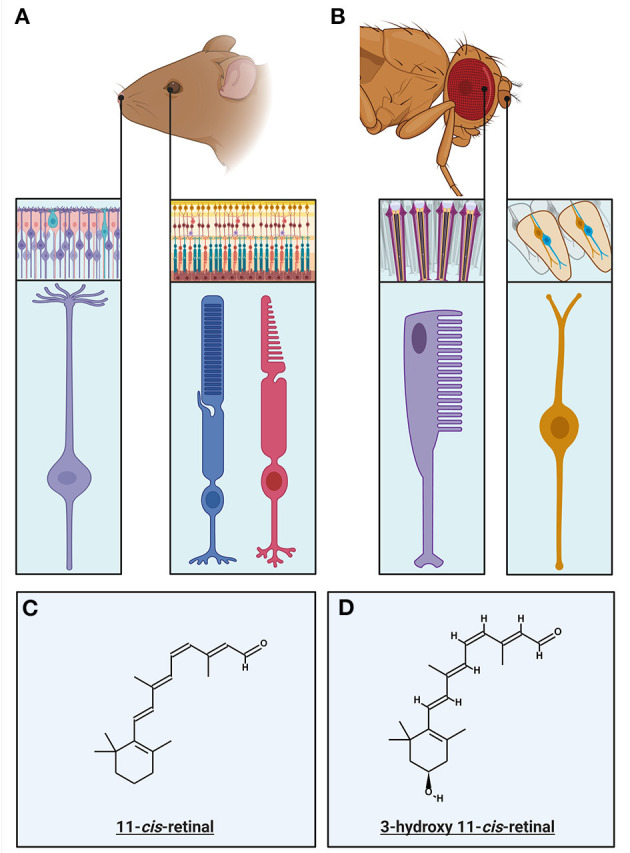
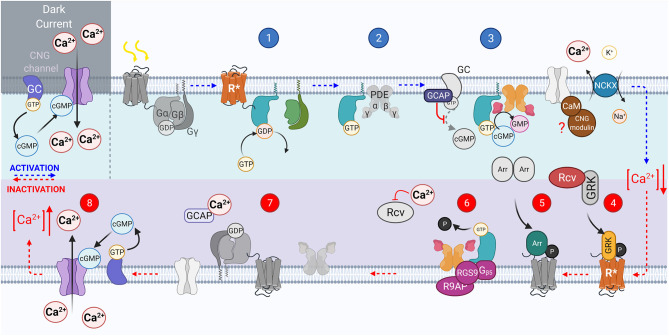
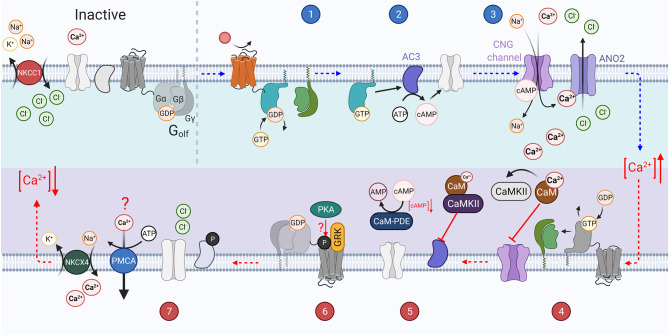
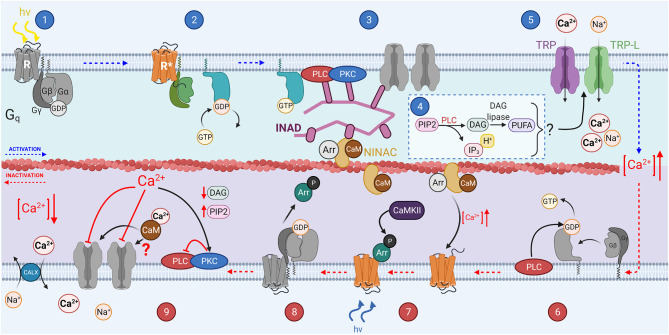
Sensing changes in the environment is crucial for survival. Animals from invertebrates to vertebrates use both visual and olfactory stimuli to direct survival behaviors including identification of food sources, finding mates, and predator avoidance. In primary sensory neurons there are signal transduction mechanisms that convert chemical or light signals into an electrical response through ligand binding or photoactivation of a receptor, that can be propagated to the olfactory and visual centers of the brain to create a perception of the odor and visual landscapes surrounding us. The fundamental principles of olfactory and phototransduction pathways within vertebrates are somewhat analogous. Signal transduction in both systems takes place in the ciliary sub-compartments of the sensory cells and relies upon the activation of G protein-coupled receptors (GPCRs) to close cyclic nucleotide-gated (CNG) cation channels in photoreceptors to produce a hyperpolarization of the cell, or in olfactory sensory neurons open CNG channels to produce a depolarization. However, while invertebrate phototransduction also involves GPCRs, invertebrate photoreceptors can be either ciliary and/or microvillar with hyperpolarizing and depolarizing responses to light, respectively. Moreover, olfactory transduction in invertebrates may be a mixture of metabotropic G protein and ionotropic signaling pathways. This review will highlight differences of the visual and olfactory transduction mechanisms between vertebrates and invertebrates, focusing on the implications to the gain of the transduction processes, and how they are modulated to allow detection of small changes in odor concentration and light intensity over a wide range of background stimulus levels.
感知环境变化对生存至关重要。从无脊椎动物到脊椎动物,动物都利用视觉和嗅觉刺激来指导生存行为,包括识别食物来源、寻找配偶和躲避捕食者。在初级感觉神经元中,存在信号转导机制,该机制通过配体结合或受体的光激活将化学或光信号转化为电反应,这种电反应可以传播到大脑的嗅觉和视觉中枢,从而产生对我们周围气味和视觉景观的感知。脊椎动物体内嗅觉和光转导途径的基本原理有些相似。这两个系统中的信号转导都发生在感觉细胞的纤毛亚区室中,并且依赖于G蛋白偶联受体(GPCRs)的激活,在光感受器中关闭环核苷酸门控(CNG)阳离子通道以产生细胞超极化,或者在嗅觉感觉神经元中打开CNG通道以产生去极化。然而,虽然无脊椎动物的光转导也涉及GPCRs,但无脊椎动物的光感受器可以是纤毛型和/或微绒毛型,分别对光有超极化和去极化反应。此外,无脊椎动物的嗅觉转导可能是代谢型G蛋白和离子型信号通路的混合。本综述将重点介绍脊椎动物和无脊椎动物之间视觉和嗅觉转导机制的差异,重点关注对转导过程增益的影响,以及它们如何被调节以在广泛的背景刺激水平范围内检测气味浓度和光强度的微小变化。