Pifferi Fabien, Laurent Benoit, Plourde Mélanie
UMR CNRS MNHN 7179 MECADEV, Brunoy, France.
Département de Biochimie et de Génomique Fonctionnelle, Université de Sherbrooke, Sherbrooke, QC, Canada.
Front Physiol. 2021 Mar 30;12:645646. doi: 10.3389/fphys.2021.645646. eCollection 2021.
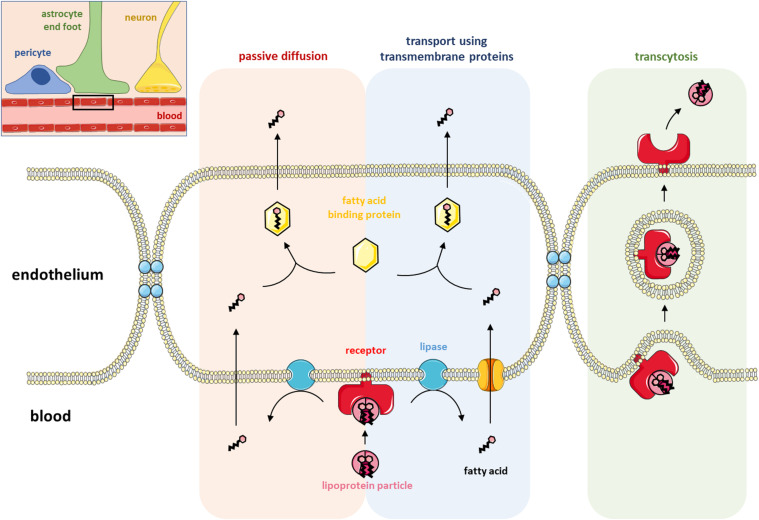
Many prospective studies have shown that a diet enriched in omega-3 polyunsaturated fatty acids (n-3 PUFAs) can improve cognitive function during normal aging and prevent the development of neurocognitive diseases. However, researchers have not elucidated how n-3 PUFAs are transferred from the blood to the brain or how they relate to cognitive scores. Transport into and out of the central nervous system depends on two main sets of barriers: the blood-brain barrier (BBB) between peripheral blood and brain tissue and the blood-cerebrospinal fluid (CSF) barrier (BCSFB) between the blood and the CSF. In this review, the current knowledge of how lipids cross these barriers to reach the CNS is presented and discussed. Implications of these processes in health and disease, particularly during aging and neurodegenerative diseases, are also addressed. An assessment provided here is that the current knowledge of how lipids cross these barriers in humans is limited, which hence potentially restrains our capacity to intervene in and prevent neurodegenerative diseases.
许多前瞻性研究表明,富含ω-3多不饱和脂肪酸(n-3 PUFAs)的饮食可以改善正常衰老过程中的认知功能,并预防神经认知疾病的发生。然而,研究人员尚未阐明n-3 PUFAs是如何从血液转移到大脑的,以及它们与认知评分之间的关系。进出中枢神经系统取决于两组主要的屏障:外周血与脑组织之间的血脑屏障(BBB)以及血液与脑脊液(CSF)之间的血脑脊液屏障(BCSFB)。在这篇综述中,我们介绍并讨论了目前关于脂质如何穿过这些屏障到达中枢神经系统的知识。还探讨了这些过程在健康和疾病中的意义,特别是在衰老和神经退行性疾病期间。这里提供的一项评估是,目前关于脂质如何在人类中穿过这些屏障的知识是有限的,这因此可能限制我们干预和预防神经退行性疾病的能力。