Ahn Sung Soo, Han Minkyung, Yoo Juyoung, Park Yong-Beom, Jung Inkyung, Lee Sang-Won
Department of Internal Medicine, Yongin Severance Hospital, Yonsei University College of Medicine, Yongin, South Korea.
Biostatistics Collaboration Unit, Department of Biomedical Systems Informatics, Yonsei University College of Medicine, Seoul, South Korea.
Front Immunol. 2021 Mar 31;12:629902. doi: 10.3389/fimmu.2021.629902. eCollection 2021.
Evidences indicate that the risk of stroke is increased in autoimmune rheumatic diseases. This study aimed to investigate the incidence of stroke in patients with systemic necrotizing vasculitis (SNV) using the national health database.
Data were obtained from the Korean National Claims database between 2010 and 2018 to identify incident SNV [anti-neutrophil cytoplasmic antibody-associated vasculitis (AAV) and polyarteritis nodosa (PAN)] cases. The standardized incidence ratio (SIR) and incidence rate ratio (IRR) were calculated to estimate the risk of stroke in patients with SNV compared to the general population and among disease subgroups. Time-dependent Cox's regression analysis was performed to identify risk factors for stroke.
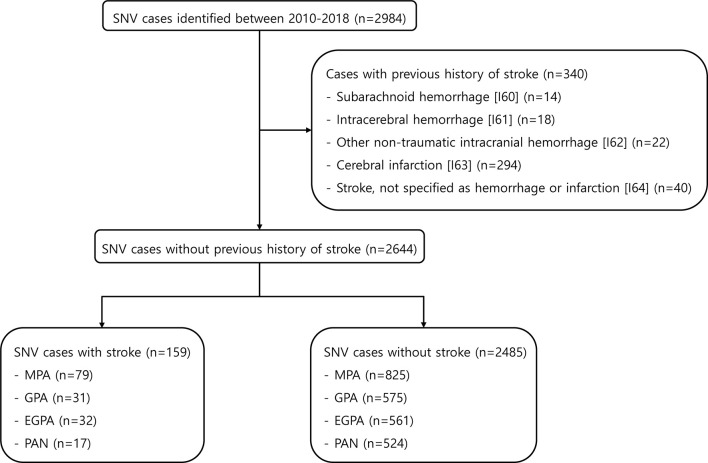
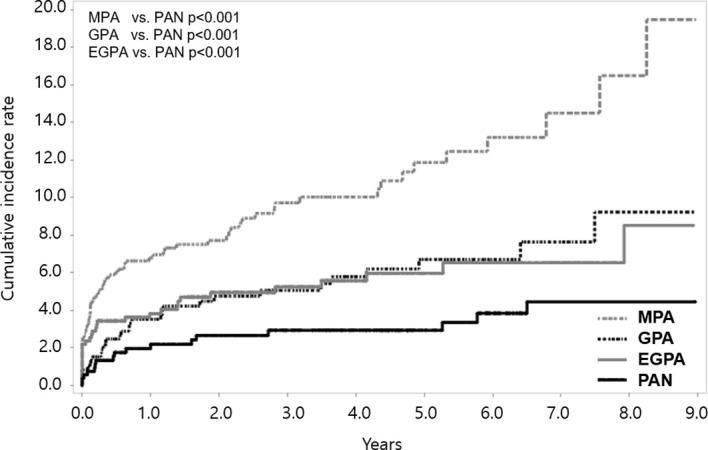
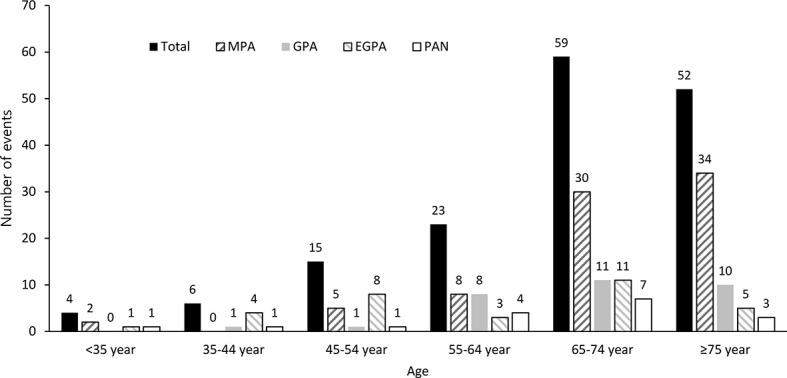
Among 2644 incident SNV cases, 159 patients (6.0%) were affected by stroke. The overall risk of stroke was significantly higher in patients with SNV compared to the general population (SIR 8.42). Stroke event rates were the highest within the first year of SNV diagnosis (67.3%). Among disease subgroups, patients with microscopic polyangiitis (MPA) exhibited higher IRR compared to PAN (adjusted IRR 1.98). In Cox's hazard analysis, older age and MPA were associated with higher risk of stroke [hazard ratio (HR) 1.05 and 1.88], whereas the administration of cyclophosphamide, azathioprine/mizoribine, methotrexate, and statins were protective in stroke (HR 0.26, 0.34, 0.49, and 0.50, respectively).
A considerable number of SNV patients experienced stroke, especially in the early phase of disease. Older age and MPA diagnosis were associated with elevated risk of stroke, while the administration of immunosuppressive agents and statins was beneficial in preventing stroke.
有证据表明自身免疫性风湿性疾病患者中风风险增加。本研究旨在利用国家健康数据库调查系统性坏死性血管炎(SNV)患者的中风发病率。
从2010年至2018年的韩国国家索赔数据库中获取数据,以确定新发SNV[抗中性粒细胞胞浆抗体相关性血管炎(AAV)和结节性多动脉炎(PAN)]病例。计算标准化发病率比(SIR)和发病率比(IRR),以估计SNV患者与普通人群相比以及在疾病亚组中的中风风险。进行时间依赖性Cox回归分析以确定中风的危险因素。
在2644例新发SNV病例中,159例患者(6.0%)发生中风。与普通人群相比,SNV患者的总体中风风险显著更高(SIR 8.42)。中风事件发生率在SNV诊断的第一年内最高(67.3%)。在疾病亚组中,显微镜下多血管炎(MPA)患者的IRR高于PAN患者(调整后的IRR 1.98)。在Cox风险分析中,年龄较大和MPA与中风风险较高相关[风险比(HR)分别为1.05和1.88],而环磷酰胺、硫唑嘌呤/米唑嘌呤、甲氨蝶呤和他汀类药物的使用对中风具有保护作用(HR分别为0.26、0.34、0.49和0.50)。
相当数量的SNV患者发生中风,尤其是在疾病早期。年龄较大和MPA诊断与中风风险升高相关,而使用免疫抑制剂和他汀类药物有利于预防中风。