Neurology Department, Wexham Park Hospital, Frimley Health Foundation Trust, Slough, UK.
Department of Clinical Neurosciences, Oxford University Hospitals, Oxford, UK.
J Neurol. 2024 Jun;271(6):3309-3320. doi: 10.1007/s00415-024-12251-1. Epub 2024 Mar 12.
The cerebral vessels may be affected in primary systemic vasculitis (PSV), but little is known about cerebrovascular events (CVEs) in this population. This study aimed to determine the frequency of CVEs at the time of diagnosis of PSV, to identify factors associated with CVEs in PSV, and to explore features and outcomes of stroke in patients with PSV.
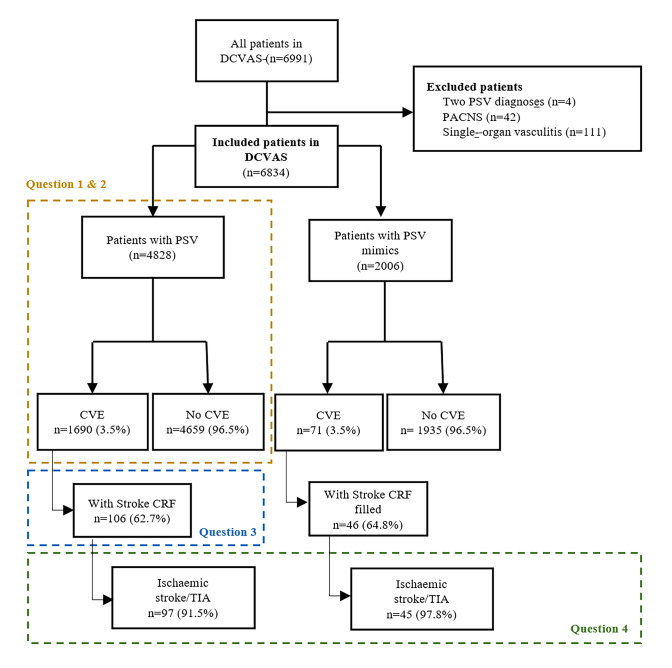
Data from adults newly diagnosed with PSV within the Diagnostic and Classification Criteria in VASculitis (DCVAS) study were analysed. Demographics, risk factors for vascular disease, and clinical features were compared between patients with PSV with and without CVE. Stroke subtypes and cumulative incidence of recurrent CVE during a prospective 6-month follow-up were also assessed.
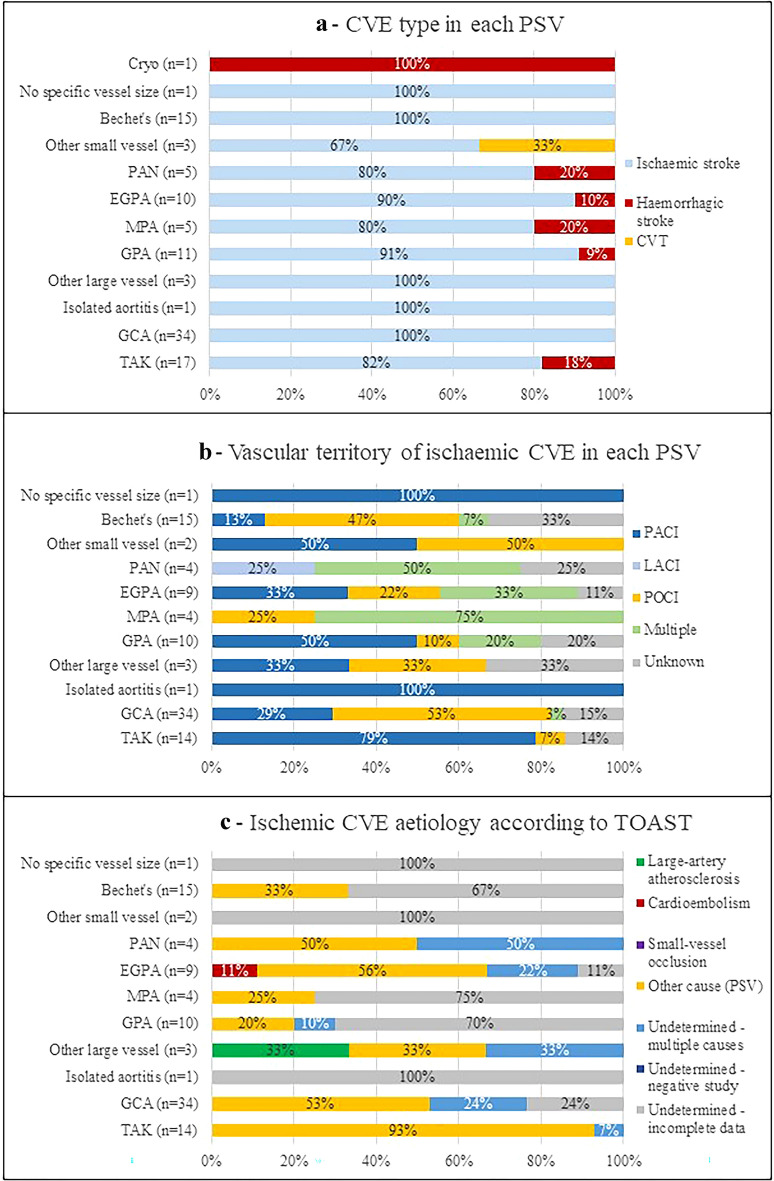
The analysis included 4828 PSV patients, and a CVE was reported in 169 (3.50%, 95% CI 3.00-4.06): 102 (2.13% 95% CI 1.73-2.56) with stroke and 81 (1.68% 95% CI 1.33-2.08) with transient ischemic attack (TIA). The frequency of CVE was highest in Behçet's disease (9.5%, 95% CI 5.79-14.37), polyarteritis nodosa (6.2%, 95% CI 3.25-10.61), and Takayasu's arteritis (6.0%, 95% CI 4.30-8.19), and lowest in microscopic polyangiitis (2.2%, 95% CI 1.09-3.86), granulomatosis with polyangiitis (2.0%, 95% CI 1.20-3.01), cryoglobulinaemic vasculitis (1.9%, 95% CI 0.05-9.89), and IgA-vasculitis (Henoch-Schönlein) (0.4%, 95% CI 0.01-2.05). PSV patients had a 11.9% cumulative incidence of recurrent CVE during a 6-month follow-up period.
CVEs affect a significant proportion of patients at time of PSV diagnosis, and the frequency varies widely among different vasculitis, being higher in Behçet's. Overall, CVE in PSV is not explained by traditional vascular risk factors and has a high risk of CVE recurrence.
原发性系统性血管炎(PSV)可能会影响脑血管,但人们对该人群中的脑血管事件(CVE)知之甚少。本研究旨在确定 PSV 诊断时 CVE 的频率,确定与 PSV 相关的 CVE 相关因素,并探讨 PSV 患者中风的特征和结局。
对符合诊断和分类标准在血管炎(DCVAS)研究中的新诊断为 PSV 的成年人的数据进行了分析。比较了 PSV 伴或不伴 CVE 患者的人口统计学、血管疾病危险因素和临床特征。还评估了中风亚型和前瞻性 6 个月随访期间 CVE 的复发累积发生率。
该分析包括 4828 例 PSV 患者,报告了 169 例(3.50%,95%CI3.00-4.06)CVE:102 例(2.13%,95%CI1.73-2.56)为中风,81 例(1.68%,95%CI1.33-2.08)为短暂性脑缺血发作(TIA)。CVE 的频率在贝切特病(9.5%,95%CI5.79-14.37)、结节性多动脉炎(6.2%,95%CI3.25-10.61)和大动脉炎(6.0%,95%CI4.30-8.19)中最高,在显微镜下多血管炎(2.2%,95%CI1.09-3.86)、肉芽肿性多血管炎(2.0%,95%CI1.20-3.01)、冷球蛋白血症性血管炎(1.9%,95%CI0.05-9.89)和 IgA 血管炎(Henoch-Schönlein)(0.4%,95%CI0.01-2.05)中最低。PSV 患者在 6 个月的随访期间,CVE 的累积复发率为 11.9%。
CVE 在 PSV 诊断时影响了很大一部分患者,不同血管炎之间的发生率差异很大,在贝切特病中更高。总体而言,PSV 中的 CVE 不能用传统的血管危险因素来解释,并且有很高的 CVE 复发风险。