Lohberger Birgit, Glaenzer Dietmar, Eck Nicole, Steinecker-Frohnwieser Bibiane, Leithner Andreas, Rinner Beate, Kerschbaum-Gruber Sylvia, Georg Dietmar
Department of Orthopedics and Trauma, Medical University of Graz, A-8036 Graz, Austria.
Department for Rehabilitation, Ludwig Boltzmann Institute for Arthritis and Rehabilitation, A-5760 Saalfelden, Austria.
Oncol Lett. 2021 Jun;21(6):428. doi: 10.3892/ol.2021.12689. Epub 2021 Mar 30.
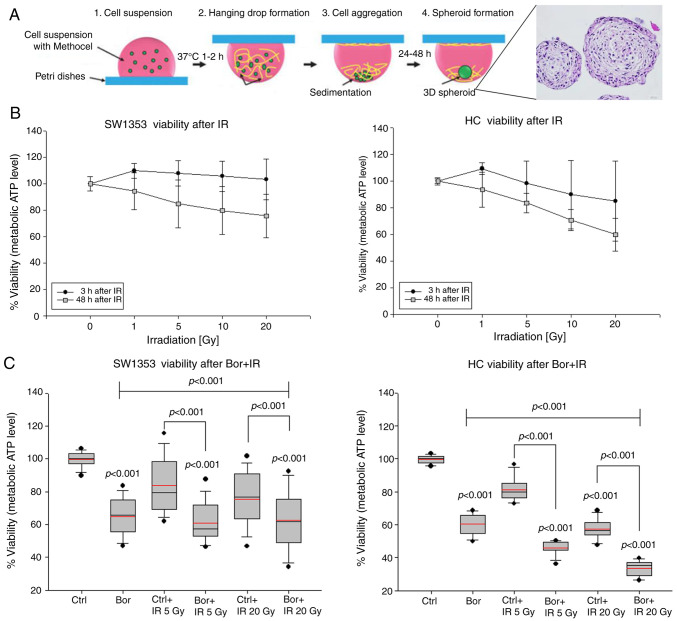
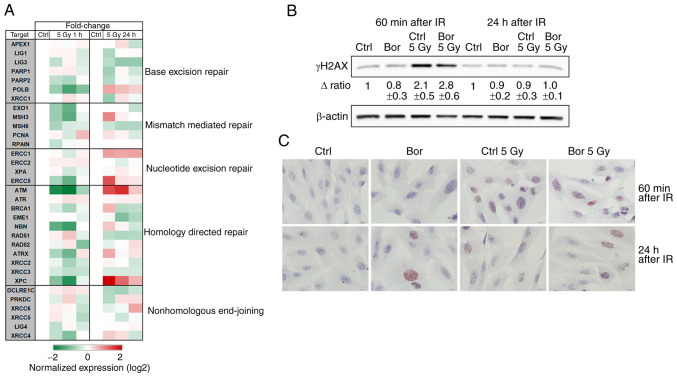
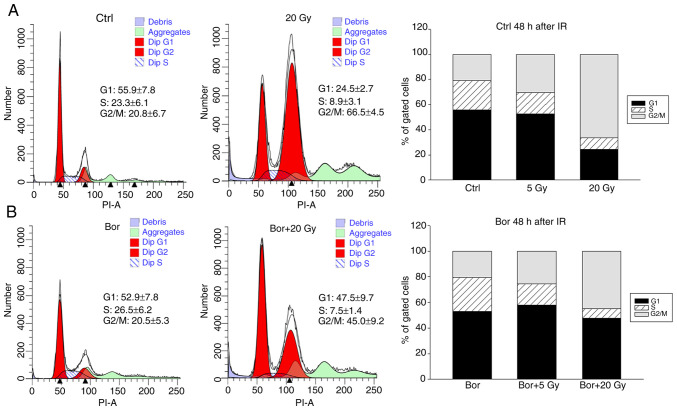
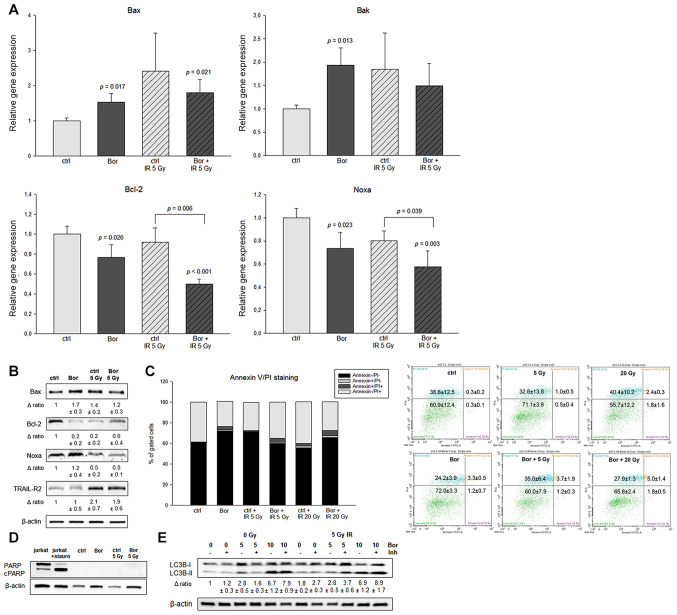
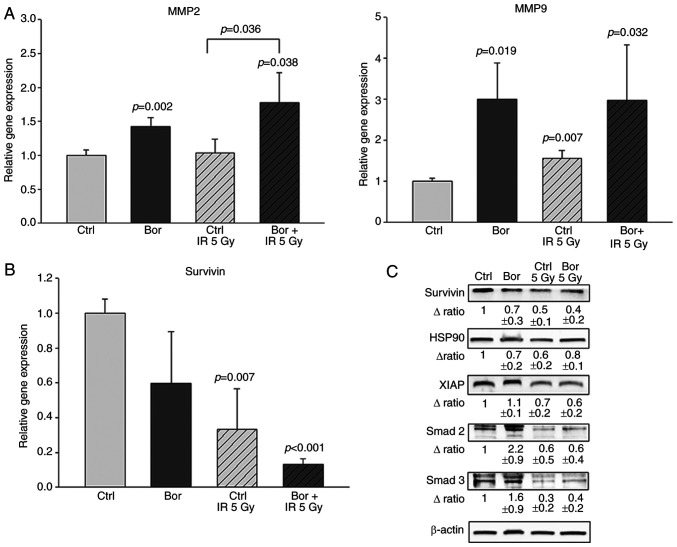
Chondrosarcomas represent a heterogeneous group of primary bone cancers that are characterized by hyaline cartilaginous neoplastic tissue and are predominantly resistant to radiation and chemotherapy. However, adjuvant radiotherapy is often recommended in inoperable cases or after incomplete resections. To improve the efficiency of treatment, the present study tested a combination therapy with ionizing radiation (IR) and the proteasome inhibitor bortezomib. Using a three-dimensional (3D) spheroid model, 0-20 Gy of IR was applied to chondrosarcoma cells and healthy human chondrocytes. Following combined treatment with IR and bortezomib, the cell cycle distribution, apoptotic induction, the survivin pathway, autophagy and DNA damage were evaluated. Both cell types exhibited a slight decrease in viability following increasing doses of IR; the chondrosarcoma cells demonstrated a significant dose-dependent increase in the expression levels of the DNA damage marker histone H2AX phosphorylation at serine 139 (γH2AX). The combination treatment with bortezomib significantly decreased the cell viability after 48 h compared with that in irradiated cells. High-dose IR induced a G/M phase arrest, which was accompanied by a decrease in the number of cells at the G and S phase. Co-treatment with bortezomib changed the distribution of the cell cycle phases. The mRNA expression levels of the proapoptotic genes Bcl-2-associated X protein (Bax) and Bak were significantly increased by bortezomib treatment and combination therapy with IR. In addition, the combination therapy resulted in a synergistic decrease of the expression levels of survivin and its corresponding downstream pathway molecules, including heat shock protein 90, X-linked inhibitor of apoptosis protein, smad 2 and smad 3. Comparative analyses of γH2AX at 1 and 24 h post-IR revealed efficient DNA repair in human chondrosarcoma cells. Therefore, additional bortezomib treatment may only temporarily improve the radiation sensitivity of chondrosarcoma cells. However, the inhibition of the survivin pathway by the combined treatment with IR and bortezomib, observed in the present study, revealed a novel aspect in the tumor biology of chondrosarcoma 3D spheroid cultures and may represent a potential target for therapy.
软骨肉瘤是一组异质性的原发性骨癌,其特征为透明软骨肿瘤组织,且主要对放疗和化疗耐药。然而,对于无法手术的病例或不完全切除术后,通常建议进行辅助放疗。为提高治疗效果,本研究测试了电离辐射(IR)与蛋白酶体抑制剂硼替佐米的联合疗法。使用三维(3D)球体模型,对软骨肉瘤细胞和健康人软骨细胞施加0 - 20 Gy的IR。在IR与硼替佐米联合治疗后,评估细胞周期分布、凋亡诱导、生存素途径、自噬和DNA损伤。随着IR剂量增加,两种细胞类型的活力均略有下降;软骨肉瘤细胞中DNA损伤标志物组蛋白H2AX在丝氨酸139处的磷酸化(γH2AX)表达水平呈现显著的剂量依赖性增加。与单纯照射细胞相比,硼替佐米联合治疗在48小时后显著降低了细胞活力。高剂量IR诱导G/M期阻滞,同时G期和S期细胞数量减少。硼替佐米联合治疗改变了细胞周期阶段的分布。硼替佐米治疗以及与IR联合治疗显著增加了促凋亡基因Bcl-2相关X蛋白(Bax)和Bak的mRNA表达水平。此外,联合治疗导致生存素及其相应下游途径分子(包括热休克蛋白90、X连锁凋亡抑制蛋白、smad 2和smad 3)的表达水平协同下降。对IR后1小时和24小时的γH2AX进行比较分析,发现人软骨肉瘤细胞中存在有效的DNA修复。因此,额外的硼替佐米治疗可能仅能暂时提高软骨肉瘤细胞的放射敏感性。然而,本研究中观察到的IR与硼替佐米联合治疗对生存素途径的抑制,揭示了软骨肉瘤3D球体培养肿瘤生物学的一个新方面,可能代表一种潜在的治疗靶点。