Fokin Artem I, Gautreau Alexis M
Laboratoire de Biologie Structurale de la Cellule, CNRS, Ecole Polytechnique, IP Paris, Palaiseau, France.
School of Biological and Medical Physics, Moscow Institute of Physics and Technology, Dolgoprudny, Russia.
Front Cell Dev Biol. 2021 Apr 1;9:658865. doi: 10.3389/fcell.2021.658865. eCollection 2021.
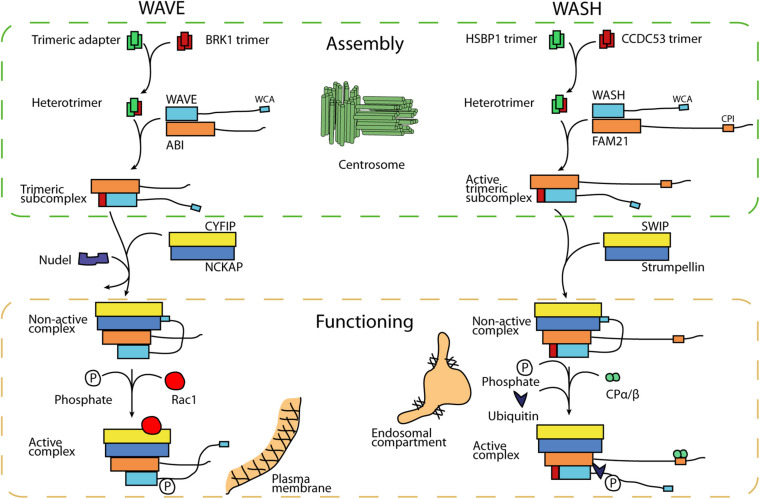
The Arp2/3 complex generates branched actin networks at different locations of the cell. The WASH and WAVE Nucleation Promoting Factors (NPFs) activate the Arp2/3 complex at the surface of endosomes or at the cell cortex, respectively. In this review, we will discuss how these two NPFs are controlled within distinct, yet related, multiprotein complexes. These complexes are not spontaneously assembled around WASH and WAVE, but require cellular assembly factors. The centrosome, which nucleates microtubules and branched actin, appears to be a privileged site for WASH complex assembly. The actin and microtubule cytoskeletons are both responsible for endosome shape and membrane remodeling. Motors, such as dynein, pull endosomes and extend membrane tubules along microtubule tracks, whereas branched actin pushes onto the endosomal membrane. It was recently uncovered that WASH assembles a super complex with dynactin, the major dynein activator, where the Capping Protein (CP) is exchanged from dynactin to the WASH complex. This CP swap initiates the first actin filament that primes the autocatalytic nucleation of branched actin at the surface of endosomes. Possible coordination between pushing and pulling forces in the remodeling of endosomal membranes is discussed.
Arp2/3复合物在细胞的不同位置生成分支状肌动蛋白网络。WASH和WAVE成核促进因子(NPFs)分别在内体表面或细胞皮层激活Arp2/3复合物。在本综述中,我们将讨论这两种NPFs如何在不同但相关的多蛋白复合物中受到调控。这些复合物并非围绕WASH和WAVE自发组装,而是需要细胞组装因子。中心体,即微管和成核分支状肌动蛋白的起始点,似乎是WASH复合物组装的特殊位点。肌动蛋白和微管细胞骨架都负责内体的形状和膜重塑。诸如动力蛋白等马达蛋白沿着微管轨道拉动内体并延伸膜小管,而分支状肌动蛋白则向内体膜施加推力。最近发现,WASH与动力蛋白激活因子主要成分动力蛋白激活蛋白组装成一个超级复合物,其中封端蛋白(CP)从动力蛋白激活蛋白交换到WASH复合物。这种CP交换启动了第一条肌动蛋白丝,引发了内体表面分支状肌动蛋白的自催化成核。本文还讨论了内体膜重塑过程中推力和拉力之间可能的协调作用。