Yaron Jordan R, Zhang Liqiang, Guo Qiuyun, Haydel Shelley E, Lucas Alexandra R
Center for Personalized Diagnostics and Center for Immunotherapy, Vaccines and Virotherapy, The Biodesign Institute, Arizona State University, Tempe, AZ, United States.
School for Engineering of Matter, Transport and Energy, Ira A. Fulton Schools of Engineering, Arizona State University, Tempe, AZ, United States.
Front Cardiovasc Med. 2021 Mar 25;8:648947. doi: 10.3389/fcvm.2021.648947. eCollection 2021.
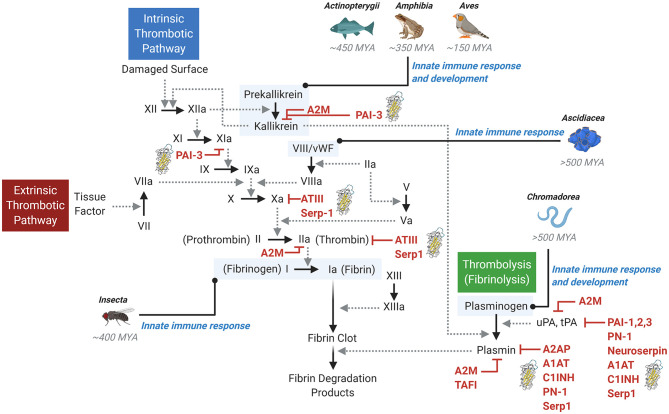
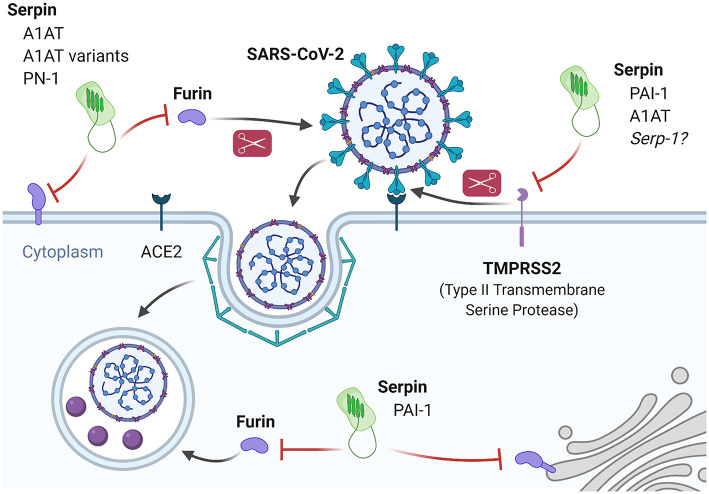
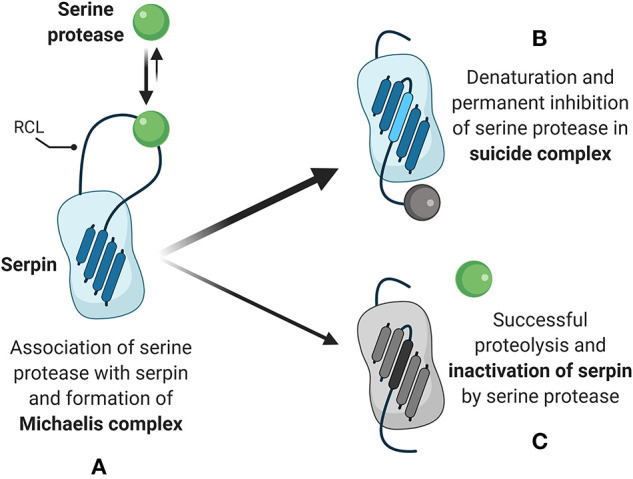
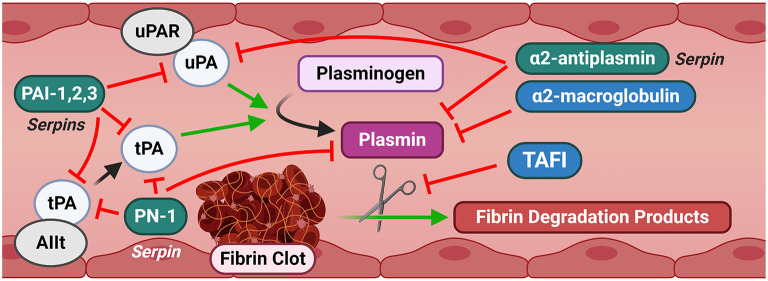
The making and breaking of clots orchestrated by the thrombotic and thrombolytic serine protease cascades are critical determinants of morbidity and mortality during infection and with vascular or tissue injury. Both the clot forming (thrombotic) and the clot dissolving (thrombolytic or fibrinolytic) cascades are composed of a highly sensitive and complex relationship of sequentially activated serine proteases and their regulatory inhibitors in the circulating blood. The proteases and inhibitors interact continuously throughout all branches of the cardiovascular system in the human body, representing one of the most abundant groups of proteins in the blood. There is an intricate interaction of the coagulation cascades with endothelial cell surface receptors lining the vascular tree, circulating immune cells, platelets and connective tissue encasing the arterial layers. Beyond their role in control of bleeding and clotting, the thrombotic and thrombolytic cascades initiate immune cell responses, representing a front line, "off-the-shelf" system for inducing inflammatory responses. These hemostatic pathways are one of the first response systems after injury with the fibrinolytic cascade being one of the earliest to evolve in primordial immune responses. An equally important contributor and parallel ancient component of these thrombotic and thrombolytic serine protease cascades are the ine rotease hibitors, termed . Serpins are metastable suicide inhibitors with ubiquitous roles in coagulation and fibrinolysis as well as multiple central regulatory pathways throughout the body. Serpins are now known to also modulate the immune response, either via control of thrombotic and thrombolytic cascades or via direct effects on cellular phenotypes, among many other functions. Here we review the co-evolution of the thrombolytic cascade and the immune response in disease and in treatment. We will focus on the relevance of these recent advances in the context of the ongoing COVID-19 pandemic. SARS-CoV-2 is a "respiratory" coronavirus that causes extensive cardiovascular pathogenesis, with microthrombi throughout the vascular tree, resulting in severe and potentially fatal coagulopathies.
由血栓形成和溶栓丝氨酸蛋白酶级联所精心编排的血凝块形成与溶解过程,是感染期间以及发生血管或组织损伤时发病率和死亡率的关键决定因素。形成血凝块的(血栓形成)级联和溶解血凝块的(溶栓或纤维蛋白溶解)级联,均由循环血液中依次激活的丝氨酸蛋白酶及其调节性抑制剂之间高度敏感且复杂的关系所构成。蛋白酶和抑制剂在人体心血管系统的所有分支中持续相互作用,是血液中最丰富的蛋白质组之一。凝血级联与血管树内衬的内皮细胞表面受体、循环免疫细胞、血小板以及包裹动脉层的结缔组织之间存在复杂的相互作用。除了在控制出血和凝血方面的作用外,血栓形成和溶栓级联还引发免疫细胞反应,代表了一种用于诱导炎症反应的一线“现成”系统。这些止血途径是损伤后的首批反应系统之一,而纤维蛋白溶解级联是原始免疫反应中最早进化的反应系统之一。这些血栓形成和溶栓丝氨酸蛋白酶级联的一个同样重要的贡献者和并行的古老组成部分是丝氨酸蛋白酶抑制剂,称为丝氨酸蛋白酶抑制剂。丝氨酸蛋白酶抑制剂是亚稳态自杀性抑制剂,在凝血、纤维蛋白溶解以及全身多个核心调节途径中具有普遍作用。现在已知丝氨酸蛋白酶抑制剂还可通过控制血栓形成和溶栓级联或通过对细胞表型的直接影响等多种其他功能来调节免疫反应。在此,我们回顾疾病和治疗中溶栓级联与免疫反应的共同进化。我们将重点关注在当前新冠疫情背景下这些最新进展的相关性。严重急性呼吸综合征冠状病毒2(SARS-CoV-2)是一种“呼吸道”冠状病毒,可导致广泛的心血管发病机制,在整个血管树中形成微血栓,从而导致严重且可能致命的凝血病。