Department of Microbiology, National Taiwan University College of Medicine, Taipei 100, Taiwan.
Department of Clinical Laboratory Sciences and Medical Biotechnology, National Taiwan University College of Medicine, Taipei 100, Taiwan.
Cell Rep. 2020 Oct 13;33(2):108254. doi: 10.1016/j.celrep.2020.108254. Epub 2020 Sep 23.
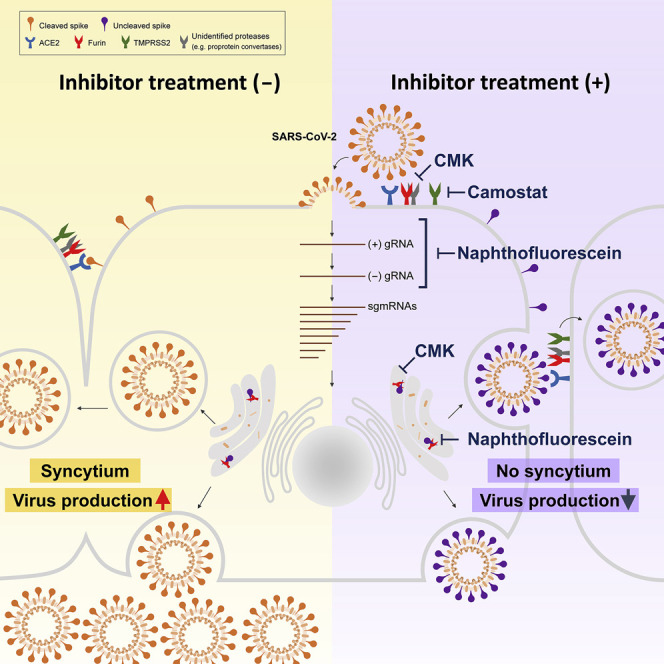
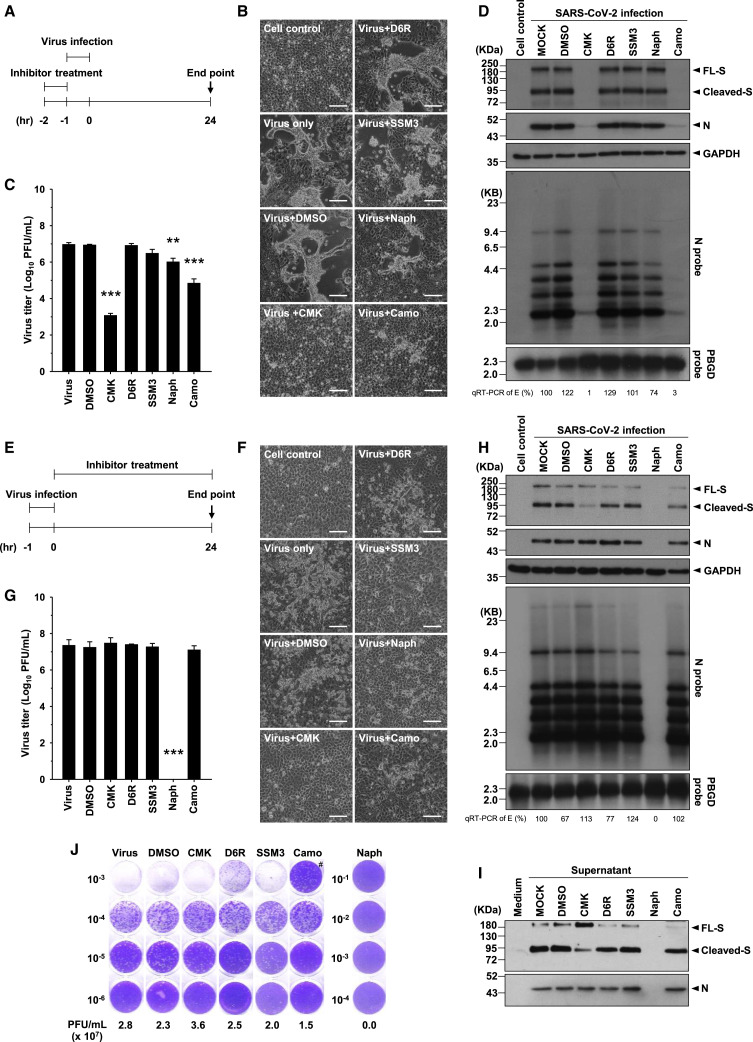
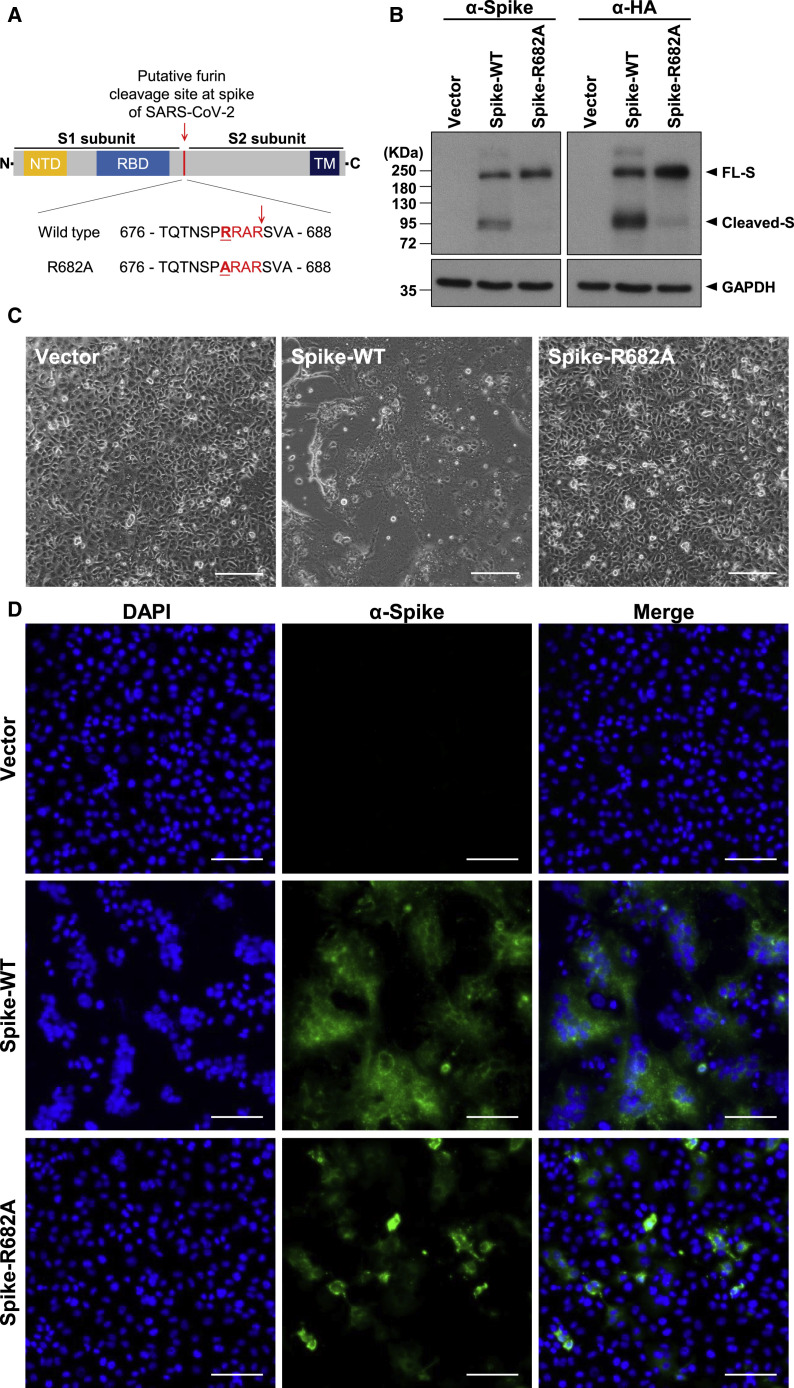
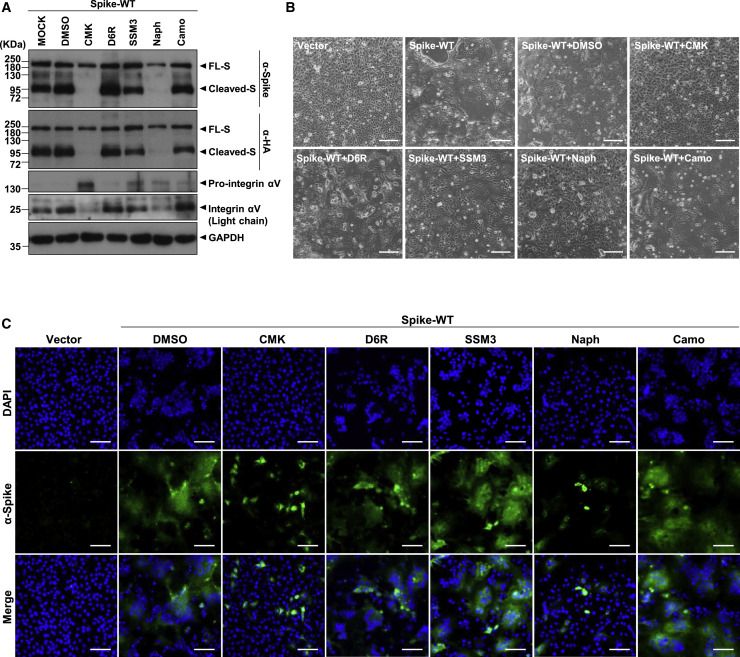
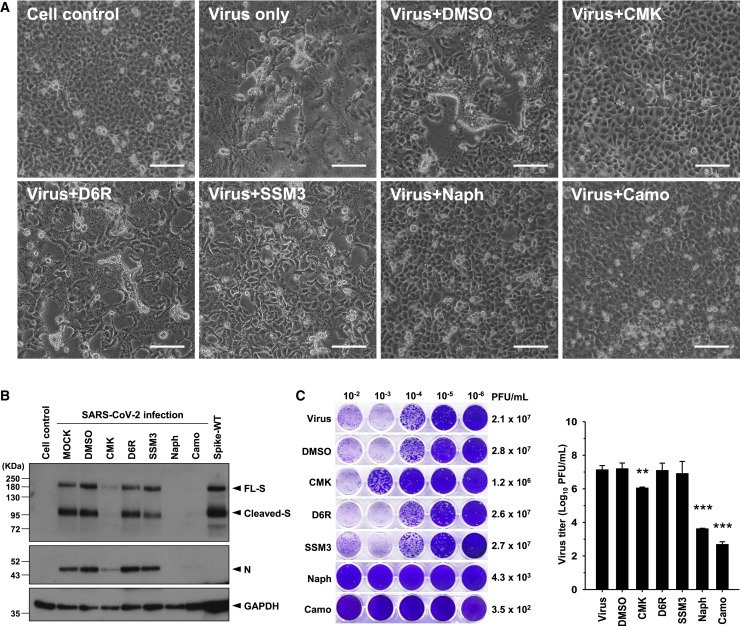
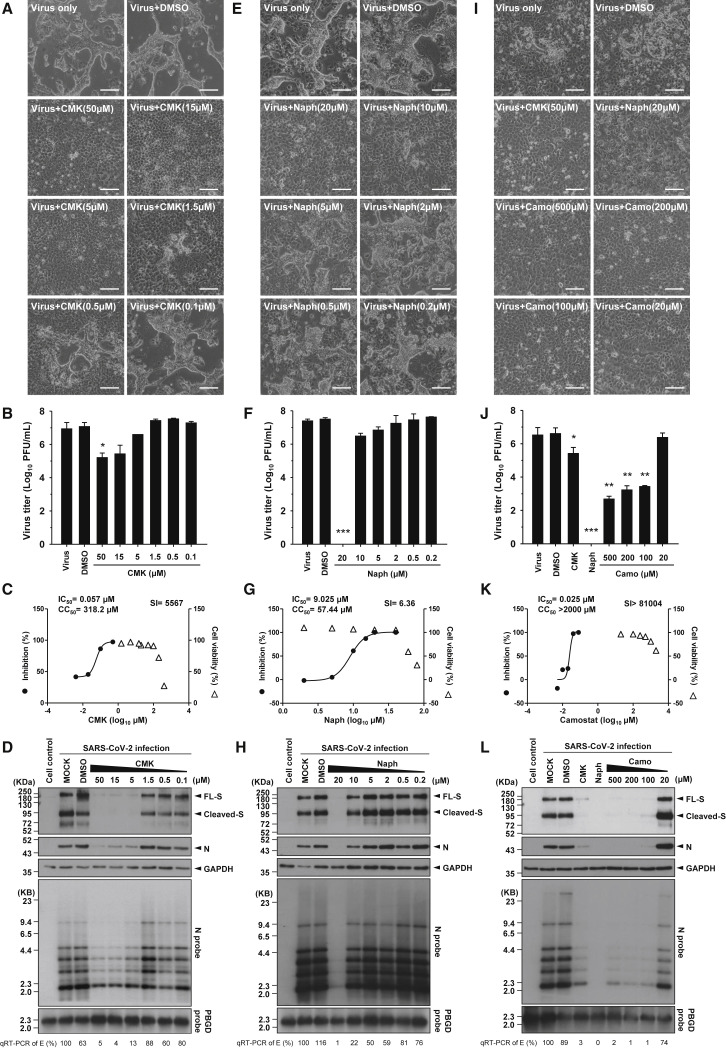
Development of specific antiviral agents is an urgent unmet need for SARS-coronavirus 2 (SARS-CoV-2) infection. This study focuses on host proteases that proteolytically activate the SARS-CoV-2 spike protein, critical for its fusion after binding to angiotensin-converting enzyme 2 (ACE2), as antiviral targets. We first validate cleavage at a putative furin substrate motif at SARS-CoV-2 spikes by expressing it in VeroE6 cells and find prominent syncytium formation. Cleavage and the syncytium are abolished by treatment with the furin inhibitors decanoyl-RVKR-chloromethylketone (CMK) and naphthofluorescein, but not by the transmembrane protease serine 2 (TMPRSS2) inhibitor camostat. CMK and naphthofluorescein show antiviral effects on SARS-CoV-2-infected cells by decreasing virus production and cytopathic effects. Further analysis reveals that, similar to camostat, CMK blocks virus entry, but it further suppresses cleavage of spikes and the syncytium. Naphthofluorescein acts primarily by suppressing viral RNA transcription. Therefore, furin inhibitors may be promising antiviral agents for prevention and treatment of SARS-CoV-2 infection.
开发针对严重急性呼吸综合征冠状病毒 2(SARS-CoV-2)感染的特效抗病毒药物是当务之急。本研究聚焦于宿主蛋白酶,这些蛋白酶能使 SARS-CoV-2 刺突蛋白发生蛋白水解激活,该蛋白在与血管紧张素转化酶 2(ACE2)结合后发生融合,是抗病毒治疗的关键靶点。我们首先通过在 VeroE6 细胞中表达 SARS-CoV-2 刺突蛋白,证实了其在假定的弗林蛋白酶底物基序处发生切割,随后观察到明显的合胞体形成。用弗林蛋白酶抑制剂癸酰基-RVKR-氯甲基酮(CMK)和萘荧光素处理可消除切割和合胞体形成,但用跨膜丝氨酸蛋白酶 2(TMPRSS2)抑制剂卡莫司他处理则无此效果。CMK 和萘荧光素可通过降低病毒产量和细胞病变效应,对 SARS-CoV-2 感染细胞发挥抗病毒作用。进一步分析表明,与卡莫司他类似,CMK 可阻断病毒进入,但它还可进一步抑制刺突蛋白的切割和合胞体形成。萘荧光素主要通过抑制病毒 RNA 转录发挥作用。因此,弗林蛋白酶抑制剂可能是预防和治疗 SARS-CoV-2 感染的有前景的抗病毒药物。