Rzewuska Magdalena, Duncan Eilidh M, Francis Jill J, Morris Andrew M, Suh Kathryn N, Davey Peter G, Grimshaw Jeremy M, Ramsay Craig R
Health Services Research Unit, University of Aberdeen, Aberdeen, United Kingdom.
School of Health Sciences, City University of London, London, United Kingdom.
Front Sociol. 2020 Jul 8;5:41. doi: 10.3389/fsoc.2020.00041. eCollection 2020.
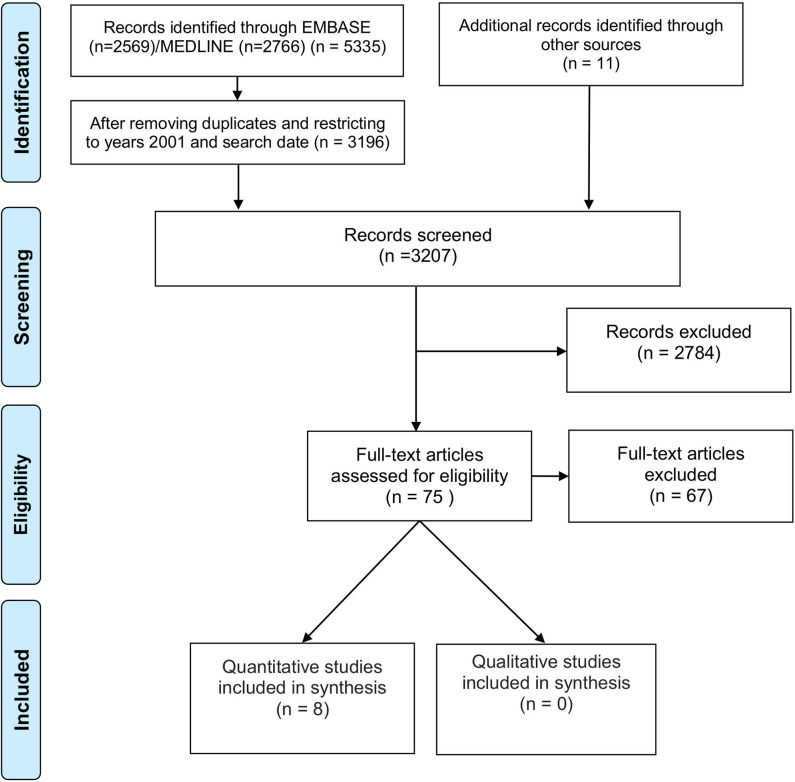
To identify perceived influences on implementation of antibiotic stewardship programmes (ASPs) in hospitals, across healthcare systems, and to exemplify the use of a behavioral framework to conceptualize those influences. EMBASE and MEDLINE databases were searched from 01/2001 to 07/2017 and reference lists were screened for transnational studies that reported barriers and/or facilitators to implementing actual or hypothetical ASPs or ASP-supporting strategies. Extracted data were synthesized using content analysis with the Theoretical Domains Framework as an organizing framework. Commonly reported influences were quantified. From 3,196 abstracts 75 full-text articles were screened for inclusion. Eight studies met the eligibility criteria. The number of countries involved in each study ranged from 2 to 36. These studies included a total of 1849 participants. North America, Europe and Australasia had the strongest representation. Participants were members of special interest groups, designated hospital representatives or clinical experts. Ten of the 14 theoretical domains in the framework were present in the results reported in the included studies. The most commonly reported (≥4 out of 8 studies) influences on ASP implementation were coded in the domain "environmental context and resources" (e.g., problems with data and information systems; lack of key personnel; inadequate financial resources) and "goals" (other higher priorities). Despite an extensive transnational research effort, there is evidence from international studies of substantial barriers to implementing ASPs in hospitals, even in developed countries. Large-scale efforts to implement hospital antibiotic stewardship in those countries will need to overcome issues around inadequacy of information systems, unavailability of key personnel and funding, and the competition from other priority initiatives. We have enhanced the evidence base to inform guidance by taking a behavioral approach to identify influences on ASP uptake. : PROSPERO registration number CRD42017076425.
为了确定医院及整个医疗系统中对抗生素管理计划(ASP)实施的认知影响,并举例说明如何使用行为框架来概念化这些影响。检索了EMBASE和MEDLINE数据库(检索时间为2001年1月至2017年7月),并筛选参考文献列表以查找跨国研究,这些研究报告了实施实际或假设的ASP或ASP支持策略的障碍和/或促进因素。使用内容分析法,以理论领域框架作为组织框架,对提取的数据进行综合分析。对常见的报告影响进行量化。从3196篇摘要中筛选出75篇全文文章以供纳入研究。八项研究符合纳入标准。每项研究涉及的国家数量从2个到36个不等。这些研究总共包括1849名参与者。北美、欧洲和澳大拉西亚的代表性最强。参与者为特殊利益集团成员、指定的医院代表或临床专家。纳入研究报告的结果中出现了框架内14个理论领域中的10个。对ASP实施最常报告的影响(8项研究中有≥4项提及)被归类在“环境背景和资源”领域(例如,数据和信息系统问题;关键人员短缺;财政资源不足)和“目标”领域(其他更高优先级事项)。尽管进行了广泛的跨国研究,但国际研究表明,即使在发达国家,医院实施ASP也存在重大障碍。在这些国家大规模实施医院抗生素管理需要克服信息系统不足、关键人员和资金缺乏以及来自其他优先举措的竞争等问题。我们采用行为方法来识别对ASP采用的影响,从而增强了证据基础,为指南提供参考。:PROSPERO注册号CRD42017076425