Scheepers Lodewyk Nicolaas, Niesing Christina Maria, Bester Petra
The Africa Unit for Transdisciplinary Health Research (AUTHeR), Faculty of Health Sciences, North-West University, Potchefstroom, North West Province, South Africa.
Antimicrob Steward Healthc Epidemiol. 2023 Feb 23;3(1):e34. doi: 10.1017/ash.2022.355. eCollection 2023.
The South African National Department of Health released guidelines and recommendations for antimicrobial stewardship (AMS) programs to be established in public healthcare facilities. Their implementation remains challenged, especially in North West Province, where the public health system functions under severe strain. This research explored and interpreted the facilitators that strengthen and barriers that hinder the implementation of the national AMS program in public hospitals in North West Province.
A qualitative design and interpretive descriptive approach enabled insight into the realities of AMS program implementation.
Public hospitals in North West Province, sampled through criterion sampling (n = 5).
Purposive criterion sampling of healthcare practitioners (n = 30) actively participating in AMS programs in the 5 sampled public hospitals.
Qualitative, interpretive description with semi-structured individual interviews that were digitally recorded and transcribed. The ATLAS.ti version 8 software facilitated content analysis, followed by second-level analysis.
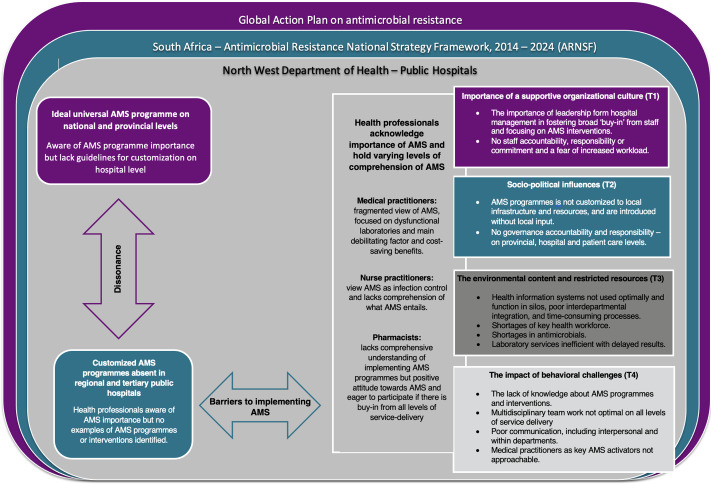
In total, 4 themes, 13 categories, and 25 subcategories emerged. We detected dissonance between government AMS ideals and the realities of AMS program implementation in public hospitals. A multilevel AMS leadership and governance vacuum exists in a dysfunctional health ecosystem in which AMS must operate. Healthcare practitioners agreed on the importance of AMS despite different understandings of AMS and ineffective multidisciplinary teams. Discipline-specific education and training are essential for all AMS participants.
AMS is essential yet complex, and its contextualization and implementation are underestimated in public hospitals. Recommendations are focused on a supportive organizational culture, contextualized AMS program implementation plans, and changes in management.
南非国家卫生部发布了关于在公共医疗机构建立抗菌药物管理(AMS)项目的指南和建议。其实施仍面临挑战,特别是在西北省,该省的公共卫生系统在重压下运作。本研究探讨并解读了加强西北省公立医院国家AMS项目实施的促进因素和阻碍实施的障碍。
定性设计和解释性描述方法有助于深入了解AMS项目实施的实际情况。
通过标准抽样(n = 5)选取西北省的公立医院。
从5家抽样公立医院中积极参与AMS项目的医疗从业者中进行目的抽样(n = 30)。
采用定性的解释性描述,通过半结构化的个人访谈进行,访谈进行数字录音和转录。ATLAS.ti 8软件辅助进行内容分析,随后进行二级分析。
共出现4个主题、13个类别和25个子类别。我们发现政府AMS理念与公立医院AMS项目实施的实际情况之间存在不一致。在AMS必须运作的功能失调的卫生生态系统中,存在多层次的AMS领导和治理真空。尽管对AMS的理解不同且多学科团队效率低下,但医疗从业者一致认同AMS的重要性。针对所有AMS参与者的特定学科教育和培训至关重要。
AMS至关重要但也很复杂,其在公立医院的情境化和实施被低估。建议集中在支持性的组织文化、情境化的AMS项目实施计划以及管理变革方面。