Schreib Andreas W, Arzt Michael, Heid Iris M, Jung Bettina, Böger Carsten A, Stadler Stefan
Department of Internal Medicine II, University Medical Center Regensburg, Franz-Josef-Strauss-Allee 11, 93053, Regensburg, Germany.
Department of Genetic Epidemiology, University Regensburg, Franz-Josef-Strauss-Allee 11, 93053, Regensburg, Germany.
Sleep Med X. 2020 May 7;2:100013. doi: 10.1016/j.sleepx.2020.100013. eCollection 2020 Dec.
Due to its prognostic importance for patients with type 2 diabetes (DM2), current guidelines recommend a systolic <130 mm Hg and diastolic <80 mm Hg blood pressure target. Periodic breathing, a form of sleep-disordered breathing, acutely causes repetitive hypoxia, sympathetic nervous system activation as well as oscillations of heart rate and blood pressure. However, limited data on the association of periodic breathing and control of blood pressure (BP) in patients with DM2 are available. Thus, the aim of the present study was to assess whether there is an association between periodic breathing and increased BP above the recommended target in DM2.
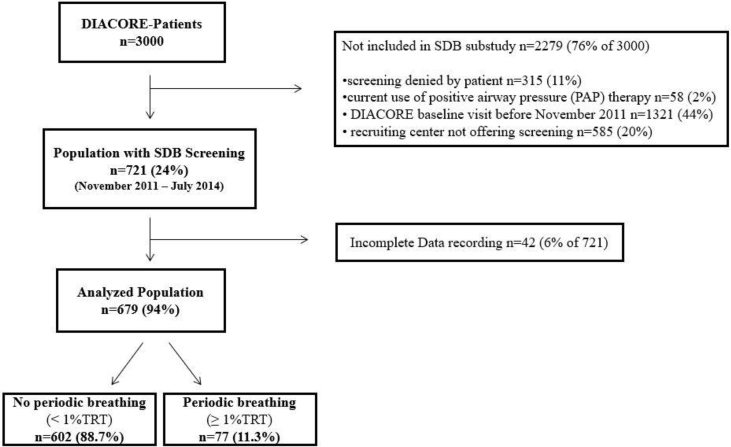
Cross-sectional data of 679 patients with DM2 from the DIACORE-SDB sub-study were analysed for association of periodic breathing with BP. Sleep-disordered breathing was assessed with a 2-channel ambulatory monitoring device including validated automatic pattern recognition for periodic breathing. BP values were determined in a standardized manner with three repeated measurements at rest.
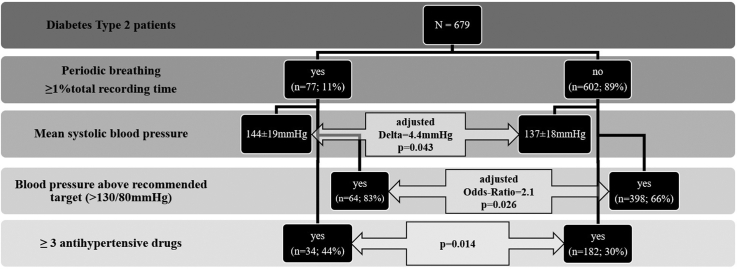
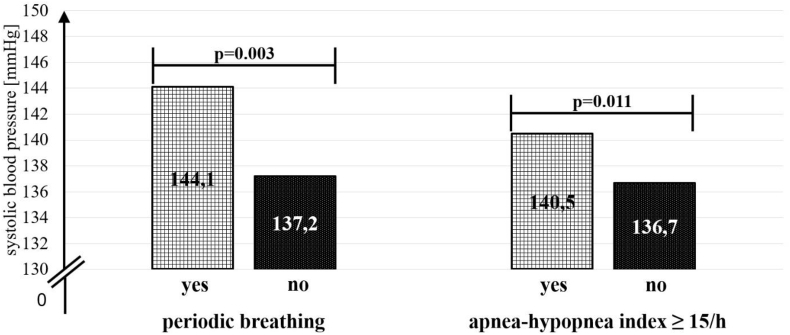
Of the 679 analysed individuals (61% male, age 66 ± 9 years, Body Mass Index [BMI] 31.0 ± 5.4 kg/m), 11% had periodic breathing. Patients with periodic breathing had significantly higher systolic BP values (144 ± 19 mm Hg vs. 137 ± 18 mm Hg, p = 0.003). Multivariable regression analysis revealed that periodic breathing was associated with higher systolic BP (B [95% confidence interval, CI] = 4.4 [0.1; 8.7], p = 0.043) and not meeting the recommended BP target for patients with diabetes (<130/80 mmHg) (odds ratio, OR [95%CI] = 2.1 [1.1; 4.0], p = 0.026) independent of sex, age, high density lipoproteins, renal function, coronary heart disease and antihypertensive treatment.
Periodic breathing is associated with higher systolic BP in patients with DM2.
鉴于其对2型糖尿病(DM2)患者预后的重要性,当前指南推荐收缩压<130 mmHg且舒张压<80 mmHg的血压目标。周期性呼吸是睡眠呼吸障碍的一种形式,可急性导致反复缺氧、交感神经系统激活以及心率和血压波动。然而,关于DM2患者中周期性呼吸与血压控制之间关联的数据有限。因此,本研究的目的是评估DM2患者中周期性呼吸与高于推荐目标的血压升高之间是否存在关联。
对DIACORE-SDB子研究中679例DM2患者的横断面数据进行分析,以探讨周期性呼吸与血压的关联。使用双通道动态监测设备评估睡眠呼吸障碍,该设备包括经过验证的周期性呼吸自动模式识别。以标准化方式在静息状态下重复测量三次来确定血压值。
在679例分析对象中(61%为男性,年龄66±9岁,体重指数[BMI]为31.0±5.4 kg/m²),11%有周期性呼吸。有周期性呼吸的患者收缩压值显著更高(144±19 mmHg对137±18 mmHg,p = 0.003)。多变量回归分析显示,周期性呼吸与较高的收缩压相关(B[95%置信区间,CI]=4.4[0.1;8.7],p = 0.043),并且与未达到糖尿病患者推荐的血压目标(<130/80 mmHg)相关(优势比,OR[95%CI]=2.1[1.1;4.0],p = 0.026),与性别、年龄、高密度脂蛋白、肾功能、冠心病和抗高血压治疗无关。
DM2患者的周期性呼吸与较高的收缩压相关。