Garcia-Vidal Carolina, Cózar-Llistó Alberto, Meira Fernanda, Dueñas Gerard, Puerta-Alcalde Pedro, Cilloniz Catia, Garcia-Pouton Nicole, Chumbita Mariana, Cardozo Celia, Hernández Marta, Rico Verónica, Bodro Marta, Morata Laura, Castro Pedro, Almuedo-Riera Alex, García Felipe, Mensa Josep, Antonio Martínez José, Sanjuan Gemma, Torres Antoni, Nicolás J M, Soriano Alex
Department of Infectious Diseases, Hospital Clinic of Barcelona-IDIBAPS, University of Barcelona, C/ Villarroel 170, 08036 Barcelona, Spain.
Department of Pneumology, Hospital Clinic of Barcelona, Spain.
Lancet Reg Health Eur. 2021 Apr;3:100041. doi: 10.1016/j.lanepe.2021.100041. Epub 2021 Jan 24.
We aimed to describe changes in characteristics and treatment strategies of hospitalised patients with COVID-19 and detail the mortality trend over time.
Observational cohort study of all consecutive patients admitted ≥ 48 h to Hospital Clinic of Barcelona for COVID-19 (1 March-30 September 2020).
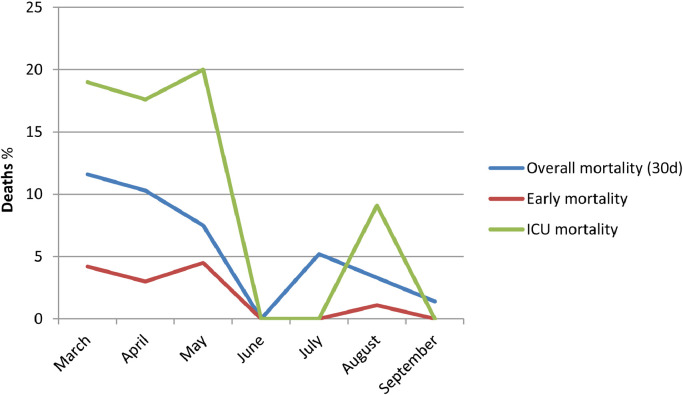
A total of 1645 consecutive patients with COVID-19 were assessed over a 7-month period. Overall mortality (≤30 days) was 9.7% (159 patients), 7.7% in patients hospitalised in regular wards and 16.7 % in patients requiring ICU admission. Overall mortality decreased from 11.6% in the first month to 1.4% in the last month, reflecting a progressive, significant downward trend ( for trend <0.001). Patients' age changed over time, peaking in June. Most changes in the use of antivirals and anti-inflammatory treatments were documented. Age (OR 1.1, CI 1.1-1.12), chronic heart disease, (OR 1.7, CI 1.1-2.9), D-dimer>700 ng/mL (OR 2.3, CI 1.3-4.1), ferritin>489 ng/mL (OR 1.9; CI 1.5-3.2), C-RP>7 mg/dL (OR 2.6; CI 1.5-4.6), and shorter duration from symptom onset to hospital admission (OR 1.11; CI 1.04-1.17) were factors associated with 30-day mortality at hospital admission. Conversely, hospital admission in the last months (OR 0.80; CI 0.65-0.98) was significantly associated with lower mortality.
In-hospital mortality has decreased in patients with COVID-19 over the last, few months, even though main patient characteristics remain similar. Several changes made when managing patients may explain this decreasing trend. Our study provides current data on mortality of patients hospitalised with COVID-19 that might be useful in establishing quality of standard of care.
EIT Health, European Union´s Horizon 2020 Research and Innovation Programme), EDRD. PPA [CM18/00132], NGP [FI19/00133], and CGV [FIS PI18/01061], have received grants from Ministerio de Sanidad y Consumo, ISCIII.
我们旨在描述新型冠状病毒肺炎(COVID-19)住院患者的特征和治疗策略变化,并详细说明随时间推移的死亡率趋势。
对2020年3月1日至9月30日期间连续入住巴塞罗那医院诊所≥48小时的所有COVID-19患者进行观察性队列研究。
在7个月的时间里,共评估了1645例连续的COVID-19患者。总体死亡率(≤30天)为9.7%(159例患者),普通病房住院患者为7.7%,需要入住重症监护病房(ICU)的患者为16.7%。总体死亡率从第一个月的11.6%降至最后一个月的1.4%,呈现出逐渐显著下降的趋势(趋势P<0.001)。患者年龄随时间变化,6月达到峰值。记录了抗病毒和抗炎治疗使用方面的大多数变化。年龄(比值比[OR]1.1,可信区间[CI]1.1 - 1.12)、慢性心脏病(OR 1.7,CI 1.1 - 2.9)、D - 二聚体>700 ng/mL(OR 2.3,CI 1.3 - 4.1)、铁蛋白>489 ng/mL(OR 1.9;CI 1.5 - 3.2)、C反应蛋白(C - RP)>7 mg/dL(OR 2.6;CI 1.5 - 4.6)以及症状出现到入院的时间较短(OR 1.11;CI 1.04 - 1.17)是入院时30天死亡率的相关因素。相反,最后几个月入院(OR 0.80;CI 0.65 - 0.98)与较低死亡率显著相关。
在过去几个月里,COVID-19患者的院内死亡率有所下降,尽管主要患者特征保持相似。在管理患者时所做的一些改变可能解释了这种下降趋势。我们的研究提供了COVID-19住院患者死亡率的当前数据,这可能有助于确立护理标准的质量。
欧洲创新与技术研究院健康(EIT Health)、欧盟“地平线2020”研究与创新计划、欧洲罕见病研究与发展中心(EDRD)。PPA[CM18/00132]、NGP[FI19/00133]和CGV[FIS PI18/01061]已获得西班牙卫生与消费部、卡洛斯三世健康研究所(ISCIII)的资助。