The Cell and Molecular Biology Graduate Group, Perelman School of Medicine, University of Pennsylvania, Philadelphia, Pennsylvania.
Department of Pediatrics, Perelman School of Medicine, University of Pennsylvania, Children's Hospital of Philadelphia, Philadelphia, Pennsylvania.
Am J Physiol Endocrinol Metab. 2021 Jun 1;320(6):E1148-E1157. doi: 10.1152/ajpendo.00600.2020. Epub 2021 Apr 19.
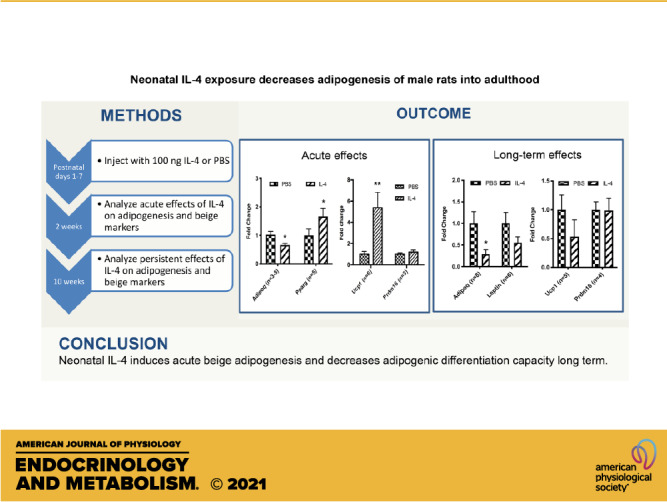
The cytokine interleukin 4 (IL-4) can increase beige adipogenesis in adult rodents. However, neonatal animals use a distinct adipocyte precursor compartment for adipogenesis as compared with adults. In this study, we address whether IL-4 can induce persistent effects on adipose tissue when administered subcutaneously in the interscapular region during the neonatal period in Sprague-Dawley rats. We injected IL-4 into neonatal male rats during -, followed by analysis of adipose tissue and adipocyte precursors at 2 wk and 10 wk of age. Adipocyte precursors were cultured and subjected to differentiation in vitro. We found that a short and transient IL-4 exposure in neonates upregulated uncoupling protein 1 () mRNA expression and decreased fat cell size in subcutaneous white adipose tissue (WAT). Adipocyte precursors from mature rats that had been treated with IL-4 as neonates displayed a decrease in adiponectin () but no change in expression, as compared with controls. Thus, neonatal IL-4 induces acute beige adipogenesis and decreases adipogenic differentiation capacity long term. Overall, these findings indicate that the neonatal period is critical for adipocyte development and may influence the later onset of obesity. We used neonatal injections in rat to show that IL-4 decreases adipogenesis and increases browning of white fat. In adulthood, adipocyte precursors show persistently decreased adipogenesis but not increased browning. These studies in the neonate are the first, to our knowledge, to show that IL-4 can have long-lasting effects.
细胞因子白细胞介素 4(IL-4)可以增加成年啮齿动物的米色脂肪生成。然而,与成年人相比,新生动物使用独特的脂肪细胞前体细胞隔间进行脂肪生成。在这项研究中,我们研究了当在新生期的肩胛间区域皮下给予 IL-4 时,它是否会在 Sprague-Dawley 大鼠中对脂肪组织产生持久影响。我们在新生雄性大鼠中注射了 IL-4 ,随后在 2 周和 10 周龄时分析了脂肪组织和脂肪细胞前体。将脂肪细胞前体培养并在体外进行分化。我们发现,新生期短暂的 IL-4 暴露可上调解偶联蛋白 1()mRNA 的表达,并减少皮下白色脂肪组织(WAT)中的脂肪细胞大小。与对照组相比,曾作为新生儿接受 IL-4 处理的成熟大鼠的脂肪细胞前体显示出脂联素()减少,但 表达没有变化。因此,新生期的 IL-4 诱导急性米色脂肪生成并长期降低脂肪生成分化能力。总的来说,这些发现表明新生儿期对于脂肪细胞发育至关重要,并且可能影响肥胖的后期发生。我们使用新生大鼠注射来表明 IL-4 可减少脂肪生成并增加白色脂肪的褐色化。在成年期,脂肪细胞前体表现出持续降低的脂肪生成能力,但没有增加的褐色化。据我们所知,这些在新生儿中的研究首次表明 IL-4 可以产生持久的影响。