Department of Infectious Diseases, Public Health Service of Amsterdam (GGD Amsterdam), Amsterdam, The Netherlands.
Department of Infectious Diseases, Public Health Service of Amsterdam (GGD Amsterdam), Amsterdam, The Netherlands
Sex Transm Infect. 2022 May;98(3):188-196. doi: 10.1136/sextrans-2020-054875. Epub 2021 Apr 19.
Global data show that transgender people (TGP) are disproportionally affected by HIV and sexually transmitted infections (STIs); however, data are scarce for Western European countries. We assessed gender identities, sexual behaviour, HIV prevalence and STI positivity rates, and compared these outcomes between TGP who reported sex work and those who did not.
We retrospectively retrieved data from all TGP who were tested at the STI clinics of Amsterdam and The Hague, the Netherlands in 2017-2018. To identify one's gender identity, a 'two-step' methodology was used assessing, first, the assigned gender at birth (assigned male at birth (AMAB)) or assigned female at birth), and second, clients were asked to select one gender identity that currently applies: (1) transgender man/transgender woman, (2) man and woman, (3) neither man nor woman, (4) other and (5) not known yet. HIV prevalence, bacterial STI (chlamydia, gonorrhoea and/or infectious syphilis) positivity rates and sexual behaviour were studied using descriptive statistics.
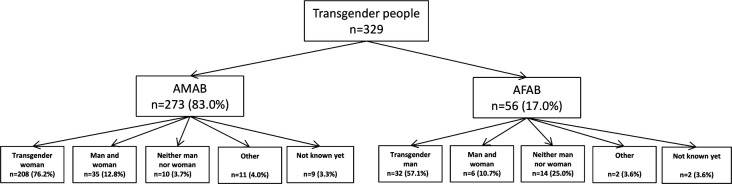
TGP reported all five categories of gender identities. In total 273 transgender people assigned male at birth (TGP-AMAB) (83.0%) and 56 transgender people assigned female at birth (TGP-AFAB) (17.0%) attended the STI clinics. Of TGP-AMAB, 14,6% (39/267, 95% CI 10.6% to 19.4%) were HIV-positive, including two new diagnoses and bacterial STI positivity was 15.0% (40/267, 95% CI 10.9% to 19.8%). Among TGP-AFAB, bacterial STI positivity was 5.6% (3/54, 95% CI 1.2% to 15.4%) and none were HIV-positive. Sex work in the past 6 months was reported by 53.3% (137/257, 95% CI 47.0% to 59.5%) of TGP-AMAB and 6.1% (3/49, 95% CI 1.3% to 16.9%) of TGP-AFAB. HIV prevalence did not differ between sex workers and non-sex workers.
Of all TGP, the majority were TGP-AMAB of whom more than half engaged in sex work. HIV prevalence and STI positivity rates were substantial among TGP-AMAB and much lower among TGP-AFAB. Studies should be performed to provide insight into whether the larger population of TGP-AMAB and TGP-AFAB are at risk of HIV and STI.
全球数据显示,跨性别者(TGP)受到艾滋病毒和性传播感染(STI)的不成比例影响;然而,西欧国家的数据很少。我们评估了性别认同、性行为、艾滋病毒流行率和性传播感染阳性率,并比较了报告性工作和未报告性工作的 TGP 之间的这些结果。
我们回顾性地从 2017-2018 年在荷兰阿姆斯特丹和海牙的性传播感染诊所接受检测的所有 TGP 中检索数据。为了确定一个人的性别认同,我们使用了一种“两步”方法,首先评估出生时的分配性别(出生时分配为男性(AMAB)或出生时分配为女性),然后要求客户选择目前适用的一种性别认同:(1)跨性别男性/跨性别女性,(2)男性和女性,(3)既不是男性也不是女性,(4)其他,(5)尚未确定。使用描述性统计数据研究了艾滋病毒流行率、细菌性 STI(衣原体、淋病和/或传染性梅毒)阳性率和性行为。
TGP 报告了所有五个类别的性别认同。共有 273 名出生时被分配为男性的跨性别者(TGP-AMAB)(83.0%)和 56 名出生时被分配为女性的跨性别者(TGP-AFAB)(17.0%)参加了性传播感染诊所。在 TGP-AMAB 中,14.6%(39/267,95%CI 10.6%至 19.4%)艾滋病毒呈阳性,包括两例新诊断病例,细菌性 STI 阳性率为 15.0%(40/267,95%CI 10.9%至 19.8%)。在 TGP-AFAB 中,细菌性 STI 阳性率为 5.6%(3/54,95%CI 1.2%至 15.4%),且无人艾滋病毒呈阳性。在过去 6 个月内报告有性工作的 TGP-AMAB 占 53.3%(137/257,95%CI 47.0%至 59.5%),TGP-AFAB 占 6.1%(3/49,95%CI 1.3%至 16.9%)。性工作者和非性工作者之间的艾滋病毒流行率没有差异。
在所有 TGP 中,大多数是 TGP-AMAB,其中超过一半从事性工作。TGP-AMAB 中的艾滋病毒流行率和性传播感染阳性率很高,而 TGP-AFAB 中的艾滋病毒流行率和性传播感染阳性率则低得多。应开展研究,以了解更大的 TGP-AMAB 和 TGP-AFAB 人群是否面临艾滋病毒和性传播感染的风险。