Du Lili, Feng Ling, Bi Shilei, Zhang Lizi, Tang Jingman, Zhong Liuying, Zhou Xingnan, Tan Hu, Huang Lijun, Lin Lin, Zeng Shanshan, Ren Luwen, Cao Yinli, Jia Jinping, Zhao Xianlan, Wang Shaoshuai, Xu Xiaoyan, Zhao Yangyu, Wang Zhijian, Zhu Qiying, Qi Hongbo, Zhang Lanzhen, Wen Suiwen, Li Hongtian, Chen Jingsi, Chen Dunjin
Department of Obstetrics and Gynecology, Key Laboratory for Major Obstetric Diseases of Guangdong Province,The Third Affiliated Hospital of Guangzhou Medical University, 63 Duobao Road, Guangzhou, 510150, Guangdong, China.
Key Laboratory for Reproduction and Genetics of Guangdong Higher Education Institutes, Guangzhou, China.
Sci Rep. 2021 Apr 19;11(1):8434. doi: 10.1038/s41598-021-87830-7.
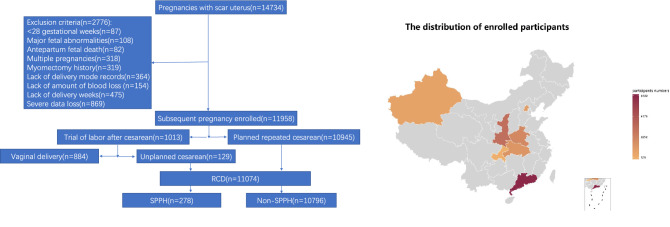
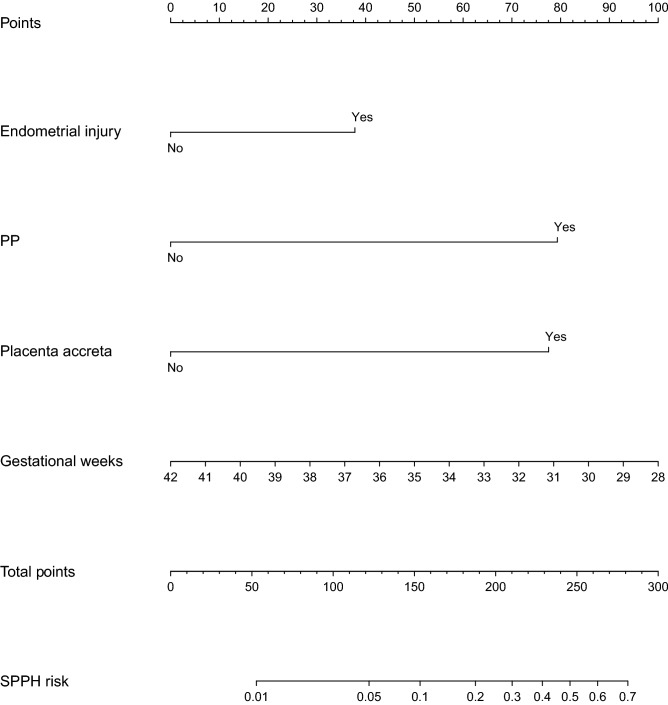
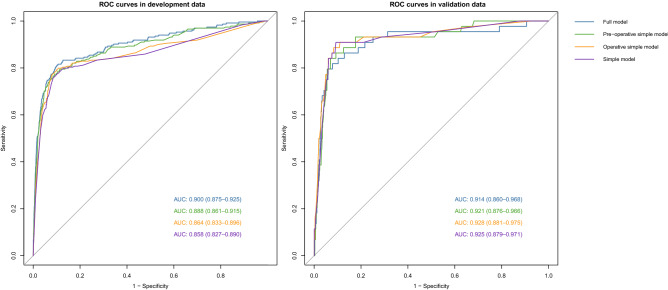
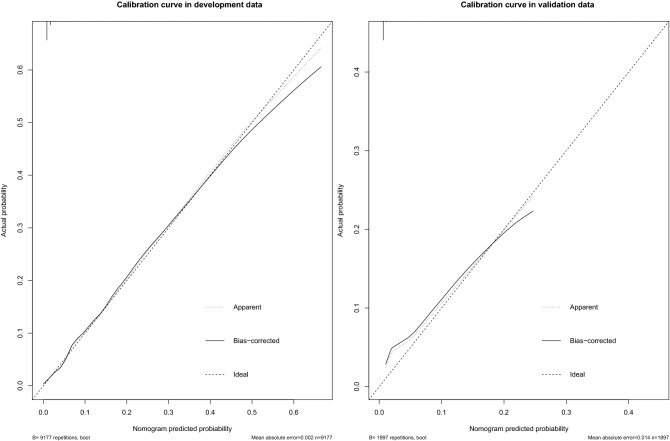
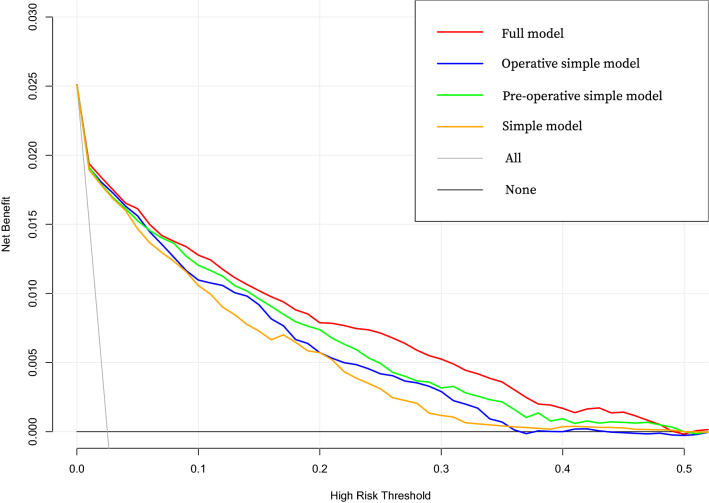
To determine the factors predicting the probability of severe postpartum hemorrhage (SPPH) in women undergoing repeat cesarean delivery (RCD). This multicenter, retrospective cohort study involved women who underwent RCD from January 2017 to December 2017, in 11 public tertiary hospitals within 7 provinces of China. The all-variables model and the multivariable logistic regression model (pre-operative, operative and simple model) were developed to estimate the probability of SPPH in development data and external validated in validation data. Discrimination and calibration were evaluated and clinical impact was determined by decision curve analysis. The study consisted of 11,074 women undergoing RCD. 278 (2.5%) women experienced SPPH. The pre-operative simple model including 9 pre-operative features, the operative simple model including 4 pre-operative and 2 intraoperative features and simple model including only 4 closely related pre-operative features showed AUC 0.888, 0.864 and 0.858 in development data and 0.921, 0.928 and 0.925 in validation data, respectively. Nomograms were developed based on predictive models for SPPH. Predictive tools based on clinical characteristics can be used to estimate the probability of SPPH in patients undergoing RCD and help to allow better preparation and management of these patients by using a multidisciplinary approach of cesarean delivery for obstetrician.
确定再次剖宫产(RCD)女性发生严重产后出血(SPPH)概率的预测因素。这项多中心回顾性队列研究纳入了2017年1月至2017年12月在中国7个省份的11家公立三级医院接受RCD的女性。建立了全变量模型和多变量逻辑回归模型(术前、术中及简单模型)来估计开发数据中SPPH的概率,并在验证数据中进行外部验证。通过决策曲线分析评估辨别力和校准度,并确定临床影响。该研究包括11074名接受RCD的女性。278名(2.5%)女性发生了SPPH。术前简单模型包括9个术前特征,术中简单模型包括4个术前和2个术中特征,仅包括4个密切相关术前特征的简单模型在开发数据中的AUC分别为0.888、0.864和0.858,在验证数据中的AUC分别为0.921、0.928和0.925。基于SPPH预测模型绘制了列线图。基于临床特征的预测工具可用于估计接受RCD患者发生SPPH的概率,并有助于产科医生通过剖宫产的多学科方法对这些患者进行更好的准备和管理。