Instituto de Nutrición de Centro América y Panamá (INCAP), Guatemala City, Guatemala.
Social Statistical and Environmental Health Sciences, RTI International, Durham, NC, USA.
Reprod Health. 2020 Jan 30;17(1):19. doi: 10.1186/s12978-020-0854-y.
Oligohydramnios is a condition of abnormally low amniotic fluid volume that has been associated with poor pregnancy outcomes. To date, the prevalence of this condition and its outcomes has not been well described in low and low-middle income countries (LMIC) where ultrasound use to diagnose this condition in pregnancy is limited. As part of a prospective trial of ultrasound at antenatal care in LMICs, we sought to evaluate the incidence of and the adverse maternal, fetal and neonatal outcomes associated with oligohydramnios.
We included data in this report from all pregnant women in community settings in Guatemala, Pakistan, Zambia and the Democratic Republic of Congo (DRC) who received a third trimester ultrasound as part of the First Look Study, a randomized trial to assess the value of ultrasound at antenatal care. Using these data, we conducted a planned secondary analysis to compare pregnancy outcomes of women with to those without oligohydramnios. Oligohydramnios was defined as measurement of an Amniotic Fluid Index less than 5 cm in at least one ultrasound in the third trimester. The outcomes assessed included maternal morbidity and fetal and neonatal mortality, preterm birth and low-birthweight. We used pairwise site comparisons with Tukey-Kramer adjustment and multivariable logistic models using general estimating equations to account for the correlation of outcomes within cluster.
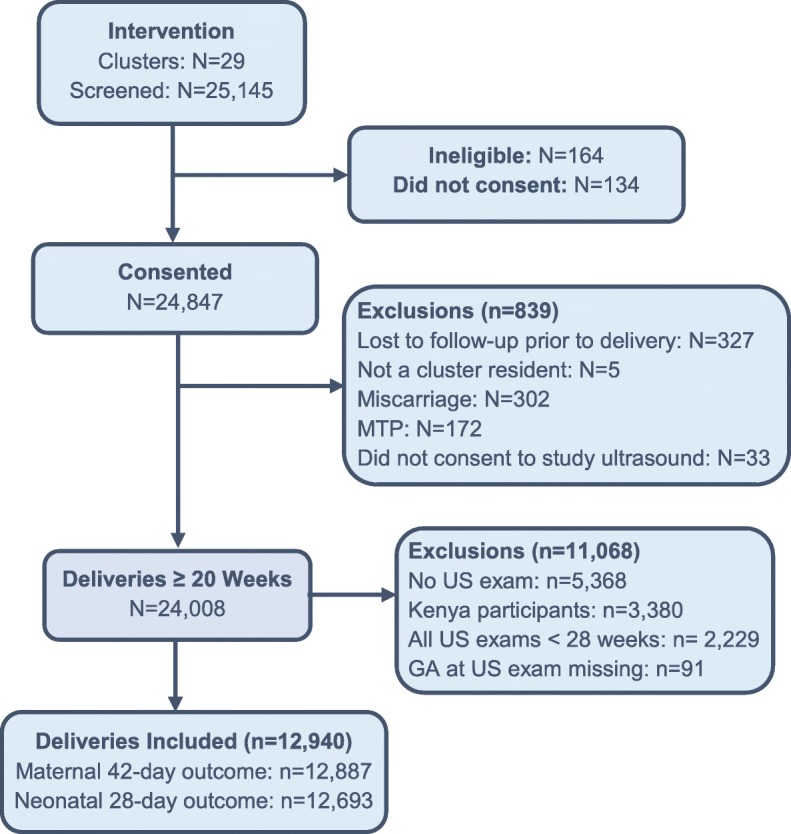
Of 12,940 women enrolled in the clusters in Guatemala, Pakistan, Zambia and the DRC in the First Look Study who had a third trimester ultrasound examination, 87 women were diagnosed with oligohydramnios, equivalent to 0.7% of those studied. Prevalence of detected oligohydramnios varied among study sites; from the lowest of 0.2% in Zambia and the DRC to the highest of 1.5% in Pakistan. Women diagnosed with oligohydramnios had higher rates of hemorrhage, fetal malposition, and cesarean delivery than women without oligohydramnios. We also found unfavorable fetal and neonatal outcomes associated with oligohydramnios including stillbirths (OR 5.16, 95%CI 2.07, 12.85), neonatal deaths < 28 days (OR 3.18, 95% CI 1.18, 8.57), low birth weight (OR 2.10, 95% CI 1.44, 3.07) and preterm births (OR 2.73, 95%CI 1.76, 4.23). The mean birth weight was 162 g less (95% CI -288.6, - 35.9) with oligohydramnios.
Oligohydramnos was associated with worse neonatal, fetal and maternal outcomes in LMIC. Further research is needed to assess effective interventions to diagnose and ultimately to reduce poor outcomes in these settings.
NCT01990625.
羊水过少是一种羊水体积异常低的情况,与不良妊娠结局有关。迄今为止,在超声用于诊断这种情况的低收入和中低收入国家(LMIC)中,这种情况的流行程度及其结局尚未得到很好的描述。作为在 LMIC 中进行产前护理超声检查的前瞻性试验的一部分,我们旨在评估与羊水过少相关的不良母婴、胎儿和新生儿结局的发生率。
我们将本报告中的数据纳入了在危地马拉、巴基斯坦、赞比亚和刚果民主共和国(DRC)社区环境中接受第三次 trimester 超声检查的所有孕妇,这些孕妇是 First Look 研究的一部分,该研究是一项随机试验,旨在评估产前护理中超声的价值。使用这些数据,我们进行了一项计划中的二次分析,以比较有和没有羊水过少的孕妇的妊娠结局。羊水过少定义为在第三次 trimester 的至少一次超声检查中测量的羊水指数小于 5cm。评估的结局包括产妇发病率和胎儿及新生儿死亡率、早产和低出生体重。我们使用配对的站点比较,并使用 Tukey-Kramer 调整和使用广义估计方程的多变量逻辑模型来解释聚类内结局的相关性。
在 First Look 研究中,共有 12940 名在危地马拉、巴基斯坦、赞比亚和 DRC 的簇中接受了第三次 trimester 超声检查的妇女被纳入研究,其中 87 名妇女被诊断为羊水过少,占研究对象的 0.7%。检测到的羊水过少的患病率在研究地点之间有所不同;从最低的赞比亚和 DRC 的 0.2%到巴基斯坦的最高的 1.5%。与没有羊水过少的妇女相比,被诊断为羊水过少的妇女有更高的出血、胎儿位置不正和剖宫产率。我们还发现与羊水过少相关的不良胎儿和新生儿结局,包括死产(OR 5.16,95%CI 2.07,12.85)、新生儿死亡<28 天(OR 3.18,95%CI 1.18,8.57)、低出生体重(OR 2.10,95%CI 1.44,3.07)和早产(OR 2.73,95%CI 1.76,4.23)。羊水过少的平均出生体重低 162g(95%CI-288.6,-35.9)。
在 LMIC 中,羊水过少与新生儿、胎儿和产妇结局较差有关。需要进一步研究评估有效的干预措施,以在这些环境中诊断并最终减少不良结局。
NCT01990625。