Assistant Professor of Nursing, Nursing Department, Faculty of Nursing, Physiotherapy and Podiatry, Universidad de Sevilla, and Research Group under the Andalusian Research, Development and Innovation Scheme PAIDI-CTS 1050 "Complex Care, Chronic and Health Outcomes", Universidad de Sevilla, Seville, Spain.
Professor of Nursing Policy, Adult Nursing Department, Florence Nightingale School of Nursing and Midwifery, King's College, London, UK.
J Nurs Scholarsh. 2021 Jul;53(4):468-478. doi: 10.1111/jnu.12649. Epub 2021 Apr 20.
To identify which patient and hospital characteristics are related to nurse staffing levels in acute care hospital settings.
A cross-sectional design was used for this study.
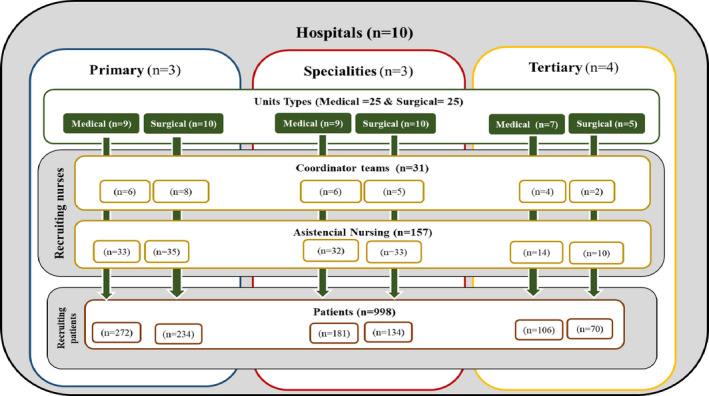
The sample comprised 1,004 patients across 10 hospitals in the Andalucian Health Care System (southern Spain) in 2015. The sampling was carried out in a stratified, consecutive manner on the basis of (a) hospital size by geographical location, (b) type of hospital unit, and (c) patients' sex and age group. Random criteria were used to select patients based on their user identification in the electronic health record system. The variables were grouped into two categories, patient and hospital characteristics. Multilevel linear regression models (MLMs) with random intercepts were used. Two models were fitted: the first was the null model, which contained no explanatory variables except the intercepts (fixed and random), and the second (explanatory) model included selected independent variables. Independent variables were allowed to enter the explanatory model if their univariate association with the nurse staffing level in the MLM was significant at p < .05.
Two hierarchical levels were established to control variance (patients and hospital). The model variables explained 63.4% of the variance at level 1 (patients) and 71.8% at level 2 (hospital). Statistically significant factors were the type of hospital unit (p = .002), shift (p < .001), and season (p < .001). None of the variables associated with patient characteristics obtained statistical significance in the model.
Nurse staffing levels were associated with hospital characteristics rather than patient characteristics.
This study provides evidence about factors that impact on nurse staffing levels in the settings studied. Further studies should determine the influence of patient characteristics in determining optimal nurse staffing levels.
确定哪些患者和医院特征与急性护理医院环境中的护士人员配备水平相关。
本研究采用横断面设计。
该样本包括 2015 年在西班牙南部安达卢西亚医疗保健系统的 10 家医院中的 1004 名患者。根据(a)地理位置的医院规模、(b)医院科室类型和(c)患者的性别和年龄组,采用分层连续抽样方法进行抽样。基于电子健康记录系统中的患者用户识别,使用随机标准选择患者。将变量分为两类,患者和医院特征。使用具有随机截距的多级线性回归模型(MLMs)。拟合了两个模型:第一个是零模型,仅包含截距(固定和随机),没有解释变量;第二个(解释性)模型包含了选定的自变量。如果 MLM 中护士人员配备水平与自变量的单变量关联具有统计学意义(p<.05),则允许自变量进入解释模型。
建立了两个层次来控制方差(患者和医院)。模型变量解释了 1 级(患者)和 2 级(医院)的 63.4%和 71.8%的方差。具有统计学意义的因素是医院科室类型(p=.002)、班次(p<.001)和季节(p<.001)。与患者特征相关的变量在模型中均未获得统计学意义。
护士人员配备水平与医院特征而非患者特征相关。
本研究提供了有关影响研究环境中护士人员配备水平的因素的证据。进一步的研究应确定患者特征对确定最佳护士人员配备水平的影响。