Radiology, HUS Diagnostic Center, University of Helsinki and Helsinki University Hospital, Haartmaninkatu 4, 00029 HUS, Helsinki, Finland.
Department of Otorhinolaryngology-Head and Neck Surgery, University of Helsinki and Helsinki University Hospital, Kasarmikatu 11-13, 00029 HUS, Helsinki, Finland.
Clin Neuroradiol. 2021 Dec;31(4):1037-1048. doi: 10.1007/s00062-021-01014-4. Epub 2021 Apr 20.
To investigate clinical and radiological factors predicting worse outcome after (chemo)radiotherapy ([C]RT) in oropharyngeal squamous cell carcinoma (OPSCC) with a focus on apparent diffusion coefficient (ADC).
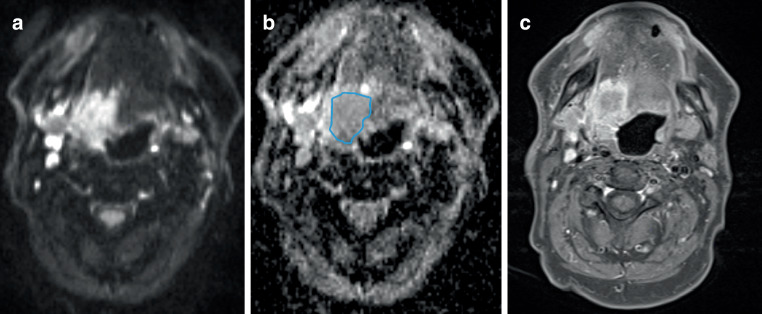
This retrospective study included 67 OPSCC patients, treated with (C)RT with curative intent and diagnosed during 2013-2017. Human papilloma virus (HPV) association was detected with p16 immunohistochemistry. Of all 67 tumors, 55 were p16 positive, 9 were p16 negative, and in 3 the p16 status was unknown. Median follow-up time was 38 months. We analyzed pretreatment magnetic resonance imaging (MRI) for factors predicting disease-free survival (DFS) and locoregional recurrence (LRR), including primary tumor volume and the largest metastasis. Crude and p16-adjusted hazard ratios were analyzed using Cox proportional hazards model. Interobserver agreement was evaluated.
Disease recurred in 13 (19.4%) patients. High ADC predicted poor DFS, but not when the analysis was adjusted for p16. A break in RT (hazard ratio, HR = 3.972, 95% confidence interval, CI 1.445-10.917, p = 0.007) and larger metastasis volume (HR = 1.041, 95% CI 1.007-1.077, p = 0.019) were associated with worse DFS. A primary tumor larger than 7 cm was associated with increased LRR rate (HR = 4.861, 1.042-22.667, p = 0.044). Among p16-positive tumors, mean ADC was lower in grade 3 tumors compared to lower grade tumors (0.736 vs. 0.883; p = 0.003).
Low tumor ADC seems to be related to p16 positivity and therefore should not be used independently to evaluate disease prognosis or to choose patients for treatment deintensification.
研究影响接受放化疗(CRT)的口咽鳞癌(OPSCC)患者预后的临床和影像学因素,重点关注表观扩散系数(ADC)。
本回顾性研究纳入了 2013 年至 2017 年间接受 CRT 治疗的 67 例 OPSCC 患者。采用 p16 免疫组化检测人乳头瘤病毒(HPV)的相关性。所有 67 例肿瘤中,55 例 p16 阳性,9 例 p16 阴性,3 例 p16 状态未知。中位随访时间为 38 个月。我们分析了治疗前磁共振成像(MRI)以评估预测无病生存率(DFS)和局部区域复发率(LRR)的因素,包括原发肿瘤体积和最大转移灶。使用 Cox 比例风险模型分析粗 Hazard 比和 p16 调整后的 Hazard 比。评估了观察者间的一致性。
13 例(19.4%)患者出现疾病复发。高 ADC 预测较差的 DFS,但在调整 p16 后则不然。放疗中断(HR=3.972,95%CI 1.445-10.917,p=0.007)和较大的转移灶体积(HR=1.041,95%CI 1.007-1.077,p=0.019)与较差的 DFS 相关。原发肿瘤大于 7cm 与 LRR 发生率增加相关(HR=4.861,1.042-22.667,p=0.044)。在 p16 阳性肿瘤中,3 级肿瘤的平均 ADC 低于低级别肿瘤(0.736 比 0.883;p=0.003)。
低肿瘤 ADC 似乎与 p16 阳性相关,因此不应独立用于评估疾病预后或选择治疗强度降低的患者。