Sijtsema Nienke D, Lauwers Iris, Verduijn Gerda M, Hoogeman Mischa S, Poot Dirk H J, Hernandez-Tamames Juan A, van der Lugt Aad, Capala Marta E, Petit Steven F
Department of Radiotherapy, Erasmus MC Cancer Institute, University Medical Center Rotterdam, Rotterdam, the Netherlands.
Department of Radiology and Nuclear Medicine, Erasmus MC, University Medical Center Rotterdam, Rotterdam, the Netherlands.
Phys Imaging Radiat Oncol. 2024 Apr 4;30:100574. doi: 10.1016/j.phro.2024.100574. eCollection 2024 Apr.
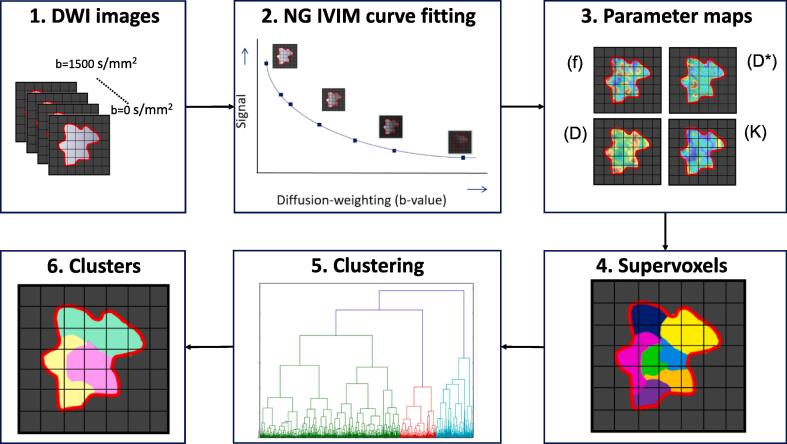
Diffusion-weighted imaging (DWI) is a promising technique for response assessment in head-and-neck cancer. Recently, we optimized Non-Gaussian Intravoxel Incoherent Motion Imaging (NG-IVIM), an extension of the conventional apparent diffusion coefficient () model, for the head and neck. In the current study, we describe the first application in a group of patients with human papillomavirus (HPV)-positive and HPV-negative oropharyngeal squamous cell carcinoma. The aim of this study was to relate and NG-IVIM DWI parameters to HPV status and clinical treatment response.
Thirty-six patients (18 HPV-positive, 18 HPV-negative) were prospectively included. Presence of progressive disease was scored within one year. The mean pre-treatment and NG-IVIM parameters in the gross tumor volume were compared between HPV-positive and HPV-negative patients. In HPV-negative patients, and NG-IVIM parameters were compared between patients with and without progressive disease.
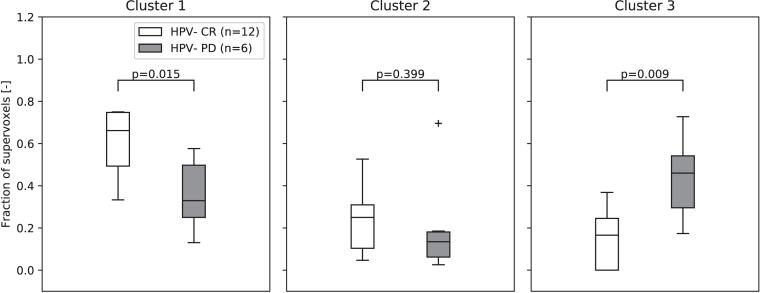
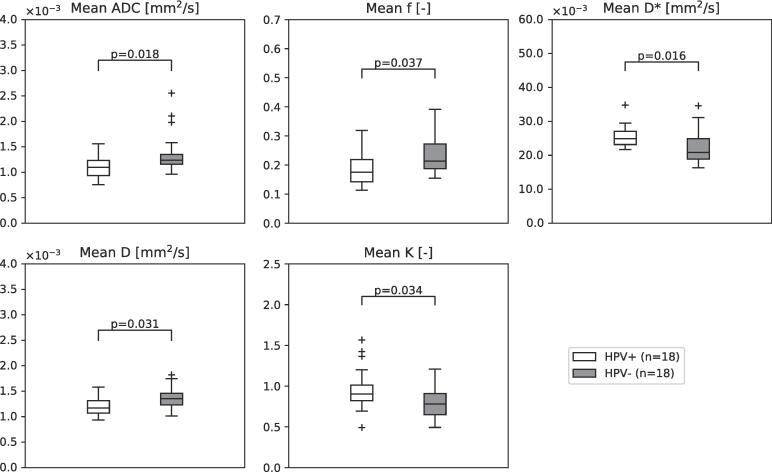
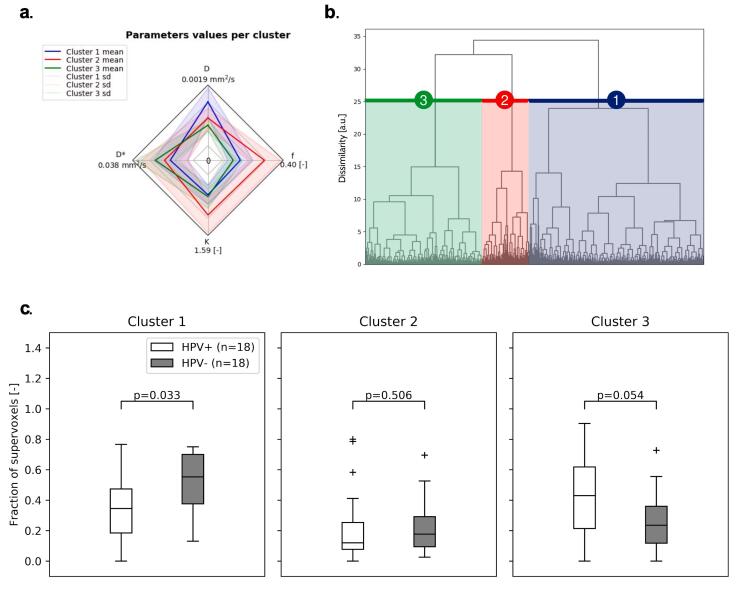
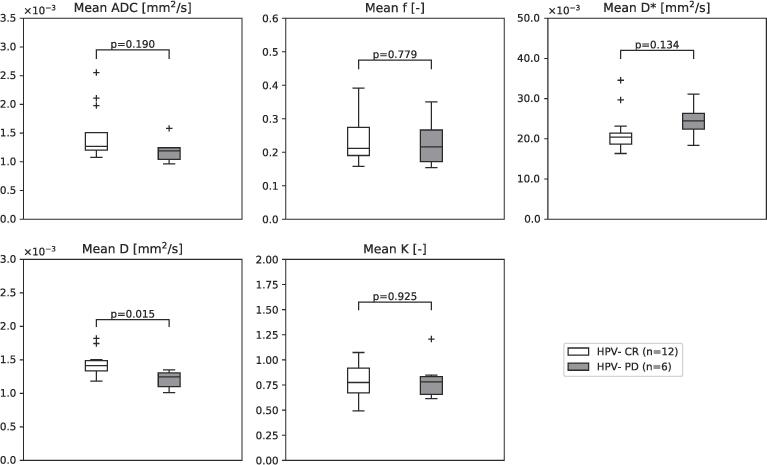
, the NG-IVIM diffusion coefficient , and perfusion fraction were significantly higher, while pseudo-diffusion coefficient and kurtosis were significantly lower in the HPV-negative compared to HPV-positive patients. In the HPV-negative group, a significantly lower was found for patients with progressive disease compared to complete responders. No relation with was observed.
The results of our single-center study suggest that is related to HPV status, but not an independent response predictor. The NG-IVIM parameter however, was independently associated to response in the HPV-negative group. Noteworthy in the opposite direction as previously thought based on .
扩散加权成像(DWI)是一种用于头颈部癌疗效评估的有前景的技术。最近,我们对头颈部优化了非高斯体素内不相干运动成像(NG-IVIM),它是传统表观扩散系数()模型的扩展。在本研究中,我们描述了其在一组人乳头瘤病毒(HPV)阳性和HPV阴性口咽鳞状细胞癌患者中的首次应用。本研究的目的是将和NG-IVIM DWI参数与HPV状态及临床治疗反应相关联。
前瞻性纳入36例患者(18例HPV阳性,18例HPV阴性)。在1年内对疾病进展情况进行评分。比较HPV阳性和HPV阴性患者大体肿瘤体积内治疗前的平均及NG-IVIM参数。在HPV阴性患者中,比较有和无疾病进展患者的及NG-IVIM参数。
与HPV阳性患者相比,HPV阴性患者的、NG-IVIM扩散系数和灌注分数显著更高,而伪扩散系数和峰度显著更低。在HPV阴性组中,与完全缓解者相比,疾病进展患者的显著更低。未观察到与的相关性。
我们单中心研究的结果表明与HPV状态相关,但不是独立的反应预测指标。然而,NG-IVIM参数在HPV阴性组中与反应独立相关。与基于之前的想法相反,这一点值得注意。