Fundación Instituto Leloir, IIBBA-CONICET, Buenos Aires, Argentina.
Department of Chemistry, University of Illinois at Chicago, Chicago, Illinois, USA.
mBio. 2021 Apr 20;12(2):e00264-21. doi: 10.1128/mBio.00264-21.
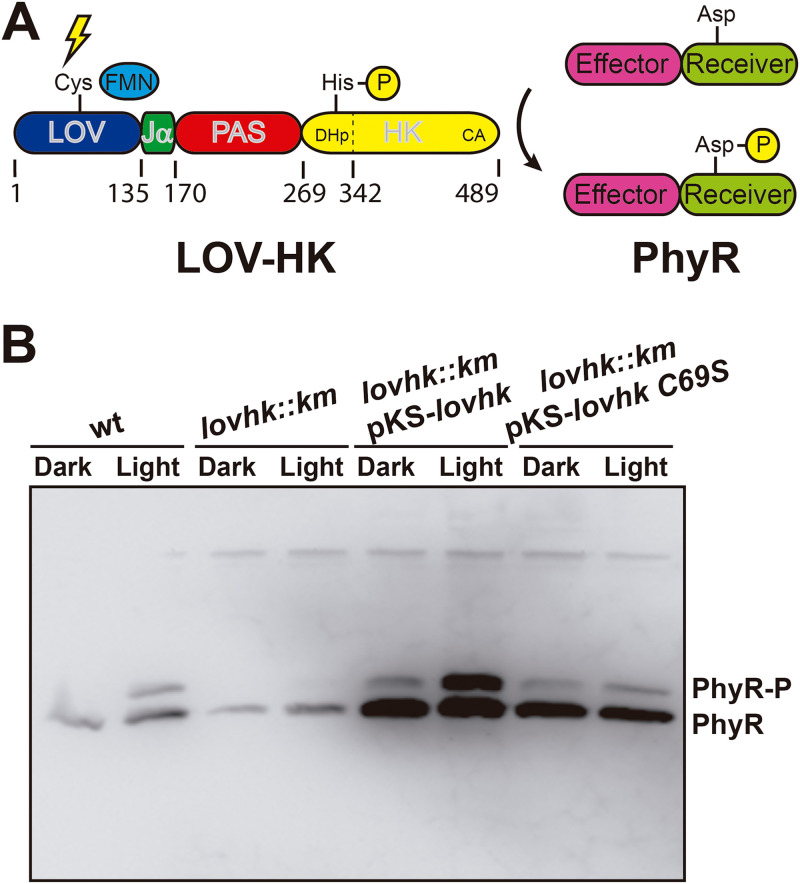
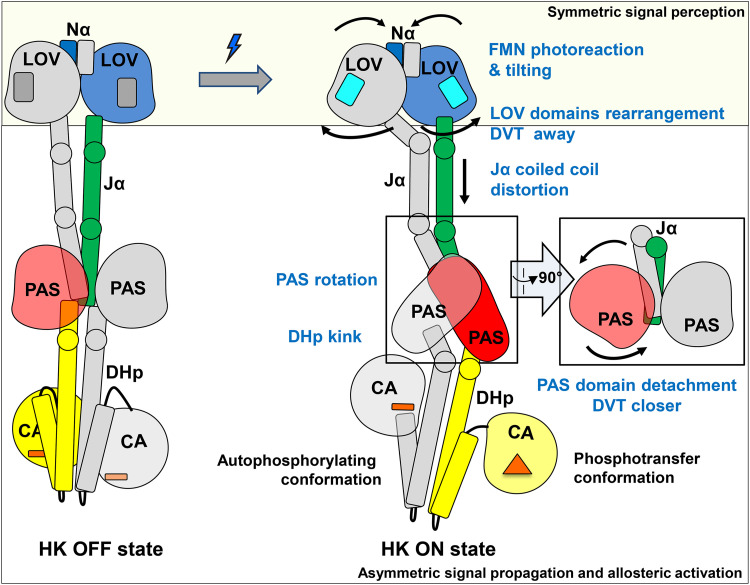
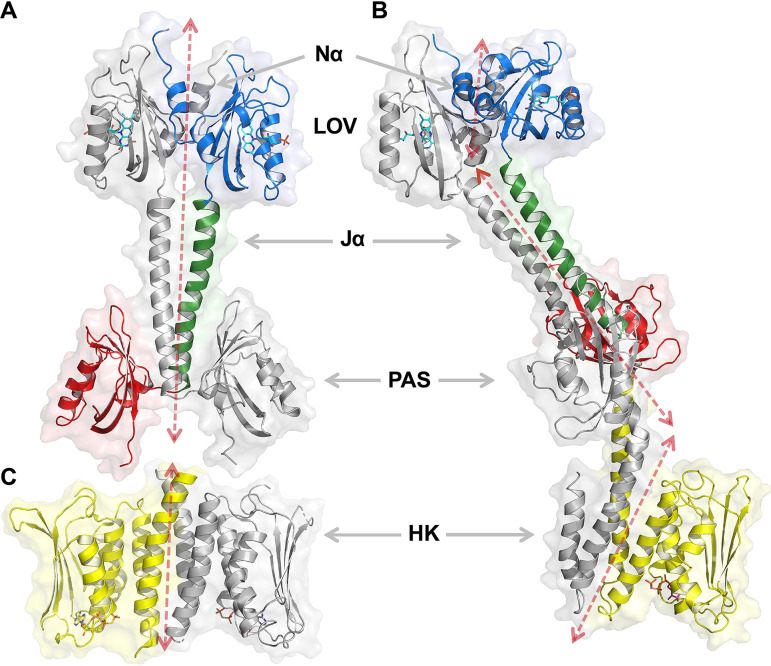
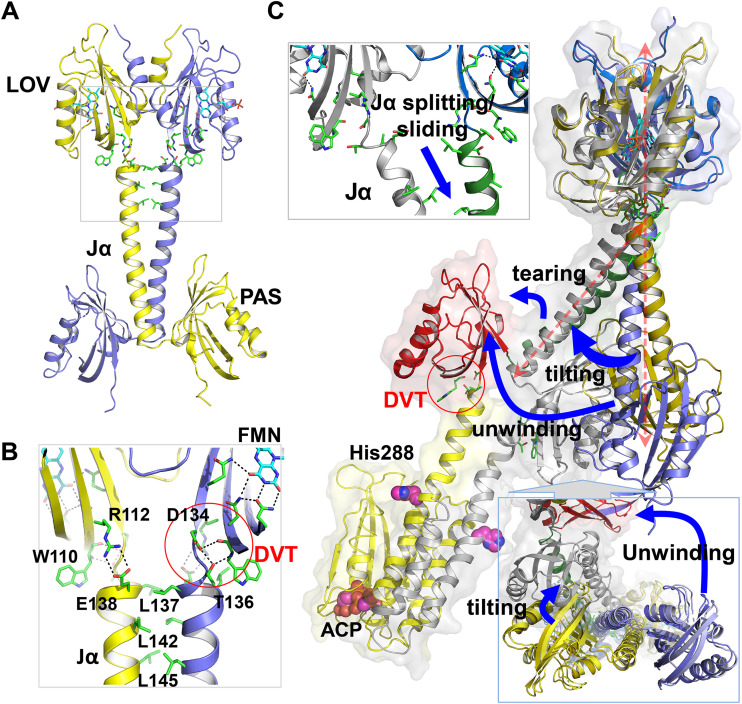
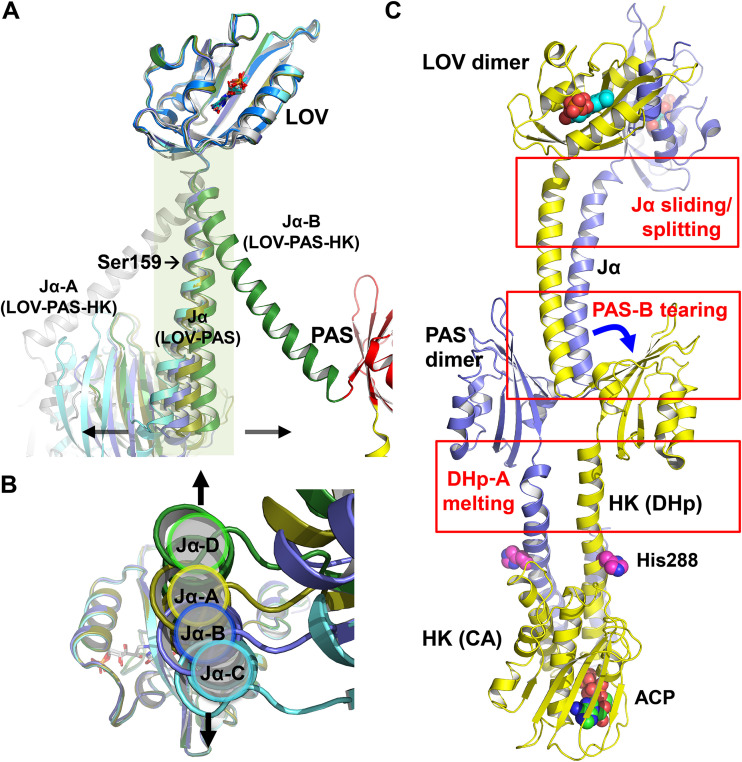
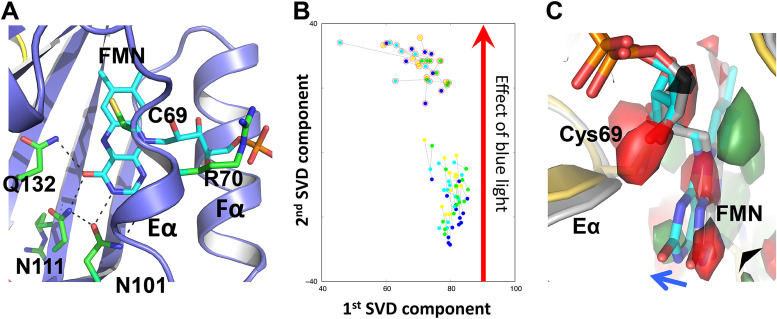
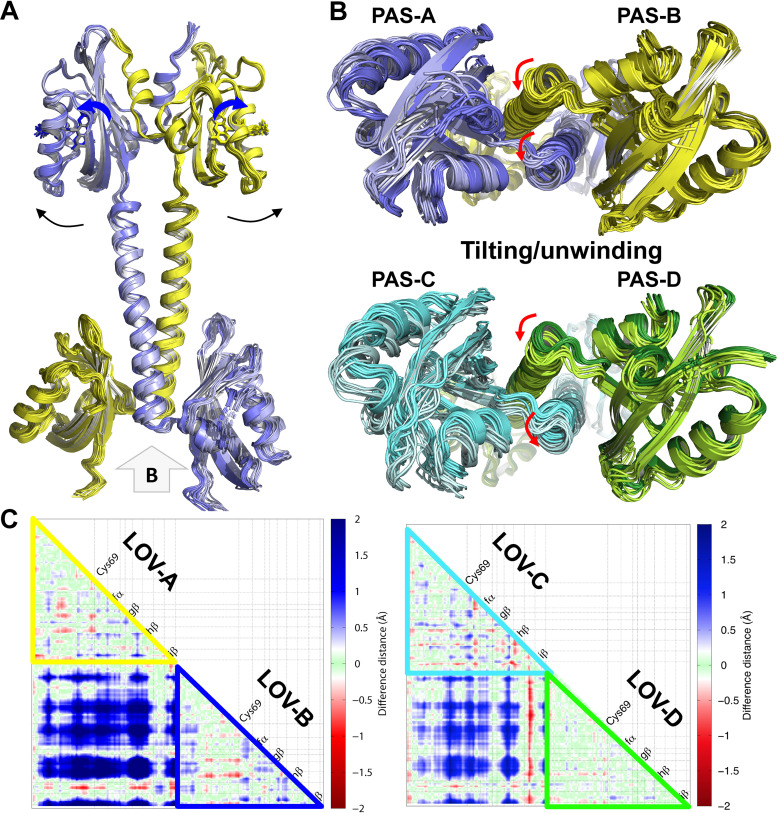
The ability to sense and respond to environmental cues is essential for adaptation and survival in living organisms. In bacteria, this process is accomplished by multidomain sensor histidine kinases that undergo autophosphorylation in response to specific stimuli, thereby triggering downstream signaling cascades. However, the molecular mechanism of allosteric activation is not fully understood in these important sensor proteins. Here, we report the full-length crystal structure of a blue light photoreceptor LOV histidine kinase (LOV-HK) involved in light-dependent virulence modulation in the pathogenic bacterium Joint analyses of dark and light structures determined in different signaling states have shown that LOV-HK transitions from a symmetric dark structure to a highly asymmetric light state. The initial local and subtle structural signal originated in the chromophore-binding LOV domain alters the dimer asymmetry via a coiled-coil rotary switch and helical bending in the helical spine. These amplified structural changes result in enhanced conformational flexibility and large-scale rearrangements that facilitate the phosphoryl transfer reaction in the HK domain. Bacteria employ two-component systems (TCSs) to sense and respond to changes in their surroundings. At the core of the TCS signaling pathway is the multidomain sensor histidine kinase, where the enzymatic activity of its output domain is allosterically controlled by the input signal perceived by the sensor domain. Here, we examine the structures and dynamics of a naturally occurring light-sensitive histidine kinase from the pathogen in both its full-length and its truncated constructs. Direct comparisons between the structures captured in different signaling states have revealed concerted protein motions in an asymmetric dimer framework in response to light. Findings of this work provide mechanistic insights into modular sensory proteins that share a similar modular architecture.
生物体对环境线索的感知和响应能力对于适应和生存至关重要。在细菌中,这个过程是由多结构域传感器组氨酸激酶完成的,这些激酶在响应特定刺激时会发生自身磷酸化,从而触发下游信号级联反应。然而,这些重要传感器蛋白中别构激活的分子机制尚未完全了解。在这里,我们报告了参与致病性细菌中光依赖性毒力调节的蓝光光感受器组氨酸激酶(LOV-HK)的全长晶体结构。
在不同信号状态下对黑暗和光照结构的联合分析表明,LOV-HK 从对称的黑暗结构转变为高度不对称的光照状态。最初源于发色团结合 LOV 结构域的局部和细微结构信号通过卷曲螺旋旋转开关和螺旋脊中的螺旋弯曲改变二聚体的不对称性。这些放大的结构变化导致构象灵活性增强和大规模重排,从而促进 HK 结构域中的磷酸转移反应。
细菌采用双组分系统(TCS)来感知和响应周围环境的变化。TCS 信号通路的核心是多结构域传感器组氨酸激酶,其输出域的酶活性通过传感器域感知到的输入信号进行别构控制。在这里,我们研究了来自病原体的天然光敏感组氨酸激酶的全长和截短构建体的结构和动力学。在不同信号状态下捕获的结构之间的直接比较揭示了光响应时不对称二聚体框架中的协同蛋白运动。
这项工作的发现为具有相似模块化架构的模块化感应蛋白提供了机制见解。